{"title":"层接层立体光刻技术在高效液相色谱介质上的大规模印刷。","authors":"Hanrong Wen, Haonan Lu, Zhuoheng Zhou, Kaiyue Sun, Yinjia Huang, Juxing Zeng, Yuchen Wang, Lianzhong Luo, Chen Xu, Jianzhong Xu, Xin Zhang, Xiaofei Wang, Sebastiaan Eeltink, Bo Zhang","doi":"10.1021/acs.analchem.4c05587","DOIUrl":null,"url":null,"abstract":"<p><p>The manufacture of high-performance liquid chromatography (HPLC) medium has long been viewed as an art rather than science; this raised a great challenge in securing separation consistency, method transferability, and scaling-up in purification of biomolecules. Herein, we report a large scale layer-by-layer manufacturing strategy for a high performance chromatography medium utilizing 3D-printing technology. Combining stereolithography 3D printing and porogenic chemistry, the strategy enables parallel production of high-performance separation medium in diverse scales, shapes, and throughput. Between 1,000 printed devices, high performance consistency was demonstrated by column-to-column and batch-to-batch reproducibility (coefficient of variation of retention time, 2.04%). Fast separations of intact proteins were realized in reversed-phase chromatography: within 1 min, resolution > 1.5 was achieved, and nondenatured antibody separation was realized in hydrophobic interaction chromatography. Purification of native proteins was directly amplified by 3 orders of magnitude: 12 mg of hemeproteins was isolated in 8 min at negligible scaling-up cost, supporting liter-scale processing of fermentation within 7 h on one 20 mm i.d. printed column. With advantages in automatic and parallel production capacity, high-fidelity microstructure across dimensions, and highly efficient method transfer and scaling-up, the stereolithographically printed high performance chromatography medium may open a new path to speeding up separation and purification processes from primary analysis to mass-purification of biomolecular entities, as demanded in the biosynthesis and pharmaceutical industries.</p>","PeriodicalId":27,"journal":{"name":"Analytical Chemistry","volume":" ","pages":"5014-5021"},"PeriodicalIF":7.3000,"publicationDate":"2025-03-11","publicationTypes":"Journal Article","fieldsOfStudy":null,"isOpenAccess":false,"openAccessPdf":"","citationCount":"0","resultStr":"{\"title\":\"Large Scale Printing of Robust HPLC Medium via Layer-by-Layer Stereolithography.\",\"authors\":\"Hanrong Wen, Haonan Lu, Zhuoheng Zhou, Kaiyue Sun, Yinjia Huang, Juxing Zeng, Yuchen Wang, Lianzhong Luo, Chen Xu, Jianzhong Xu, Xin Zhang, Xiaofei Wang, Sebastiaan Eeltink, Bo Zhang\",\"doi\":\"10.1021/acs.analchem.4c05587\",\"DOIUrl\":null,\"url\":null,\"abstract\":\"<p><p>The manufacture of high-performance liquid chromatography (HPLC) medium has long been viewed as an art rather than science; this raised a great challenge in securing separation consistency, method transferability, and scaling-up in purification of biomolecules. Herein, we report a large scale layer-by-layer manufacturing strategy for a high performance chromatography medium utilizing 3D-printing technology. Combining stereolithography 3D printing and porogenic chemistry, the strategy enables parallel production of high-performance separation medium in diverse scales, shapes, and throughput. Between 1,000 printed devices, high performance consistency was demonstrated by column-to-column and batch-to-batch reproducibility (coefficient of variation of retention time, 2.04%). Fast separations of intact proteins were realized in reversed-phase chromatography: within 1 min, resolution > 1.5 was achieved, and nondenatured antibody separation was realized in hydrophobic interaction chromatography. Purification of native proteins was directly amplified by 3 orders of magnitude: 12 mg of hemeproteins was isolated in 8 min at negligible scaling-up cost, supporting liter-scale processing of fermentation within 7 h on one 20 mm i.d. printed column. With advantages in automatic and parallel production capacity, high-fidelity microstructure across dimensions, and highly efficient method transfer and scaling-up, the stereolithographically printed high performance chromatography medium may open a new path to speeding up separation and purification processes from primary analysis to mass-purification of biomolecular entities, as demanded in the biosynthesis and pharmaceutical industries.</p>\",\"PeriodicalId\":27,\"journal\":{\"name\":\"Analytical Chemistry\",\"volume\":\" \",\"pages\":\"5014-5021\"},\"PeriodicalIF\":7.3000,\"publicationDate\":\"2025-03-11\",\"publicationTypes\":\"Journal Article\",\"fieldsOfStudy\":null,\"isOpenAccess\":false,\"openAccessPdf\":\"\",\"citationCount\":\"0\",\"resultStr\":null,\"platform\":\"Semanticscholar\",\"paperid\":null,\"PeriodicalName\":\"Analytical Chemistry\",\"FirstCategoryId\":\"92\",\"ListUrlMain\":\"https://doi.org/10.1021/acs.analchem.4c05587\",\"RegionNum\":1,\"RegionCategory\":\"化学\",\"ArticlePicture\":[],\"TitleCN\":null,\"AbstractTextCN\":null,\"PMCID\":null,\"EPubDate\":\"2025/2/13 0:00:00\",\"PubModel\":\"Epub\",\"JCR\":\"Q1\",\"JCRName\":\"CHEMISTRY, ANALYTICAL\",\"Score\":null,\"Total\":0}","platform":"Semanticscholar","paperid":null,"PeriodicalName":"Analytical Chemistry","FirstCategoryId":"92","ListUrlMain":"https://doi.org/10.1021/acs.analchem.4c05587","RegionNum":1,"RegionCategory":"化学","ArticlePicture":[],"TitleCN":null,"AbstractTextCN":null,"PMCID":null,"EPubDate":"2025/2/13 0:00:00","PubModel":"Epub","JCR":"Q1","JCRName":"CHEMISTRY, ANALYTICAL","Score":null,"Total":0}
Large Scale Printing of Robust HPLC Medium via Layer-by-Layer Stereolithography.
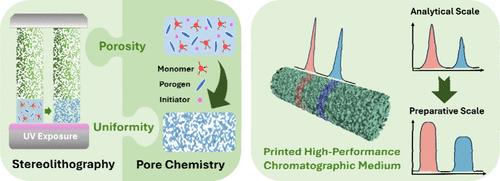
The manufacture of high-performance liquid chromatography (HPLC) medium has long been viewed as an art rather than science; this raised a great challenge in securing separation consistency, method transferability, and scaling-up in purification of biomolecules. Herein, we report a large scale layer-by-layer manufacturing strategy for a high performance chromatography medium utilizing 3D-printing technology. Combining stereolithography 3D printing and porogenic chemistry, the strategy enables parallel production of high-performance separation medium in diverse scales, shapes, and throughput. Between 1,000 printed devices, high performance consistency was demonstrated by column-to-column and batch-to-batch reproducibility (coefficient of variation of retention time, 2.04%). Fast separations of intact proteins were realized in reversed-phase chromatography: within 1 min, resolution > 1.5 was achieved, and nondenatured antibody separation was realized in hydrophobic interaction chromatography. Purification of native proteins was directly amplified by 3 orders of magnitude: 12 mg of hemeproteins was isolated in 8 min at negligible scaling-up cost, supporting liter-scale processing of fermentation within 7 h on one 20 mm i.d. printed column. With advantages in automatic and parallel production capacity, high-fidelity microstructure across dimensions, and highly efficient method transfer and scaling-up, the stereolithographically printed high performance chromatography medium may open a new path to speeding up separation and purification processes from primary analysis to mass-purification of biomolecular entities, as demanded in the biosynthesis and pharmaceutical industries.
期刊介绍:
Analytical Chemistry, a peer-reviewed research journal, focuses on disseminating new and original knowledge across all branches of analytical chemistry. Fundamental articles may explore general principles of chemical measurement science and need not directly address existing or potential analytical methodology. They can be entirely theoretical or report experimental results. Contributions may cover various phases of analytical operations, including sampling, bioanalysis, electrochemistry, mass spectrometry, microscale and nanoscale systems, environmental analysis, separations, spectroscopy, chemical reactions and selectivity, instrumentation, imaging, surface analysis, and data processing. Papers discussing known analytical methods should present a significant, original application of the method, a notable improvement, or results on an important analyte.




 京公网安备 11010802042870号
京ICP备2023020795号-1
京公网安备 11010802042870号
京ICP备2023020795号-1

 分享
分享
 求助内容:
求助内容: 应助结果提醒方式:
 扫码关注我们
