Chengcheng Zhu, Xi Liu, Chang Li, Yan Chen, Xinyu Guo, Dawei Luo, Wenhai Ji, Wenjun Deng, Rui Li
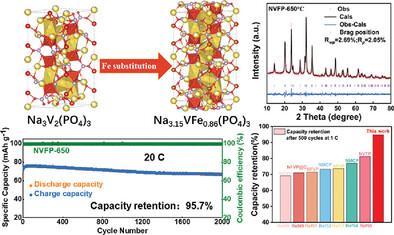
{"title":"用于高性能钠离子电池的缺钠NASICON Na3+ xVFe(PO4)3阴极。","authors":"Chengcheng Zhu, Xi Liu, Chang Li, Yan Chen, Xinyu Guo, Dawei Luo, Wenhai Ji, Wenjun Deng, Rui Li","doi":"10.1002/smtd.202401697","DOIUrl":null,"url":null,"abstract":"<p>NASICON-type Na<sub>3</sub>V<sub>2</sub>(PO<sub>4</sub>)<sub>3</sub>(NVP) material possesses robust 3D structure and high sodium diffusivity, thus showcasing its immense potential in sodium-ion batteries (SIBs). However, considering the perspective of environmental conservation, it is imperative to substitute vanadium with elements that are both cost-effective and non-toxic in order to further enhance its application in SIBs. Herein, Fe is utilized to replace the V site in the sodium vanadium phosphate structure and successfully prepared a pure phase sodium-deficient NASICON (sodium superionic conductor) Na<sub>3.15</sub>VFe<sub>0.86</sub>(PO<sub>4</sub>)<sub>3</sub> (NVFP-650) cathode. It is found that the regulation of sintering temperature for Na<sub>3+</sub><i><sub>x</sub></i>VFe(PO<sub>4</sub>)<sub>3</sub>(NVFP) material can effectively mitigate the formation of secondary phases and enhance the electrochemical properties of the resulting product. The sodium-deficient cathode shows enhanced electrochemical performance and sodium ion diffusion kinetics. It exhibits a high capacity of 102.8 mAh g<sup>−1</sup> at 0.1 C, and exhibits a high-capacity retention of 95.7% after 2000 cycles at 20 C. The energy storage mechanism and structural evolution are further investigated through SEM, TEM, XPS, and in situ XRD characterizations. The compositional modulation of sodium-deficient NVFP and the elucidation of its cycling mechanisms in this work would provide valuable insights for enhancing the performance of sodium energy storage systems.</p>","PeriodicalId":229,"journal":{"name":"Small Methods","volume":"9 5","pages":""},"PeriodicalIF":9.1000,"publicationDate":"2025-02-14","publicationTypes":"Journal Article","fieldsOfStudy":null,"isOpenAccess":false,"openAccessPdf":"","citationCount":"0","resultStr":"{\"title\":\"Sodium-Deficient NASICON Na3+xVFe(PO4)3 Cathode for High-Performance Sodium-Ion Batteries\",\"authors\":\"Chengcheng Zhu, Xi Liu, Chang Li, Yan Chen, Xinyu Guo, Dawei Luo, Wenhai Ji, Wenjun Deng, Rui Li\",\"doi\":\"10.1002/smtd.202401697\",\"DOIUrl\":null,\"url\":null,\"abstract\":\"<p>NASICON-type Na<sub>3</sub>V<sub>2</sub>(PO<sub>4</sub>)<sub>3</sub>(NVP) material possesses robust 3D structure and high sodium diffusivity, thus showcasing its immense potential in sodium-ion batteries (SIBs). However, considering the perspective of environmental conservation, it is imperative to substitute vanadium with elements that are both cost-effective and non-toxic in order to further enhance its application in SIBs. Herein, Fe is utilized to replace the V site in the sodium vanadium phosphate structure and successfully prepared a pure phase sodium-deficient NASICON (sodium superionic conductor) Na<sub>3.15</sub>VFe<sub>0.86</sub>(PO<sub>4</sub>)<sub>3</sub> (NVFP-650) cathode. It is found that the regulation of sintering temperature for Na<sub>3+</sub><i><sub>x</sub></i>VFe(PO<sub>4</sub>)<sub>3</sub>(NVFP) material can effectively mitigate the formation of secondary phases and enhance the electrochemical properties of the resulting product. The sodium-deficient cathode shows enhanced electrochemical performance and sodium ion diffusion kinetics. It exhibits a high capacity of 102.8 mAh g<sup>−1</sup> at 0.1 C, and exhibits a high-capacity retention of 95.7% after 2000 cycles at 20 C. The energy storage mechanism and structural evolution are further investigated through SEM, TEM, XPS, and in situ XRD characterizations. The compositional modulation of sodium-deficient NVFP and the elucidation of its cycling mechanisms in this work would provide valuable insights for enhancing the performance of sodium energy storage systems.</p>\",\"PeriodicalId\":229,\"journal\":{\"name\":\"Small Methods\",\"volume\":\"9 5\",\"pages\":\"\"},\"PeriodicalIF\":9.1000,\"publicationDate\":\"2025-02-14\",\"publicationTypes\":\"Journal Article\",\"fieldsOfStudy\":null,\"isOpenAccess\":false,\"openAccessPdf\":\"\",\"citationCount\":\"0\",\"resultStr\":null,\"platform\":\"Semanticscholar\",\"paperid\":null,\"PeriodicalName\":\"Small Methods\",\"FirstCategoryId\":\"88\",\"ListUrlMain\":\"https://onlinelibrary.wiley.com/doi/10.1002/smtd.202401697\",\"RegionNum\":2,\"RegionCategory\":\"材料科学\",\"ArticlePicture\":[],\"TitleCN\":null,\"AbstractTextCN\":null,\"PMCID\":null,\"EPubDate\":\"\",\"PubModel\":\"\",\"JCR\":\"Q1\",\"JCRName\":\"CHEMISTRY, PHYSICAL\",\"Score\":null,\"Total\":0}","platform":"Semanticscholar","paperid":null,"PeriodicalName":"Small Methods","FirstCategoryId":"88","ListUrlMain":"https://onlinelibrary.wiley.com/doi/10.1002/smtd.202401697","RegionNum":2,"RegionCategory":"材料科学","ArticlePicture":[],"TitleCN":null,"AbstractTextCN":null,"PMCID":null,"EPubDate":"","PubModel":"","JCR":"Q1","JCRName":"CHEMISTRY, PHYSICAL","Score":null,"Total":0}
引用次数: 0
摘要
nasicon型Na3V2(PO4)3(NVP)材料具有坚固的3D结构和高钠扩散率,因此在钠离子电池(sib)中显示出巨大的潜力。然而,从环境保护的角度考虑,为了进一步加强其在sib中的应用,迫切需要用既经济又无毒的元素替代钒。本文利用Fe取代磷酸钒钠结构中的V位,成功制备了纯相缺钠NASICON(钠超离子导体)Na3.15VFe0.86(PO4)3 (NVFP-650)阴极。研究发现,调节Na3+ xVFe(PO4)3(NVFP)材料的烧结温度可以有效地减缓二次相的形成,提高产物的电化学性能。缺钠阴极的电化学性能和钠离子扩散动力学得到了增强。在0.1℃下的高容量为102.8 mAh g-1,在20℃下循环2000次后的高容量保留率为95.7%。通过SEM、TEM、XPS和原位XRD表征进一步研究了其储能机理和结构演变。缺钠NVFP的组成调控及其循环机制的阐明将为提高钠储能系统的性能提供有价值的见解。
Sodium-Deficient NASICON Na3+xVFe(PO4)3 Cathode for High-Performance Sodium-Ion Batteries
NASICON-type Na3V2(PO4)3(NVP) material possesses robust 3D structure and high sodium diffusivity, thus showcasing its immense potential in sodium-ion batteries (SIBs). However, considering the perspective of environmental conservation, it is imperative to substitute vanadium with elements that are both cost-effective and non-toxic in order to further enhance its application in SIBs. Herein, Fe is utilized to replace the V site in the sodium vanadium phosphate structure and successfully prepared a pure phase sodium-deficient NASICON (sodium superionic conductor) Na3.15VFe0.86(PO4)3 (NVFP-650) cathode. It is found that the regulation of sintering temperature for Na3+xVFe(PO4)3(NVFP) material can effectively mitigate the formation of secondary phases and enhance the electrochemical properties of the resulting product. The sodium-deficient cathode shows enhanced electrochemical performance and sodium ion diffusion kinetics. It exhibits a high capacity of 102.8 mAh g−1 at 0.1 C, and exhibits a high-capacity retention of 95.7% after 2000 cycles at 20 C. The energy storage mechanism and structural evolution are further investigated through SEM, TEM, XPS, and in situ XRD characterizations. The compositional modulation of sodium-deficient NVFP and the elucidation of its cycling mechanisms in this work would provide valuable insights for enhancing the performance of sodium energy storage systems.
Small MethodsMaterials Science-General Materials Science
CiteScore
17.40
自引率
1.60%
发文量
347
期刊介绍:
Small Methods is a multidisciplinary journal that publishes groundbreaking research on methods relevant to nano- and microscale research. It welcomes contributions from the fields of materials science, biomedical science, chemistry, and physics, showcasing the latest advancements in experimental techniques.
With a notable 2022 Impact Factor of 12.4 (Journal Citation Reports, Clarivate Analytics, 2023), Small Methods is recognized for its significant impact on the scientific community.
The online ISSN for Small Methods is 2366-9608.




 京公网安备 11010802042870号
京ICP备2023020795号-1
京公网安备 11010802042870号
京ICP备2023020795号-1

 分享
分享
 求助内容:
求助内容: 应助结果提醒方式:
 扫码关注我们
