Yamuna Ana, Floor A van den Brand, Onno C P van Schayck, Giridhara R Babu
{"title":"孕期体育活动与孕产妇健康结局之间的关系:来自印度班加罗尔MAASTHI队列研究的证据","authors":"Yamuna Ana, Floor A van den Brand, Onno C P van Schayck, Giridhara R Babu","doi":"10.3389/fspor.2025.1265929","DOIUrl":null,"url":null,"abstract":"<p><strong>Background: </strong>Sedentary behavior is one of the major modifiable behavioral risk factors for non-communicable diseases. Physical activity (PA) is crucial during pregnancy but pregnant women may become sedentary, leading to adverse health outcomes. Our study aimed to explore the association between social support and PA levels during pregnancy and the relationship between sedentary behavior and adverse pregnancy health outcomes including delivery.</p><p><strong>Methods: </strong>The study used a validated physical activity questionnaire to assess the physical activity levels of pregnant women. We collected detailed sociodemographic information, pregnancy characteristics, assessed social support. We assessed presence of depressive symptoms and conducted oral glucose tolerance tests, hemoglobin and blood pressure assessments, anthropometric measurements, and collected delivery details. We used linear logistic regression to assess the association between a continuous measure of physical activity level and maternal outcomes and performed multivariable logistic regression analysis to understand the association between sedentary behavior and maternal health outcomes and mode of delivery after adjusting for potential confounders.</p><p><strong>Results: </strong>We interviewed 2,424 eligible pregnant women at baseline and 1,317 were considered in the final analysis after excluding those who missed follow-ups. We observed that one unit increase in physical activity level was associated with reduced prenatal depressive symptoms (<i>β</i> = -6.36, <i>p</i> < 0.001), fasting (<i>β</i> = 2.06, <i>p</i> = 0.04), and postprandial blood sugar levels (<i>β</i> = -0.99, <i>p</i> = 0.01), respectively. Pregnant women who had good social support tended to engage in higher levels of activity. In addition, women who engaged in sedentary behavior during pregnancy were 1.07 times more likely to be obese and 4.32 times more likely to have elective cesarean section (C-section) delivery than those who engaged in moderate activity.</p><p><strong>Conclusion: </strong>The study found that physical activity during pregnancy has several beneficial effects on maternal prenatal health outcomes, including a reduced risk of obesity and C-section delivery, lower blood glucose levels, and improved mental health. Therefore, it is essential to adhere to the recommended guidelines for physical activity during pregnancy. Healthcare providers and policymakers in India should consider promoting physical activity as part of comprehensive routine prenatal care.</p>","PeriodicalId":12716,"journal":{"name":"Frontiers in Sports and Active Living","volume":"7 ","pages":"1265929"},"PeriodicalIF":2.6000,"publicationDate":"2025-01-30","publicationTypes":"Journal Article","fieldsOfStudy":null,"isOpenAccess":false,"openAccessPdf":"https://www.ncbi.nlm.nih.gov/pmc/articles/PMC11821958/pdf/","citationCount":"0","resultStr":"{\"title\":\"Relationship between physical activity during pregnancy and maternal health outcomes: evidence from the MAASTHI cohort study in Bengaluru, India.\",\"authors\":\"Yamuna Ana, Floor A van den Brand, Onno C P van Schayck, Giridhara R Babu\",\"doi\":\"10.3389/fspor.2025.1265929\",\"DOIUrl\":null,\"url\":null,\"abstract\":\"<p><strong>Background: </strong>Sedentary behavior is one of the major modifiable behavioral risk factors for non-communicable diseases. Physical activity (PA) is crucial during pregnancy but pregnant women may become sedentary, leading to adverse health outcomes. Our study aimed to explore the association between social support and PA levels during pregnancy and the relationship between sedentary behavior and adverse pregnancy health outcomes including delivery.</p><p><strong>Methods: </strong>The study used a validated physical activity questionnaire to assess the physical activity levels of pregnant women. We collected detailed sociodemographic information, pregnancy characteristics, assessed social support. We assessed presence of depressive symptoms and conducted oral glucose tolerance tests, hemoglobin and blood pressure assessments, anthropometric measurements, and collected delivery details. We used linear logistic regression to assess the association between a continuous measure of physical activity level and maternal outcomes and performed multivariable logistic regression analysis to understand the association between sedentary behavior and maternal health outcomes and mode of delivery after adjusting for potential confounders.</p><p><strong>Results: </strong>We interviewed 2,424 eligible pregnant women at baseline and 1,317 were considered in the final analysis after excluding those who missed follow-ups. We observed that one unit increase in physical activity level was associated with reduced prenatal depressive symptoms (<i>β</i> = -6.36, <i>p</i> < 0.001), fasting (<i>β</i> = 2.06, <i>p</i> = 0.04), and postprandial blood sugar levels (<i>β</i> = -0.99, <i>p</i> = 0.01), respectively. Pregnant women who had good social support tended to engage in higher levels of activity. In addition, women who engaged in sedentary behavior during pregnancy were 1.07 times more likely to be obese and 4.32 times more likely to have elective cesarean section (C-section) delivery than those who engaged in moderate activity.</p><p><strong>Conclusion: </strong>The study found that physical activity during pregnancy has several beneficial effects on maternal prenatal health outcomes, including a reduced risk of obesity and C-section delivery, lower blood glucose levels, and improved mental health. Therefore, it is essential to adhere to the recommended guidelines for physical activity during pregnancy. Healthcare providers and policymakers in India should consider promoting physical activity as part of comprehensive routine prenatal care.</p>\",\"PeriodicalId\":12716,\"journal\":{\"name\":\"Frontiers in Sports and Active Living\",\"volume\":\"7 \",\"pages\":\"1265929\"},\"PeriodicalIF\":2.6000,\"publicationDate\":\"2025-01-30\",\"publicationTypes\":\"Journal Article\",\"fieldsOfStudy\":null,\"isOpenAccess\":false,\"openAccessPdf\":\"https://www.ncbi.nlm.nih.gov/pmc/articles/PMC11821958/pdf/\",\"citationCount\":\"0\",\"resultStr\":null,\"platform\":\"Semanticscholar\",\"paperid\":null,\"PeriodicalName\":\"Frontiers in Sports and Active Living\",\"FirstCategoryId\":\"1085\",\"ListUrlMain\":\"https://doi.org/10.3389/fspor.2025.1265929\",\"RegionNum\":0,\"RegionCategory\":null,\"ArticlePicture\":[],\"TitleCN\":null,\"AbstractTextCN\":null,\"PMCID\":null,\"EPubDate\":\"2025/1/1 0:00:00\",\"PubModel\":\"eCollection\",\"JCR\":\"Q2\",\"JCRName\":\"SPORT SCIENCES\",\"Score\":null,\"Total\":0}","platform":"Semanticscholar","paperid":null,"PeriodicalName":"Frontiers in Sports and Active Living","FirstCategoryId":"1085","ListUrlMain":"https://doi.org/10.3389/fspor.2025.1265929","RegionNum":0,"RegionCategory":null,"ArticlePicture":[],"TitleCN":null,"AbstractTextCN":null,"PMCID":null,"EPubDate":"2025/1/1 0:00:00","PubModel":"eCollection","JCR":"Q2","JCRName":"SPORT SCIENCES","Score":null,"Total":0}
引用次数: 0
摘要
背景:久坐行为是可改变的非传染性疾病的主要行为风险因素之一。身体活动(PA)在怀孕期间是至关重要的,但孕妇可能久坐不动,导致不利的健康结果。本研究旨在探讨怀孕期间社会支持与PA水平之间的关系,以及久坐行为与包括分娩在内的不良妊娠健康结局之间的关系。方法:采用经验证的体力活动问卷对孕妇的体力活动水平进行评估。我们收集了详细的社会人口统计信息,妊娠特征,评估了社会支持。我们评估了抑郁症状的存在,并进行了口服葡萄糖耐量试验,血红蛋白和血压评估,人体测量测量,并收集了递送细节。我们使用线性逻辑回归来评估连续测量体力活动水平与产妇结局之间的关系,并进行多变量逻辑回归分析,以了解在调整潜在混杂因素后久坐行为与产妇健康结局和分娩方式之间的关系。结果:我们在基线时采访了2424名符合条件的孕妇,在排除未随访的孕妇后,最终分析考虑了1317名孕妇。我们观察到,每增加一个单位的体力活动水平与产前抑郁症状(β = -6.36, p β = 2.06, p = 0.04)和餐后血糖水平(β = -0.99, p = 0.01)的减少有关。拥有良好社会支持的孕妇倾向于参与更高水平的活动。此外,在怀孕期间从事久坐行为的妇女肥胖的可能性是从事适度运动的妇女的1.07倍,选择性剖宫产(C-section)分娩的可能性是从事适度运动的妇女的4.32倍。结论:研究发现,怀孕期间的体育锻炼对孕妇产前健康结果有几个有益的影响,包括降低肥胖和剖腹产的风险,降低血糖水平,改善心理健康。因此,在怀孕期间坚持建议的身体活动指南是至关重要的。印度的医疗保健提供者和决策者应考虑将促进身体活动作为全面常规产前护理的一部分。
Relationship between physical activity during pregnancy and maternal health outcomes: evidence from the MAASTHI cohort study in Bengaluru, India.
Background: Sedentary behavior is one of the major modifiable behavioral risk factors for non-communicable diseases. Physical activity (PA) is crucial during pregnancy but pregnant women may become sedentary, leading to adverse health outcomes. Our study aimed to explore the association between social support and PA levels during pregnancy and the relationship between sedentary behavior and adverse pregnancy health outcomes including delivery.
Methods: The study used a validated physical activity questionnaire to assess the physical activity levels of pregnant women. We collected detailed sociodemographic information, pregnancy characteristics, assessed social support. We assessed presence of depressive symptoms and conducted oral glucose tolerance tests, hemoglobin and blood pressure assessments, anthropometric measurements, and collected delivery details. We used linear logistic regression to assess the association between a continuous measure of physical activity level and maternal outcomes and performed multivariable logistic regression analysis to understand the association between sedentary behavior and maternal health outcomes and mode of delivery after adjusting for potential confounders.
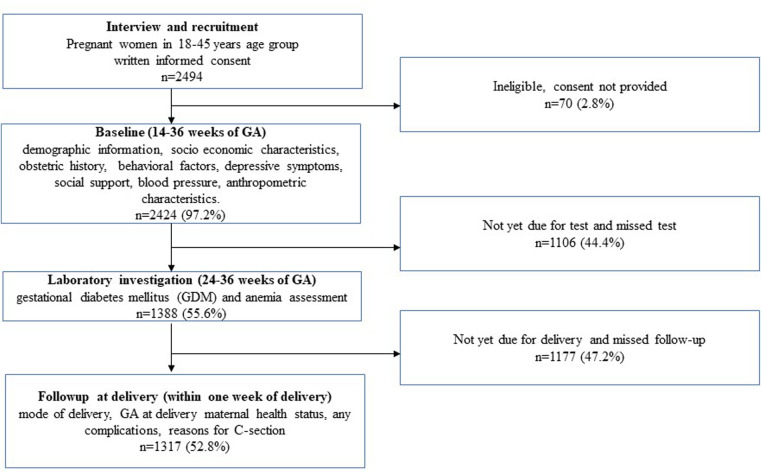
Results: We interviewed 2,424 eligible pregnant women at baseline and 1,317 were considered in the final analysis after excluding those who missed follow-ups. We observed that one unit increase in physical activity level was associated with reduced prenatal depressive symptoms (β = -6.36, p < 0.001), fasting (β = 2.06, p = 0.04), and postprandial blood sugar levels (β = -0.99, p = 0.01), respectively. Pregnant women who had good social support tended to engage in higher levels of activity. In addition, women who engaged in sedentary behavior during pregnancy were 1.07 times more likely to be obese and 4.32 times more likely to have elective cesarean section (C-section) delivery than those who engaged in moderate activity.
Conclusion: The study found that physical activity during pregnancy has several beneficial effects on maternal prenatal health outcomes, including a reduced risk of obesity and C-section delivery, lower blood glucose levels, and improved mental health. Therefore, it is essential to adhere to the recommended guidelines for physical activity during pregnancy. Healthcare providers and policymakers in India should consider promoting physical activity as part of comprehensive routine prenatal care.





 京公网安备 11010802042870号
京ICP备2023020795号-1
京公网安备 11010802042870号
京ICP备2023020795号-1

 分享
分享
 求助内容:
求助内容: 应助结果提醒方式:
 扫码关注我们
