Qian Li, Tong Zhang, Shan Yao, Feifei Gao, Lisha Nie, Hehan Tang, Bin Song, Yi Wei
{"title":"肝切除后肝癌患者肝再生术前T1作图及gd - eob - dtpa增强磁共振肝功能成像评分评估","authors":"Qian Li, Tong Zhang, Shan Yao, Feifei Gao, Lisha Nie, Hehan Tang, Bin Song, Yi Wei","doi":"10.3389/fimmu.2025.1516848","DOIUrl":null,"url":null,"abstract":"<p><strong>Objectives: </strong>To explore whether T1 mapping parameters and the functional liver imaging score (FLIS) based on Gd-EOB-DTPA MRI could evaluate liver regeneration after hepatectomy for HCC patient.</p><p><strong>Methods: </strong>This retrospective study finally included 60 HCC patients (48 men and 12 women, with a median age of 53 years). T1 relaxation time of liver before gadoxetic acid injection (T1<sub>pre</sub>) and during the hepatobiliary phase (T1<sub>HBP</sub>), reduction rate (Δ%) and FLIS were calculated, their correlations with liver fibrosis stage, hepatic steatosis, and liver regeneration, quantified as regeneration index (RI), were assessed by Kendall's tau-b correlation test or Spearman's correlation test. Multivariate linear regression analyses were used to explore the indicator of RI.</p><p><strong>Results: </strong>T1<sub>pre</sub>, T1<sub>HBP</sub>, Δ%, and FLIS manifested significant correlation with fibrosis stage (r = 0.434, <i>P</i> =0.001; r = 0.546, <i>P</i> < 0.001; r = -0.356, <i>P</i> =0.005; r = -0.653, <i>P <</i>0.001, respectively). T1<sub>pre</sub> showed significant correction with steatosis grade (r = 0.415, <i>P</i> =0.001). Fibrosis stage and steatosis grade were associated with RI (r = -0.436, <i>P</i><0.001; r = -0.338, <i>P</i> =0.008). Accordingly, T1<sub>pre</sub>, T1<sub>HBP</sub> and FLIS were the significant predictors (<i>P</i><0.05) of RI in multivariate analysis. Similarly, in the patients undergoing minor hepatectomy (n=35), T1<sub>HBP</sub>, Δ% and FLIS were related to RI (<i>P</i><0.05) in multivariate analysis. Nevertheless, in the patients undergoing major hepatectomy (n=25), no T1 mapping parameter and FLIS was the independent predictor of RI.</p><p><strong>Conclusions: </strong>T1 mapping parameters and FLIS were the potential noninvasive indicators of liver regeneration, except for HCC patients undergoing major hepatectomy.</p><p><strong>Clinical relevance statement: </strong>The value of T1 mapping and FLIS with Gd-EOB-DTPA MRI for accurate preoperative evaluation of liver regeneration is critical to prevent liver failure and improve prognosis of HCC patients.</p>","PeriodicalId":12622,"journal":{"name":"Frontiers in Immunology","volume":"16 ","pages":"1516848"},"PeriodicalIF":5.9000,"publicationDate":"2025-01-30","publicationTypes":"Journal Article","fieldsOfStudy":null,"isOpenAccess":false,"openAccessPdf":"https://www.ncbi.nlm.nih.gov/pmc/articles/PMC11821634/pdf/","citationCount":"0","resultStr":"{\"title\":\"Preoperative assessment of liver regeneration using T1 mapping and the functional liver imaging score derived from Gd-EOB-DTPA-enhanced magnetic resonance for patient with hepatocellular carcinoma after hepatectomy.\",\"authors\":\"Qian Li, Tong Zhang, Shan Yao, Feifei Gao, Lisha Nie, Hehan Tang, Bin Song, Yi Wei\",\"doi\":\"10.3389/fimmu.2025.1516848\",\"DOIUrl\":null,\"url\":null,\"abstract\":\"<p><strong>Objectives: </strong>To explore whether T1 mapping parameters and the functional liver imaging score (FLIS) based on Gd-EOB-DTPA MRI could evaluate liver regeneration after hepatectomy for HCC patient.</p><p><strong>Methods: </strong>This retrospective study finally included 60 HCC patients (48 men and 12 women, with a median age of 53 years). T1 relaxation time of liver before gadoxetic acid injection (T1<sub>pre</sub>) and during the hepatobiliary phase (T1<sub>HBP</sub>), reduction rate (Δ%) and FLIS were calculated, their correlations with liver fibrosis stage, hepatic steatosis, and liver regeneration, quantified as regeneration index (RI), were assessed by Kendall's tau-b correlation test or Spearman's correlation test. Multivariate linear regression analyses were used to explore the indicator of RI.</p><p><strong>Results: </strong>T1<sub>pre</sub>, T1<sub>HBP</sub>, Δ%, and FLIS manifested significant correlation with fibrosis stage (r = 0.434, <i>P</i> =0.001; r = 0.546, <i>P</i> < 0.001; r = -0.356, <i>P</i> =0.005; r = -0.653, <i>P <</i>0.001, respectively). T1<sub>pre</sub> showed significant correction with steatosis grade (r = 0.415, <i>P</i> =0.001). Fibrosis stage and steatosis grade were associated with RI (r = -0.436, <i>P</i><0.001; r = -0.338, <i>P</i> =0.008). Accordingly, T1<sub>pre</sub>, T1<sub>HBP</sub> and FLIS were the significant predictors (<i>P</i><0.05) of RI in multivariate analysis. Similarly, in the patients undergoing minor hepatectomy (n=35), T1<sub>HBP</sub>, Δ% and FLIS were related to RI (<i>P</i><0.05) in multivariate analysis. Nevertheless, in the patients undergoing major hepatectomy (n=25), no T1 mapping parameter and FLIS was the independent predictor of RI.</p><p><strong>Conclusions: </strong>T1 mapping parameters and FLIS were the potential noninvasive indicators of liver regeneration, except for HCC patients undergoing major hepatectomy.</p><p><strong>Clinical relevance statement: </strong>The value of T1 mapping and FLIS with Gd-EOB-DTPA MRI for accurate preoperative evaluation of liver regeneration is critical to prevent liver failure and improve prognosis of HCC patients.</p>\",\"PeriodicalId\":12622,\"journal\":{\"name\":\"Frontiers in Immunology\",\"volume\":\"16 \",\"pages\":\"1516848\"},\"PeriodicalIF\":5.9000,\"publicationDate\":\"2025-01-30\",\"publicationTypes\":\"Journal Article\",\"fieldsOfStudy\":null,\"isOpenAccess\":false,\"openAccessPdf\":\"https://www.ncbi.nlm.nih.gov/pmc/articles/PMC11821634/pdf/\",\"citationCount\":\"0\",\"resultStr\":null,\"platform\":\"Semanticscholar\",\"paperid\":null,\"PeriodicalName\":\"Frontiers in Immunology\",\"FirstCategoryId\":\"3\",\"ListUrlMain\":\"https://doi.org/10.3389/fimmu.2025.1516848\",\"RegionNum\":2,\"RegionCategory\":\"医学\",\"ArticlePicture\":[],\"TitleCN\":null,\"AbstractTextCN\":null,\"PMCID\":null,\"EPubDate\":\"2025/1/1 0:00:00\",\"PubModel\":\"eCollection\",\"JCR\":\"Q1\",\"JCRName\":\"IMMUNOLOGY\",\"Score\":null,\"Total\":0}","platform":"Semanticscholar","paperid":null,"PeriodicalName":"Frontiers in Immunology","FirstCategoryId":"3","ListUrlMain":"https://doi.org/10.3389/fimmu.2025.1516848","RegionNum":2,"RegionCategory":"医学","ArticlePicture":[],"TitleCN":null,"AbstractTextCN":null,"PMCID":null,"EPubDate":"2025/1/1 0:00:00","PubModel":"eCollection","JCR":"Q1","JCRName":"IMMUNOLOGY","Score":null,"Total":0}
引用次数: 0
摘要
目的:探讨基于Gd-EOB-DTPA MRI的T1定位参数和肝脏功能成像评分(FLIS)对HCC患者肝切除术后肝脏再生的评价价值。方法:本回顾性研究最终纳入60例HCC患者(男性48例,女性12例,中位年龄53岁)。计算加多etic酸注射前(T1pre)和肝胆期(T1HBP)肝脏T1松弛时间、还原率(Δ%)和FLIS,并通过Kendall's tau-b相关检验或Spearman相关检验评估其与肝纤维化分期、肝脂肪变性和肝脏再生的相关性,量化为再生指数(RI)。采用多元线性回归分析对RI指标进行探讨。结果:T1pre、T1HBP、Δ%、FLIS与纤维化分期有显著相关性(r = 0.434, P =0.001;r = 0.546, P < 0.001;r = -0.356, P =0.005;r = -0.653, P < 0.001)。T1pre与脂肪变性分级有显著的校正(r = 0.415, P =0.001)。纤维化分期和脂肪变性分级与RI相关(r = -0.436, PP =0.008)。因此,T1pre, T1HBP和FLIS是显著的预测因子(PHBP, Δ%和FLIS与RI相关)。结论:T1定位参数和FLIS是肝再生的潜在无创指标,除了接受大肝切除术的HCC患者。临床相关性声明:Gd-EOB-DTPA MRI T1定位和FLIS对肝再生术前准确评估的价值对于预防肝衰竭和改善HCC患者预后至关重要。
Preoperative assessment of liver regeneration using T1 mapping and the functional liver imaging score derived from Gd-EOB-DTPA-enhanced magnetic resonance for patient with hepatocellular carcinoma after hepatectomy.
Objectives: To explore whether T1 mapping parameters and the functional liver imaging score (FLIS) based on Gd-EOB-DTPA MRI could evaluate liver regeneration after hepatectomy for HCC patient.
Methods: This retrospective study finally included 60 HCC patients (48 men and 12 women, with a median age of 53 years). T1 relaxation time of liver before gadoxetic acid injection (T1pre) and during the hepatobiliary phase (T1HBP), reduction rate (Δ%) and FLIS were calculated, their correlations with liver fibrosis stage, hepatic steatosis, and liver regeneration, quantified as regeneration index (RI), were assessed by Kendall's tau-b correlation test or Spearman's correlation test. Multivariate linear regression analyses were used to explore the indicator of RI.
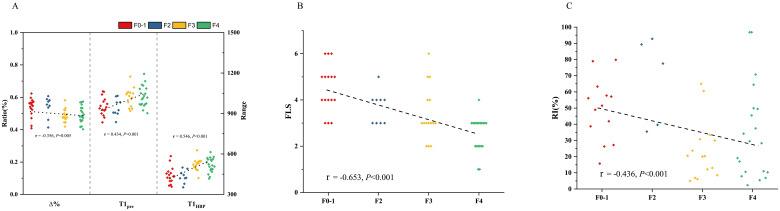
Results: T1pre, T1HBP, Δ%, and FLIS manifested significant correlation with fibrosis stage (r = 0.434, P =0.001; r = 0.546, P < 0.001; r = -0.356, P =0.005; r = -0.653, P <0.001, respectively). T1pre showed significant correction with steatosis grade (r = 0.415, P =0.001). Fibrosis stage and steatosis grade were associated with RI (r = -0.436, P<0.001; r = -0.338, P =0.008). Accordingly, T1pre, T1HBP and FLIS were the significant predictors (P<0.05) of RI in multivariate analysis. Similarly, in the patients undergoing minor hepatectomy (n=35), T1HBP, Δ% and FLIS were related to RI (P<0.05) in multivariate analysis. Nevertheless, in the patients undergoing major hepatectomy (n=25), no T1 mapping parameter and FLIS was the independent predictor of RI.
Conclusions: T1 mapping parameters and FLIS were the potential noninvasive indicators of liver regeneration, except for HCC patients undergoing major hepatectomy.
Clinical relevance statement: The value of T1 mapping and FLIS with Gd-EOB-DTPA MRI for accurate preoperative evaluation of liver regeneration is critical to prevent liver failure and improve prognosis of HCC patients.
期刊介绍:
Frontiers in Immunology is a leading journal in its field, publishing rigorously peer-reviewed research across basic, translational and clinical immunology. This multidisciplinary open-access journal is at the forefront of disseminating and communicating scientific knowledge and impactful discoveries to researchers, academics, clinicians and the public worldwide.
Frontiers in Immunology is the official Journal of the International Union of Immunological Societies (IUIS). Encompassing the entire field of Immunology, this journal welcomes papers that investigate basic mechanisms of immune system development and function, with a particular emphasis given to the description of the clinical and immunological phenotype of human immune disorders, and on the definition of their molecular basis.






 京公网安备 11010802042870号
京ICP备2023020795号-1
京公网安备 11010802042870号
京ICP备2023020795号-1

 分享
分享
 求助内容:
求助内容: 应助结果提醒方式:
 扫码关注我们
