{"title":"应激相带宽作为新发急性失代偿性心力衰竭伴射血分数降低患者左心室反向重构的预测因子","authors":"Yudai Tanaka, Daisuke Kitano, Shunichi Yoda, Saki Mizobuchi, Masatsugu Miyagawa, Katsunori Fukumoto, Hidesato Fujito, Takumi Hatta, Yuki Saito, Kazuto Toyama, Yasuo Okumura","doi":"10.1186/s12872-025-04548-4","DOIUrl":null,"url":null,"abstract":"<p><strong>Background: </strong>Stress phase bandwidth (SPBW), assessed using single-photon emission computed tomography (SPECT), is considered to be a useful indicator of left ventricular dyssynchrony. However, few reports have examined whether it can be used as an indicator for improvement of left ventricular ejection fraction (LVEF) in new-onset heart failure with reduced ejection fraction (HFrEF).</p><p><strong>Methods and results: </strong>A total of 64 patients (mean age 56 years, 39 male) who were admitted to our hospital with new-onset non-ischemic HFrEF (median LVEF 24.7%) from January 2018 to December 2022 in the SAKURA-HF registry and underwent SPECT were enrolled. The relationship between SPBW in the acute phase and LVEF improvement in the chronic phase was retrospectively investigated in the present study. LVEF improved significantly in the 36 patients (from 27.1 to 62.8%, p < 0.001). Guideline-directed medical therapy in both groups was comparable. SPBW was significantly lower in the group with improved LVEF (median 55.5° vs. 79.0°, p = 0.010). Logistic regression analysis revealed that SPBW was an independent predictor for LVEF improvement. Moreover, an SPBW of 71.0° was suggested as a possible cut-off value.</p><p><strong>Conclusions: </strong>SPBW may predict the improvement of LVEF in new-onset non-ischemic HFrEF, suggesting its potential utility in heart failure management.</p>","PeriodicalId":9195,"journal":{"name":"BMC Cardiovascular Disorders","volume":"25 1","pages":"98"},"PeriodicalIF":2.3000,"publicationDate":"2025-02-13","publicationTypes":"Journal Article","fieldsOfStudy":null,"isOpenAccess":false,"openAccessPdf":"https://www.ncbi.nlm.nih.gov/pmc/articles/PMC11823062/pdf/","citationCount":"0","resultStr":"{\"title\":\"Stress phase bandwidth as a predictor of left ventricular reverse remodeling in patients with new-onset acute decompensated heart failure with reduced ejection fraction.\",\"authors\":\"Yudai Tanaka, Daisuke Kitano, Shunichi Yoda, Saki Mizobuchi, Masatsugu Miyagawa, Katsunori Fukumoto, Hidesato Fujito, Takumi Hatta, Yuki Saito, Kazuto Toyama, Yasuo Okumura\",\"doi\":\"10.1186/s12872-025-04548-4\",\"DOIUrl\":null,\"url\":null,\"abstract\":\"<p><strong>Background: </strong>Stress phase bandwidth (SPBW), assessed using single-photon emission computed tomography (SPECT), is considered to be a useful indicator of left ventricular dyssynchrony. However, few reports have examined whether it can be used as an indicator for improvement of left ventricular ejection fraction (LVEF) in new-onset heart failure with reduced ejection fraction (HFrEF).</p><p><strong>Methods and results: </strong>A total of 64 patients (mean age 56 years, 39 male) who were admitted to our hospital with new-onset non-ischemic HFrEF (median LVEF 24.7%) from January 2018 to December 2022 in the SAKURA-HF registry and underwent SPECT were enrolled. The relationship between SPBW in the acute phase and LVEF improvement in the chronic phase was retrospectively investigated in the present study. LVEF improved significantly in the 36 patients (from 27.1 to 62.8%, p < 0.001). Guideline-directed medical therapy in both groups was comparable. SPBW was significantly lower in the group with improved LVEF (median 55.5° vs. 79.0°, p = 0.010). Logistic regression analysis revealed that SPBW was an independent predictor for LVEF improvement. Moreover, an SPBW of 71.0° was suggested as a possible cut-off value.</p><p><strong>Conclusions: </strong>SPBW may predict the improvement of LVEF in new-onset non-ischemic HFrEF, suggesting its potential utility in heart failure management.</p>\",\"PeriodicalId\":9195,\"journal\":{\"name\":\"BMC Cardiovascular Disorders\",\"volume\":\"25 1\",\"pages\":\"98\"},\"PeriodicalIF\":2.3000,\"publicationDate\":\"2025-02-13\",\"publicationTypes\":\"Journal Article\",\"fieldsOfStudy\":null,\"isOpenAccess\":false,\"openAccessPdf\":\"https://www.ncbi.nlm.nih.gov/pmc/articles/PMC11823062/pdf/\",\"citationCount\":\"0\",\"resultStr\":null,\"platform\":\"Semanticscholar\",\"paperid\":null,\"PeriodicalName\":\"BMC Cardiovascular Disorders\",\"FirstCategoryId\":\"3\",\"ListUrlMain\":\"https://doi.org/10.1186/s12872-025-04548-4\",\"RegionNum\":3,\"RegionCategory\":\"医学\",\"ArticlePicture\":[],\"TitleCN\":null,\"AbstractTextCN\":null,\"PMCID\":null,\"EPubDate\":\"\",\"PubModel\":\"\",\"JCR\":\"Q3\",\"JCRName\":\"CARDIAC & CARDIOVASCULAR SYSTEMS\",\"Score\":null,\"Total\":0}","platform":"Semanticscholar","paperid":null,"PeriodicalName":"BMC Cardiovascular Disorders","FirstCategoryId":"3","ListUrlMain":"https://doi.org/10.1186/s12872-025-04548-4","RegionNum":3,"RegionCategory":"医学","ArticlePicture":[],"TitleCN":null,"AbstractTextCN":null,"PMCID":null,"EPubDate":"","PubModel":"","JCR":"Q3","JCRName":"CARDIAC & CARDIOVASCULAR SYSTEMS","Score":null,"Total":0}
Stress phase bandwidth as a predictor of left ventricular reverse remodeling in patients with new-onset acute decompensated heart failure with reduced ejection fraction.
Background: Stress phase bandwidth (SPBW), assessed using single-photon emission computed tomography (SPECT), is considered to be a useful indicator of left ventricular dyssynchrony. However, few reports have examined whether it can be used as an indicator for improvement of left ventricular ejection fraction (LVEF) in new-onset heart failure with reduced ejection fraction (HFrEF).
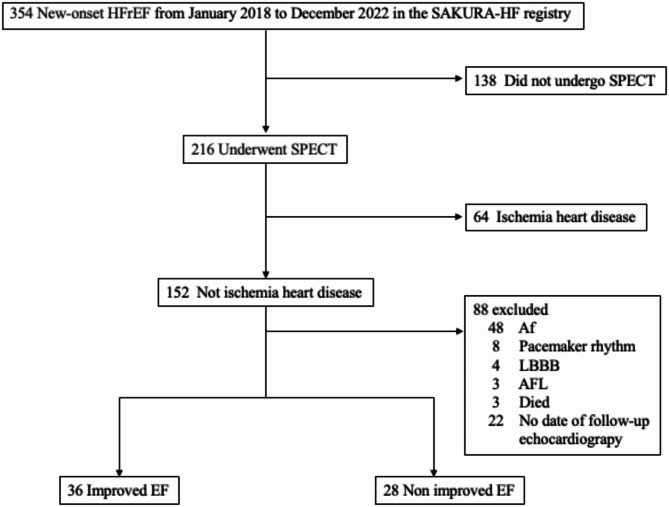
Methods and results: A total of 64 patients (mean age 56 years, 39 male) who were admitted to our hospital with new-onset non-ischemic HFrEF (median LVEF 24.7%) from January 2018 to December 2022 in the SAKURA-HF registry and underwent SPECT were enrolled. The relationship between SPBW in the acute phase and LVEF improvement in the chronic phase was retrospectively investigated in the present study. LVEF improved significantly in the 36 patients (from 27.1 to 62.8%, p < 0.001). Guideline-directed medical therapy in both groups was comparable. SPBW was significantly lower in the group with improved LVEF (median 55.5° vs. 79.0°, p = 0.010). Logistic regression analysis revealed that SPBW was an independent predictor for LVEF improvement. Moreover, an SPBW of 71.0° was suggested as a possible cut-off value.
Conclusions: SPBW may predict the improvement of LVEF in new-onset non-ischemic HFrEF, suggesting its potential utility in heart failure management.
期刊介绍:
BMC Cardiovascular Disorders is an open access, peer-reviewed journal that considers articles on all aspects of the prevention, diagnosis and management of disorders of the heart and circulatory system, as well as related molecular and cell biology, genetics, pathophysiology, epidemiology, and controlled trials.






 京公网安备 11010802042870号
京ICP备2023020795号-1
京公网安备 11010802042870号
京ICP备2023020795号-1

 分享
分享
 求助内容:
求助内容: 应助结果提醒方式:
 扫码关注我们
