Xiaoyan Li, Lishan Lin, Li Pang, Ke Pu, Jiayue Fu, Yushan Shen, Wenjing Zhang, Huiyun Xu, Yinbo Niu
{"title":"网络毒理学在中药安全性评价中的应用及发展趋势。","authors":"Xiaoyan Li, Lishan Lin, Li Pang, Ke Pu, Jiayue Fu, Yushan Shen, Wenjing Zhang, Huiyun Xu, Yinbo Niu","doi":"10.1016/j.jep.2025.119480","DOIUrl":null,"url":null,"abstract":"<div><h3>Ethnopharmacological relevance</h3><div>Integrating network toxicology into traditional Chinese medicine toxicology boosts the efficiency and comprehensiveness of safety evaluations for these medicines.</div></div><div><h3>Aim of the study</h3><div>This paper aims to deepen the comprehension of network toxicology and facilitate its application in the safety evaluation of traditional Chinese medicines.</div></div><div><h3>Materials and methods</h3><div>Using “network pharmacology,” “network toxicology,” and “traditional Chinese medicine” as keywords, relevant literature was searched in databases such as Web of Science, PubMed, and CNKI. The cited literature spans from 1999 to 2024.</div></div><div><h3>Results</h3><div>Network toxicology constructs a “toxicity-gene-target-drug” network model to characterize the toxicological features of the research subject. This paper reviews existing toxicity prediction tools and databases, explores methodologies for toxicity prediction, and comprehensively summarizes the applications of network toxicology in the prediction of harmful components, analysis of toxicity mechanisms, integration of interdisciplinary approaches, and combination with omics technologies. Additionally, it analyzes the current challenges and limitations of network toxicology.</div></div><div><h3>Conclusions</h3><div>Network toxicology has been extensively utilized in the safety research of traditional Chinese medicine, particularly in identifying toxic components and elucidating their mechanisms. However, there remains significant space for advancement. Future research could investigate integrating network toxicology with cutting-edge technologies like artificial intelligence and multi-omics approaches, thereby offering robust theoretical foundations for developing a comprehensive traditional Chinese medicine safety evaluation system.</div></div>","PeriodicalId":15761,"journal":{"name":"Journal of ethnopharmacology","volume":"343 ","pages":"Article 119480"},"PeriodicalIF":5.4000,"publicationDate":"2025-03-13","publicationTypes":"Journal Article","fieldsOfStudy":null,"isOpenAccess":false,"openAccessPdf":"","citationCount":"0","resultStr":"{\"title\":\"Application and development trends of network toxicology in the safety assessment of traditional Chinese medicine\",\"authors\":\"Xiaoyan Li, Lishan Lin, Li Pang, Ke Pu, Jiayue Fu, Yushan Shen, Wenjing Zhang, Huiyun Xu, Yinbo Niu\",\"doi\":\"10.1016/j.jep.2025.119480\",\"DOIUrl\":null,\"url\":null,\"abstract\":\"<div><h3>Ethnopharmacological relevance</h3><div>Integrating network toxicology into traditional Chinese medicine toxicology boosts the efficiency and comprehensiveness of safety evaluations for these medicines.</div></div><div><h3>Aim of the study</h3><div>This paper aims to deepen the comprehension of network toxicology and facilitate its application in the safety evaluation of traditional Chinese medicines.</div></div><div><h3>Materials and methods</h3><div>Using “network pharmacology,” “network toxicology,” and “traditional Chinese medicine” as keywords, relevant literature was searched in databases such as Web of Science, PubMed, and CNKI. The cited literature spans from 1999 to 2024.</div></div><div><h3>Results</h3><div>Network toxicology constructs a “toxicity-gene-target-drug” network model to characterize the toxicological features of the research subject. This paper reviews existing toxicity prediction tools and databases, explores methodologies for toxicity prediction, and comprehensively summarizes the applications of network toxicology in the prediction of harmful components, analysis of toxicity mechanisms, integration of interdisciplinary approaches, and combination with omics technologies. Additionally, it analyzes the current challenges and limitations of network toxicology.</div></div><div><h3>Conclusions</h3><div>Network toxicology has been extensively utilized in the safety research of traditional Chinese medicine, particularly in identifying toxic components and elucidating their mechanisms. However, there remains significant space for advancement. Future research could investigate integrating network toxicology with cutting-edge technologies like artificial intelligence and multi-omics approaches, thereby offering robust theoretical foundations for developing a comprehensive traditional Chinese medicine safety evaluation system.</div></div>\",\"PeriodicalId\":15761,\"journal\":{\"name\":\"Journal of ethnopharmacology\",\"volume\":\"343 \",\"pages\":\"Article 119480\"},\"PeriodicalIF\":5.4000,\"publicationDate\":\"2025-03-13\",\"publicationTypes\":\"Journal Article\",\"fieldsOfStudy\":null,\"isOpenAccess\":false,\"openAccessPdf\":\"\",\"citationCount\":\"0\",\"resultStr\":null,\"platform\":\"Semanticscholar\",\"paperid\":null,\"PeriodicalName\":\"Journal of ethnopharmacology\",\"FirstCategoryId\":\"3\",\"ListUrlMain\":\"https://www.sciencedirect.com/science/article/pii/S0378874125001631\",\"RegionNum\":2,\"RegionCategory\":\"医学\",\"ArticlePicture\":[],\"TitleCN\":null,\"AbstractTextCN\":null,\"PMCID\":null,\"EPubDate\":\"2025/2/11 0:00:00\",\"PubModel\":\"Epub\",\"JCR\":\"Q1\",\"JCRName\":\"CHEMISTRY, MEDICINAL\",\"Score\":null,\"Total\":0}","platform":"Semanticscholar","paperid":null,"PeriodicalName":"Journal of ethnopharmacology","FirstCategoryId":"3","ListUrlMain":"https://www.sciencedirect.com/science/article/pii/S0378874125001631","RegionNum":2,"RegionCategory":"医学","ArticlePicture":[],"TitleCN":null,"AbstractTextCN":null,"PMCID":null,"EPubDate":"2025/2/11 0:00:00","PubModel":"Epub","JCR":"Q1","JCRName":"CHEMISTRY, MEDICINAL","Score":null,"Total":0}
引用次数: 0
摘要
民族药理学相关性:将网络毒理学与中药毒理学相结合,提高了中药安全性评价的效率和全面性。研究目的:加深对网络毒理学的认识,促进网络毒理学在中药安全性评价中的应用。材料与方法:以“网络药理学”、“网络毒理学”、“中药”为关键词,在Web of Science、PubMed、CNKI等数据库中检索相关文献。被引用的文献从1999年到2024年。结果:网络毒理学构建了“毒理-基因-靶点-药物”网络模型,表征了研究对象的毒理学特征。本文综述了现有的毒性预测工具和数据库,探讨了毒性预测的方法,全面总结了网络毒理学在有害成分预测、毒性机制分析、跨学科方法整合以及与组学技术结合等方面的应用。此外,还分析了网络毒理学目前面临的挑战和局限性。结论:网络毒理学在中药安全性研究中得到了广泛的应用,特别是在鉴别毒性成分和阐明其作用机制方面。然而,仍有很大的发展空间。未来的研究可以探索将网络毒理学与人工智能和多组学方法等前沿技术相结合,从而为建立综合的中药安全性评价体系提供坚实的理论基础。
Application and development trends of network toxicology in the safety assessment of traditional Chinese medicine
Ethnopharmacological relevance
Integrating network toxicology into traditional Chinese medicine toxicology boosts the efficiency and comprehensiveness of safety evaluations for these medicines.
Aim of the study
This paper aims to deepen the comprehension of network toxicology and facilitate its application in the safety evaluation of traditional Chinese medicines.
Materials and methods
Using “network pharmacology,” “network toxicology,” and “traditional Chinese medicine” as keywords, relevant literature was searched in databases such as Web of Science, PubMed, and CNKI. The cited literature spans from 1999 to 2024.
Results
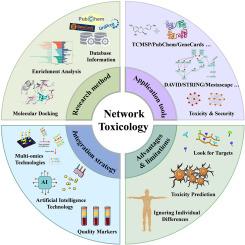
Network toxicology constructs a “toxicity-gene-target-drug” network model to characterize the toxicological features of the research subject. This paper reviews existing toxicity prediction tools and databases, explores methodologies for toxicity prediction, and comprehensively summarizes the applications of network toxicology in the prediction of harmful components, analysis of toxicity mechanisms, integration of interdisciplinary approaches, and combination with omics technologies. Additionally, it analyzes the current challenges and limitations of network toxicology.
Conclusions
Network toxicology has been extensively utilized in the safety research of traditional Chinese medicine, particularly in identifying toxic components and elucidating their mechanisms. However, there remains significant space for advancement. Future research could investigate integrating network toxicology with cutting-edge technologies like artificial intelligence and multi-omics approaches, thereby offering robust theoretical foundations for developing a comprehensive traditional Chinese medicine safety evaluation system.
期刊介绍:
The Journal of Ethnopharmacology is dedicated to the exchange of information and understandings about people''s use of plants, fungi, animals, microorganisms and minerals and their biological and pharmacological effects based on the principles established through international conventions. Early people confronted with illness and disease, discovered a wealth of useful therapeutic agents in the plant and animal kingdoms. The empirical knowledge of these medicinal substances and their toxic potential was passed on by oral tradition and sometimes recorded in herbals and other texts on materia medica. Many valuable drugs of today (e.g., atropine, ephedrine, tubocurarine, digoxin, reserpine) came into use through the study of indigenous remedies. Chemists continue to use plant-derived drugs (e.g., morphine, taxol, physostigmine, quinidine, emetine) as prototypes in their attempts to develop more effective and less toxic medicinals.





 京公网安备 11010802042870号
京ICP备2023020795号-1
京公网安备 11010802042870号
京ICP备2023020795号-1

 分享
分享
 求助内容:
求助内容: 应助结果提醒方式:
 扫码关注我们
