Zaki Milhelm, Oana Zanoaga, Laura Pop, Andrada Iovita, Paul Chiroi, Antonia Harangus, Cristina Cismaru, Cornelia Braicu, Ioana Berindan-Neagoe
{"title":"氧化应激生物标志物鉴别细菌和病毒感染的评价:谷胱甘肽二硫(GSSG)和还原性谷胱甘肽(GSH)的比较研究","authors":"Zaki Milhelm, Oana Zanoaga, Laura Pop, Andrada Iovita, Paul Chiroi, Antonia Harangus, Cristina Cismaru, Cornelia Braicu, Ioana Berindan-Neagoe","doi":"10.15386/mpr-2821","DOIUrl":null,"url":null,"abstract":"<p><strong>Background and aims: </strong>This study evaluates the potential of oxidative stress biomarkers, specifically glutathione disulfide (GSSG) and reduced glutathione (GSH), for differentiating bacterial and viral infections. Oxidative stress plays a crucial role in the immune response, and glutathione is a key regulator of cellular redox balance. The aim was to assess whether differences in GSH and GSSG levels could be used as diagnostic markers for infection type.</p><p><strong>Methods: </strong>A chemiluminescence-based method evaluated GSH and GSSG as potential biomarkers for distinguishing between bacterial and viral infections. The GSH and GSSG concentrations were analyzed across bacterial, viral, and control groups.</p><p><strong>Results: </strong>Our data revealed significant differences in the GSH/GSSG ratio between the analyzed groups, with bacterial infections showing higher oxidative stress markers compared to viral infections. A combined analysis of GSH and GSSG concentrations, visualized through heatmaps and ROC curves, improved diagnostic accuracy, with clustering patterns distinguishing infection types.</p><p><strong>Conclusions: </strong>These findings suggest that the GSH/GSSG ratio could be used as a biomarker in distinguishing between bacterial and viral infections, offering potential clinical applications for more accurate diagnosis. Further research is required to validate these results in larger cohorts and to explore the underlying mechanisms of oxidative stress in pathogen-specific immune responses.</p>","PeriodicalId":18438,"journal":{"name":"Medicine and Pharmacy Reports","volume":"98 1","pages":"46-53"},"PeriodicalIF":0.0000,"publicationDate":"2025-01-01","publicationTypes":"Journal Article","fieldsOfStudy":null,"isOpenAccess":false,"openAccessPdf":"https://www.ncbi.nlm.nih.gov/pmc/articles/PMC11817587/pdf/","citationCount":"0","resultStr":"{\"title\":\"Evaluation of oxidative stress biomarkers for differentiating bacterial and viral infections: a comparative study of glutathione disulfide (GSSG) and reduced glutathione (GSH).\",\"authors\":\"Zaki Milhelm, Oana Zanoaga, Laura Pop, Andrada Iovita, Paul Chiroi, Antonia Harangus, Cristina Cismaru, Cornelia Braicu, Ioana Berindan-Neagoe\",\"doi\":\"10.15386/mpr-2821\",\"DOIUrl\":null,\"url\":null,\"abstract\":\"<p><strong>Background and aims: </strong>This study evaluates the potential of oxidative stress biomarkers, specifically glutathione disulfide (GSSG) and reduced glutathione (GSH), for differentiating bacterial and viral infections. Oxidative stress plays a crucial role in the immune response, and glutathione is a key regulator of cellular redox balance. The aim was to assess whether differences in GSH and GSSG levels could be used as diagnostic markers for infection type.</p><p><strong>Methods: </strong>A chemiluminescence-based method evaluated GSH and GSSG as potential biomarkers for distinguishing between bacterial and viral infections. The GSH and GSSG concentrations were analyzed across bacterial, viral, and control groups.</p><p><strong>Results: </strong>Our data revealed significant differences in the GSH/GSSG ratio between the analyzed groups, with bacterial infections showing higher oxidative stress markers compared to viral infections. A combined analysis of GSH and GSSG concentrations, visualized through heatmaps and ROC curves, improved diagnostic accuracy, with clustering patterns distinguishing infection types.</p><p><strong>Conclusions: </strong>These findings suggest that the GSH/GSSG ratio could be used as a biomarker in distinguishing between bacterial and viral infections, offering potential clinical applications for more accurate diagnosis. Further research is required to validate these results in larger cohorts and to explore the underlying mechanisms of oxidative stress in pathogen-specific immune responses.</p>\",\"PeriodicalId\":18438,\"journal\":{\"name\":\"Medicine and Pharmacy Reports\",\"volume\":\"98 1\",\"pages\":\"46-53\"},\"PeriodicalIF\":0.0000,\"publicationDate\":\"2025-01-01\",\"publicationTypes\":\"Journal Article\",\"fieldsOfStudy\":null,\"isOpenAccess\":false,\"openAccessPdf\":\"https://www.ncbi.nlm.nih.gov/pmc/articles/PMC11817587/pdf/\",\"citationCount\":\"0\",\"resultStr\":null,\"platform\":\"Semanticscholar\",\"paperid\":null,\"PeriodicalName\":\"Medicine and Pharmacy Reports\",\"FirstCategoryId\":\"1085\",\"ListUrlMain\":\"https://doi.org/10.15386/mpr-2821\",\"RegionNum\":0,\"RegionCategory\":null,\"ArticlePicture\":[],\"TitleCN\":null,\"AbstractTextCN\":null,\"PMCID\":null,\"EPubDate\":\"2025/1/31 0:00:00\",\"PubModel\":\"Epub\",\"JCR\":\"Q2\",\"JCRName\":\"Medicine\",\"Score\":null,\"Total\":0}","platform":"Semanticscholar","paperid":null,"PeriodicalName":"Medicine and Pharmacy Reports","FirstCategoryId":"1085","ListUrlMain":"https://doi.org/10.15386/mpr-2821","RegionNum":0,"RegionCategory":null,"ArticlePicture":[],"TitleCN":null,"AbstractTextCN":null,"PMCID":null,"EPubDate":"2025/1/31 0:00:00","PubModel":"Epub","JCR":"Q2","JCRName":"Medicine","Score":null,"Total":0}
Evaluation of oxidative stress biomarkers for differentiating bacterial and viral infections: a comparative study of glutathione disulfide (GSSG) and reduced glutathione (GSH).
Background and aims: This study evaluates the potential of oxidative stress biomarkers, specifically glutathione disulfide (GSSG) and reduced glutathione (GSH), for differentiating bacterial and viral infections. Oxidative stress plays a crucial role in the immune response, and glutathione is a key regulator of cellular redox balance. The aim was to assess whether differences in GSH and GSSG levels could be used as diagnostic markers for infection type.
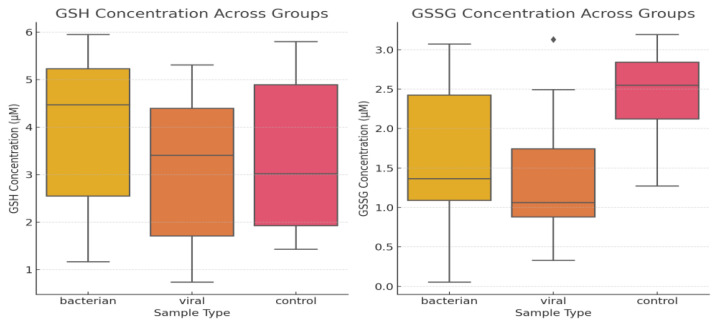
Methods: A chemiluminescence-based method evaluated GSH and GSSG as potential biomarkers for distinguishing between bacterial and viral infections. The GSH and GSSG concentrations were analyzed across bacterial, viral, and control groups.
Results: Our data revealed significant differences in the GSH/GSSG ratio between the analyzed groups, with bacterial infections showing higher oxidative stress markers compared to viral infections. A combined analysis of GSH and GSSG concentrations, visualized through heatmaps and ROC curves, improved diagnostic accuracy, with clustering patterns distinguishing infection types.
Conclusions: These findings suggest that the GSH/GSSG ratio could be used as a biomarker in distinguishing between bacterial and viral infections, offering potential clinical applications for more accurate diagnosis. Further research is required to validate these results in larger cohorts and to explore the underlying mechanisms of oxidative stress in pathogen-specific immune responses.







 京公网安备 11010802042870号
京ICP备2023020795号-1
京公网安备 11010802042870号
京ICP备2023020795号-1

 分享
分享
 求助内容:
求助内容: 应助结果提醒方式:
 扫码关注我们
