Huiquan Duan, Wei Wu, Ping Li, Samuel Bouyain, Brandon L Garcia, Brian V Geisbrecht
{"title":"C1r酶原的阻断激活定义了一种补体抑制的新模式。","authors":"Huiquan Duan, Wei Wu, Ping Li, Samuel Bouyain, Brandon L Garcia, Brian V Geisbrecht","doi":"10.1016/j.jbc.2025.108301","DOIUrl":null,"url":null,"abstract":"<p><p>Many hematophagous organisms secrete inhibitors of the coagulation and complement systems as constituents of their salivary fluid. Whereas previous studies on salivary gland extracts from the sandfly Lutzomyia longipalpis identified SALO (salivary anticomplement from L. longipalpis) as a potent inhibitor of the classical complement pathway (CP), its precise mechanism of action has remained elusive. Here, we show that SALO inhibits the CP by binding selectively to the C1r zymogen. Using surface plasmon resonance, we found that SALO expressed by human embryonic kidney 293(T) cells (eSALO-WT) bound with nanomolar affinity to the zymogen of complement protease C1r (pro-C1r), but that it did not bind the enzymatically active form of C1r. To gain insight into the structural basis for CP inhibition by SALO, we solved a 3.3 Å resolution crystal structure of eSALO-WT bound to a recombinant form of C1r that was engineered to remain in a zymogen-like state (zC1r-12SP). eSALO-WT formed extensive interactions with the zymogen activation loop of zC1r-12SP, including groups derived from residues R463 and I464, which compose its scissile peptide bond. Although the interactions with R463 and I464 were mediated by side-chain sulfation of eSALO-WT at position Y51, we found that this modification enhanced the potency of SALO but was not required for its activity. Consistent with our structural observations, subsequent studies showed that eSALO-WT binding to pro-C1r blocked its activation and thereby inhibited the CP in hemolytic assays of complement function. Together, our results define a new mode of inhibiting complement by blocking the farthest upstream enzymatic reaction of the CP.</p>","PeriodicalId":15140,"journal":{"name":"Journal of Biological Chemistry","volume":" ","pages":"108301"},"PeriodicalIF":4.0000,"publicationDate":"2025-03-01","publicationTypes":"Journal Article","fieldsOfStudy":null,"isOpenAccess":false,"openAccessPdf":"https://www.ncbi.nlm.nih.gov/pmc/articles/PMC11928764/pdf/","citationCount":"0","resultStr":"{\"title\":\"Blocking activation of the C1r zymogen defines a novel mode of complement inhibition.\",\"authors\":\"Huiquan Duan, Wei Wu, Ping Li, Samuel Bouyain, Brandon L Garcia, Brian V Geisbrecht\",\"doi\":\"10.1016/j.jbc.2025.108301\",\"DOIUrl\":null,\"url\":null,\"abstract\":\"<p><p>Many hematophagous organisms secrete inhibitors of the coagulation and complement systems as constituents of their salivary fluid. Whereas previous studies on salivary gland extracts from the sandfly Lutzomyia longipalpis identified SALO (salivary anticomplement from L. longipalpis) as a potent inhibitor of the classical complement pathway (CP), its precise mechanism of action has remained elusive. Here, we show that SALO inhibits the CP by binding selectively to the C1r zymogen. Using surface plasmon resonance, we found that SALO expressed by human embryonic kidney 293(T) cells (eSALO-WT) bound with nanomolar affinity to the zymogen of complement protease C1r (pro-C1r), but that it did not bind the enzymatically active form of C1r. To gain insight into the structural basis for CP inhibition by SALO, we solved a 3.3 Å resolution crystal structure of eSALO-WT bound to a recombinant form of C1r that was engineered to remain in a zymogen-like state (zC1r-12SP). eSALO-WT formed extensive interactions with the zymogen activation loop of zC1r-12SP, including groups derived from residues R463 and I464, which compose its scissile peptide bond. Although the interactions with R463 and I464 were mediated by side-chain sulfation of eSALO-WT at position Y51, we found that this modification enhanced the potency of SALO but was not required for its activity. Consistent with our structural observations, subsequent studies showed that eSALO-WT binding to pro-C1r blocked its activation and thereby inhibited the CP in hemolytic assays of complement function. Together, our results define a new mode of inhibiting complement by blocking the farthest upstream enzymatic reaction of the CP.</p>\",\"PeriodicalId\":15140,\"journal\":{\"name\":\"Journal of Biological Chemistry\",\"volume\":\" \",\"pages\":\"108301\"},\"PeriodicalIF\":4.0000,\"publicationDate\":\"2025-03-01\",\"publicationTypes\":\"Journal Article\",\"fieldsOfStudy\":null,\"isOpenAccess\":false,\"openAccessPdf\":\"https://www.ncbi.nlm.nih.gov/pmc/articles/PMC11928764/pdf/\",\"citationCount\":\"0\",\"resultStr\":null,\"platform\":\"Semanticscholar\",\"paperid\":null,\"PeriodicalName\":\"Journal of Biological Chemistry\",\"FirstCategoryId\":\"99\",\"ListUrlMain\":\"https://doi.org/10.1016/j.jbc.2025.108301\",\"RegionNum\":2,\"RegionCategory\":\"生物学\",\"ArticlePicture\":[],\"TitleCN\":null,\"AbstractTextCN\":null,\"PMCID\":null,\"EPubDate\":\"2025/2/11 0:00:00\",\"PubModel\":\"Epub\",\"JCR\":\"Q2\",\"JCRName\":\"BIOCHEMISTRY & MOLECULAR BIOLOGY\",\"Score\":null,\"Total\":0}","platform":"Semanticscholar","paperid":null,"PeriodicalName":"Journal of Biological Chemistry","FirstCategoryId":"99","ListUrlMain":"https://doi.org/10.1016/j.jbc.2025.108301","RegionNum":2,"RegionCategory":"生物学","ArticlePicture":[],"TitleCN":null,"AbstractTextCN":null,"PMCID":null,"EPubDate":"2025/2/11 0:00:00","PubModel":"Epub","JCR":"Q2","JCRName":"BIOCHEMISTRY & MOLECULAR BIOLOGY","Score":null,"Total":0}
引用次数: 0
摘要
许多噬血生物分泌凝血和补体系统的抑制剂作为其唾液液的成分。尽管以往对长掌白蛉唾液腺提取物的研究发现SALO (salivary Anticomplement from Lutzomyia longipalpis)是经典补体途径(CP)的有效抑制剂,但其确切的作用机制尚不清楚。我们发现SALO通过选择性结合C1r酶原抑制CP。利用表面等离子体共振,我们发现HEK293(T)细胞(eSALO-WT)表达的SALO与补体蛋白酶C1r (pro-C1r)的酶原结合具有纳米摩尔亲和力,但它不与酶活性形式的C1r结合。为了深入了解SALO抑制CP的结构基础,我们解决了3.3 Å分辨率的eSALO-WT与重组形式的C1r结合的晶体结构,该C1r被设计成保持在酶原样状态(zC1r-12SP)。eSALO-WT与zC1r-12SP的酶原激活环形成了广泛的相互作用,包括残基R463和I464衍生的基团,它们构成了其可剪切的肽键。虽然与R463和I464的相互作用是通过Y51位置的eSALO-WT侧链磺化介导的,但我们发现这种修饰增强了SALO的效力,但不是其活性所必需的。与我们的结构观察一致,随后的研究表明,eSALO-WT与pro-C1r结合阻断了其激活,从而抑制了补体功能溶血试验中的CP。总之,我们的结果定义了一种新的模式,抑制补体通过阻断最远上游的酶促反应的CP。
Blocking activation of the C1r zymogen defines a novel mode of complement inhibition.
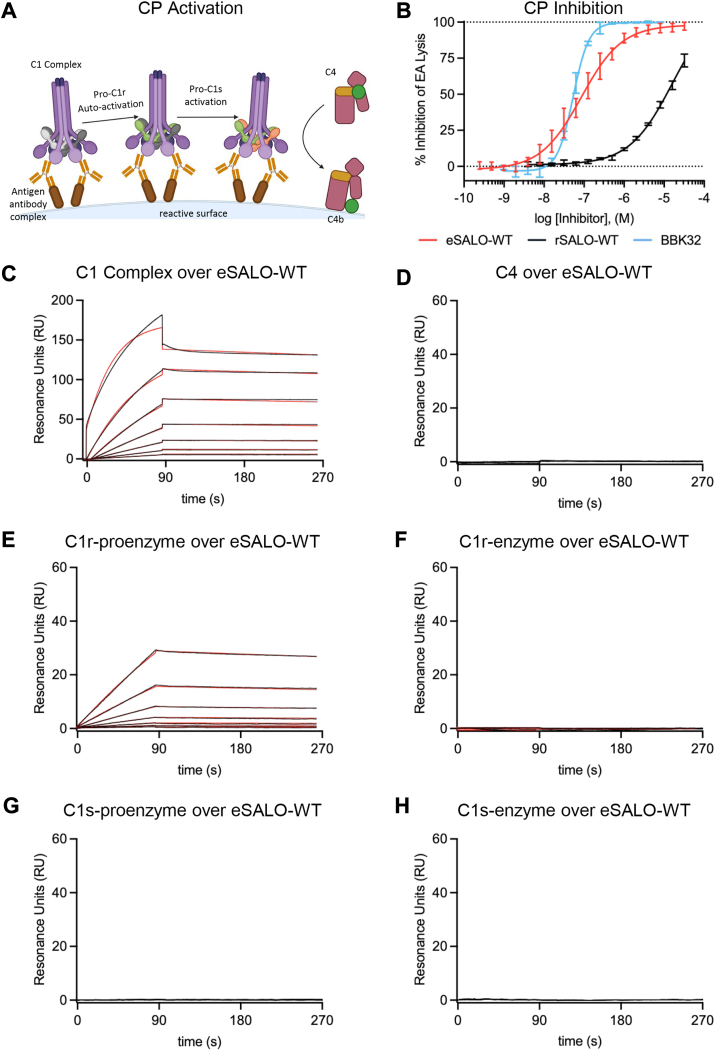
Many hematophagous organisms secrete inhibitors of the coagulation and complement systems as constituents of their salivary fluid. Whereas previous studies on salivary gland extracts from the sandfly Lutzomyia longipalpis identified SALO (salivary anticomplement from L. longipalpis) as a potent inhibitor of the classical complement pathway (CP), its precise mechanism of action has remained elusive. Here, we show that SALO inhibits the CP by binding selectively to the C1r zymogen. Using surface plasmon resonance, we found that SALO expressed by human embryonic kidney 293(T) cells (eSALO-WT) bound with nanomolar affinity to the zymogen of complement protease C1r (pro-C1r), but that it did not bind the enzymatically active form of C1r. To gain insight into the structural basis for CP inhibition by SALO, we solved a 3.3 Å resolution crystal structure of eSALO-WT bound to a recombinant form of C1r that was engineered to remain in a zymogen-like state (zC1r-12SP). eSALO-WT formed extensive interactions with the zymogen activation loop of zC1r-12SP, including groups derived from residues R463 and I464, which compose its scissile peptide bond. Although the interactions with R463 and I464 were mediated by side-chain sulfation of eSALO-WT at position Y51, we found that this modification enhanced the potency of SALO but was not required for its activity. Consistent with our structural observations, subsequent studies showed that eSALO-WT binding to pro-C1r blocked its activation and thereby inhibited the CP in hemolytic assays of complement function. Together, our results define a new mode of inhibiting complement by blocking the farthest upstream enzymatic reaction of the CP.
期刊介绍:
The Journal of Biological Chemistry welcomes high-quality science that seeks to elucidate the molecular and cellular basis of biological processes. Papers published in JBC can therefore fall under the umbrellas of not only biological chemistry, chemical biology, or biochemistry, but also allied disciplines such as biophysics, systems biology, RNA biology, immunology, microbiology, neurobiology, epigenetics, computational biology, ’omics, and many more. The outcome of our focus on papers that contribute novel and important mechanistic insights, rather than on a particular topic area, is that JBC is truly a melting pot for scientists across disciplines. In addition, JBC welcomes papers that describe methods that will help scientists push their biochemical inquiries forward and resources that will be of use to the research community.






 京公网安备 11010802042870号
京ICP备2023020795号-1
京公网安备 11010802042870号
京ICP备2023020795号-1

 分享
分享
 求助内容:
求助内容: 应助结果提醒方式:
 扫码关注我们
