Janina Quintero Bisonó, Shannon M Knapp, Dalancee Trabue, Ryan Yee, Francesca Williamson, Adedoyin Johnson, Stephen Watty, Natalie Pool, Megan Hebdon, Wanda Moore, Ekow Yankah, Nneamaka Ezema, Nia Kimbrough, Karen Lightbourne, Brownsyne Tucker Edmonds, Quinn Capers, David Brown, Denee Johnson, Jalynn Evans, Brandi Foree, Anastasia Holman, Courtland Blount, Brahmajee Nallamothu, John M Hollingsworth, Khadijah Breathett
{"title":"在中西部的一个州,根据病人种族,医疗团队隔离与心脏病专家接受护理的关系","authors":"Janina Quintero Bisonó, Shannon M Knapp, Dalancee Trabue, Ryan Yee, Francesca Williamson, Adedoyin Johnson, Stephen Watty, Natalie Pool, Megan Hebdon, Wanda Moore, Ekow Yankah, Nneamaka Ezema, Nia Kimbrough, Karen Lightbourne, Brownsyne Tucker Edmonds, Quinn Capers, David Brown, Denee Johnson, Jalynn Evans, Brandi Foree, Anastasia Holman, Courtland Blount, Brahmajee Nallamothu, John M Hollingsworth, Khadijah Breathett","doi":"10.1161/JAHA.124.037197","DOIUrl":null,"url":null,"abstract":"<p><strong>Background: </strong>Segregation index (SI) has been associated with worsened health. However, the relationship between SI within health care teams (degree of heterogeneity between teams caring for Black compared with White patients) and cardiovascular care is unclear among adequately insured populations. We sought to assess the relationship between health care team SI, patient race, receipt of care by a cardiologist, 1-year survival, and 30-day readmission rates for Black compared with White patients admitted with heart failure, ischemic heart disease, or valvular heart disease.</p><p><strong>Methods: </strong>Using Optum's de-identified Clinformatics Data Mart Database (CDM) from 2009 to 2020, generalized linear mixed-effects were used to analyze effects of patient race and SI on receipt of care by a cardiologist, and care by a cardiologist on 1-year survival and 30-day readmission.</p><p><strong>Results: </strong>Among 6572 patients (17.1% Black), the odds of receiving care by a cardiologist were 31.3% less for Black than White patients (adjusted odds ratio 0.687 [95% CI, 0.545-0.872]; <i>P</i>=0.001). However, there was no statistically significant association of SI on receipt of care by a cardiologist (<i>P</i>=0.14). For those seen by a cardiologist, the adjusted odds ratio (Black-to-White) of 1-year survival increased with increasing SI (<i>P</i>=0.02). SI had no statistically significant effect on 30-day readmission (<i>P</i>=0.86).</p><p><strong>Conclusions: </strong>Among patients hospitalized for heart failure, ischemic heart disease, or valvular heart disease, segregation of health care teams was not associated with receipt of care by cardiologists in Indiana hospitals. When cardiologists were included, the odds of 1-year survival increased for Black versus White patients with increasing segregation of clinicians, and segregation was not associated with 30-day readmission.</p>","PeriodicalId":54370,"journal":{"name":"Journal of the American Heart Association","volume":" ","pages":"e037197"},"PeriodicalIF":5.3000,"publicationDate":"2025-02-18","publicationTypes":"Journal Article","fieldsOfStudy":null,"isOpenAccess":false,"openAccessPdf":"https://www.ncbi.nlm.nih.gov/pmc/articles/PMC12074763/pdf/","citationCount":"0","resultStr":"{\"title\":\"Relationship Between Health Care Team Segregation and Receipt of Care by a Cardiologist According to Patient Race in a Midwestern State.\",\"authors\":\"Janina Quintero Bisonó, Shannon M Knapp, Dalancee Trabue, Ryan Yee, Francesca Williamson, Adedoyin Johnson, Stephen Watty, Natalie Pool, Megan Hebdon, Wanda Moore, Ekow Yankah, Nneamaka Ezema, Nia Kimbrough, Karen Lightbourne, Brownsyne Tucker Edmonds, Quinn Capers, David Brown, Denee Johnson, Jalynn Evans, Brandi Foree, Anastasia Holman, Courtland Blount, Brahmajee Nallamothu, John M Hollingsworth, Khadijah Breathett\",\"doi\":\"10.1161/JAHA.124.037197\",\"DOIUrl\":null,\"url\":null,\"abstract\":\"<p><strong>Background: </strong>Segregation index (SI) has been associated with worsened health. However, the relationship between SI within health care teams (degree of heterogeneity between teams caring for Black compared with White patients) and cardiovascular care is unclear among adequately insured populations. We sought to assess the relationship between health care team SI, patient race, receipt of care by a cardiologist, 1-year survival, and 30-day readmission rates for Black compared with White patients admitted with heart failure, ischemic heart disease, or valvular heart disease.</p><p><strong>Methods: </strong>Using Optum's de-identified Clinformatics Data Mart Database (CDM) from 2009 to 2020, generalized linear mixed-effects were used to analyze effects of patient race and SI on receipt of care by a cardiologist, and care by a cardiologist on 1-year survival and 30-day readmission.</p><p><strong>Results: </strong>Among 6572 patients (17.1% Black), the odds of receiving care by a cardiologist were 31.3% less for Black than White patients (adjusted odds ratio 0.687 [95% CI, 0.545-0.872]; <i>P</i>=0.001). However, there was no statistically significant association of SI on receipt of care by a cardiologist (<i>P</i>=0.14). For those seen by a cardiologist, the adjusted odds ratio (Black-to-White) of 1-year survival increased with increasing SI (<i>P</i>=0.02). SI had no statistically significant effect on 30-day readmission (<i>P</i>=0.86).</p><p><strong>Conclusions: </strong>Among patients hospitalized for heart failure, ischemic heart disease, or valvular heart disease, segregation of health care teams was not associated with receipt of care by cardiologists in Indiana hospitals. When cardiologists were included, the odds of 1-year survival increased for Black versus White patients with increasing segregation of clinicians, and segregation was not associated with 30-day readmission.</p>\",\"PeriodicalId\":54370,\"journal\":{\"name\":\"Journal of the American Heart Association\",\"volume\":\" \",\"pages\":\"e037197\"},\"PeriodicalIF\":5.3000,\"publicationDate\":\"2025-02-18\",\"publicationTypes\":\"Journal Article\",\"fieldsOfStudy\":null,\"isOpenAccess\":false,\"openAccessPdf\":\"https://www.ncbi.nlm.nih.gov/pmc/articles/PMC12074763/pdf/\",\"citationCount\":\"0\",\"resultStr\":null,\"platform\":\"Semanticscholar\",\"paperid\":null,\"PeriodicalName\":\"Journal of the American Heart Association\",\"FirstCategoryId\":\"3\",\"ListUrlMain\":\"https://doi.org/10.1161/JAHA.124.037197\",\"RegionNum\":1,\"RegionCategory\":\"医学\",\"ArticlePicture\":[],\"TitleCN\":null,\"AbstractTextCN\":null,\"PMCID\":null,\"EPubDate\":\"2025/2/14 0:00:00\",\"PubModel\":\"Epub\",\"JCR\":\"Q1\",\"JCRName\":\"CARDIAC & CARDIOVASCULAR SYSTEMS\",\"Score\":null,\"Total\":0}","platform":"Semanticscholar","paperid":null,"PeriodicalName":"Journal of the American Heart Association","FirstCategoryId":"3","ListUrlMain":"https://doi.org/10.1161/JAHA.124.037197","RegionNum":1,"RegionCategory":"医学","ArticlePicture":[],"TitleCN":null,"AbstractTextCN":null,"PMCID":null,"EPubDate":"2025/2/14 0:00:00","PubModel":"Epub","JCR":"Q1","JCRName":"CARDIAC & CARDIOVASCULAR SYSTEMS","Score":null,"Total":0}
Relationship Between Health Care Team Segregation and Receipt of Care by a Cardiologist According to Patient Race in a Midwestern State.
Background: Segregation index (SI) has been associated with worsened health. However, the relationship between SI within health care teams (degree of heterogeneity between teams caring for Black compared with White patients) and cardiovascular care is unclear among adequately insured populations. We sought to assess the relationship between health care team SI, patient race, receipt of care by a cardiologist, 1-year survival, and 30-day readmission rates for Black compared with White patients admitted with heart failure, ischemic heart disease, or valvular heart disease.
Methods: Using Optum's de-identified Clinformatics Data Mart Database (CDM) from 2009 to 2020, generalized linear mixed-effects were used to analyze effects of patient race and SI on receipt of care by a cardiologist, and care by a cardiologist on 1-year survival and 30-day readmission.
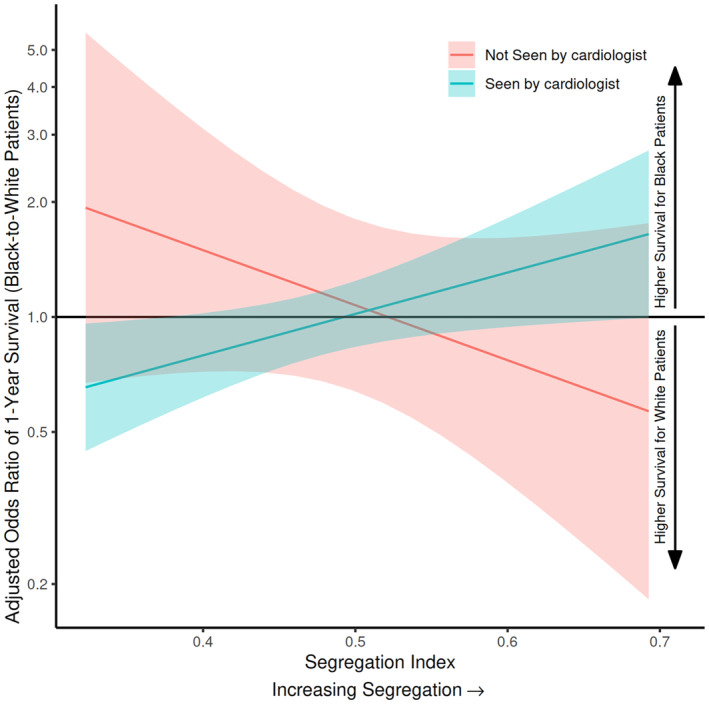
Results: Among 6572 patients (17.1% Black), the odds of receiving care by a cardiologist were 31.3% less for Black than White patients (adjusted odds ratio 0.687 [95% CI, 0.545-0.872]; P=0.001). However, there was no statistically significant association of SI on receipt of care by a cardiologist (P=0.14). For those seen by a cardiologist, the adjusted odds ratio (Black-to-White) of 1-year survival increased with increasing SI (P=0.02). SI had no statistically significant effect on 30-day readmission (P=0.86).
Conclusions: Among patients hospitalized for heart failure, ischemic heart disease, or valvular heart disease, segregation of health care teams was not associated with receipt of care by cardiologists in Indiana hospitals. When cardiologists were included, the odds of 1-year survival increased for Black versus White patients with increasing segregation of clinicians, and segregation was not associated with 30-day readmission.
期刊介绍:
As an Open Access journal, JAHA - Journal of the American Heart Association is rapidly and freely available, accelerating the translation of strong science into effective practice.
JAHA is an authoritative, peer-reviewed Open Access journal focusing on cardiovascular and cerebrovascular disease. JAHA provides a global forum for basic and clinical research and timely reviews on cardiovascular disease and stroke. As an Open Access journal, its content is free on publication to read, download, and share, accelerating the translation of strong science into effective practice.






 京公网安备 11010802042870号
京ICP备2023020795号-1
京公网安备 11010802042870号
京ICP备2023020795号-1

 分享
分享
 求助内容:
求助内容: 应助结果提醒方式:
 扫码关注我们
