Titilola Falasinnu, Md Belal Hossain, Mohammad Ehsanul Karim, Kenneth Arnold Weber Ii, Sean Mackey
{"title":"美国的疼痛问题:利用国家健康访谈调查(NHIS)数据评估高影响慢性疼痛模型的普遍性。","authors":"Titilola Falasinnu, Md Belal Hossain, Mohammad Ehsanul Karim, Kenneth Arnold Weber Ii, Sean Mackey","doi":"10.1136/bmjph-2024-001628","DOIUrl":null,"url":null,"abstract":"<p><strong>Introduction: </strong>High-impact chronic pain (HICP) significantly affects the quality of life for millions of U.S. adults, imposing substantial economic/healthcare burdens. Disproportionate effects are observed among racial/ethnic minorities and older adults.</p><p><strong>Methods: </strong>We leveraged the National Health Interview Survey (NHIS) from 2016 (n=32,980), 2017 (n=26,700), and 2021 (n=28,740) to validate and develop analytical models for HICP. Initial models (2016 NHIS data) identified correlates associated with HICP, including hospital stays, diagnosis of specific diseases, psychological symptoms, and employment status. We assessed the models' generalizability and drew comparisons across time. We constructed five validation scenarios to account for variations in the availability of predictor variables across datasets and different time frames for pain assessment questions. We used logistic regression with LASSO and random forest techniques. We assessed model discrimination, calibration, and overall performance using metrics such as area under the curve (AUC), calibration slope, and Brier score.</p><p><strong>Results: </strong>Scenario 1, validating the NHIS 2016 model against 2017 data, demonstrated excellent discrimination with an AUC of 0.89 (95% CI: 0.88-0.90) for both LASSO and random forest models. Subgroup-specific performance varied, with the lowest AUC among adults aged ≥65 years (0.81, 95% CI: 0.78-0.82) and the highest among Hispanic respondents (0.91, 95% CI: 0.88-0.94). Model calibration was generally robust, although underfitting was observed for Hispanic respondents (calibration slope: 1.31). Scenario 3, testing the NHIS 2016 model on 2021 data, showed reduced discrimination (AUC: 0.82, 95% CI: 0.81-0.83) and overfitting (calibration slopes < 1). De novo models based on 2021 data showed comparable discrimination (AUC: 0.86, 95% CI: 0.85-0.87) but poorer calibration when validated against older datasets.</p><p><strong>Conclusion: </strong>These findings underscore the potential of these models to guide personalized medicine strategies for HICP, aiming for more preventive rather than reactive healthcare. However, the model's broader applicability requires further validation in varied settings and global populations.</p>","PeriodicalId":101362,"journal":{"name":"BMJ public health","volume":"3 1","pages":"e001628"},"PeriodicalIF":0.0000,"publicationDate":"2025-01-27","publicationTypes":"Journal Article","fieldsOfStudy":null,"isOpenAccess":false,"openAccessPdf":"https://www.ncbi.nlm.nih.gov/pmc/articles/PMC11822865/pdf/","citationCount":"0","resultStr":"{\"title\":\"Problem of pain in the USA: evaluating the generalisability of high-impact chronic pain models over time using National Health Interview Survey (NHIS) data.\",\"authors\":\"Titilola Falasinnu, Md Belal Hossain, Mohammad Ehsanul Karim, Kenneth Arnold Weber Ii, Sean Mackey\",\"doi\":\"10.1136/bmjph-2024-001628\",\"DOIUrl\":null,\"url\":null,\"abstract\":\"<p><strong>Introduction: </strong>High-impact chronic pain (HICP) significantly affects the quality of life for millions of U.S. adults, imposing substantial economic/healthcare burdens. Disproportionate effects are observed among racial/ethnic minorities and older adults.</p><p><strong>Methods: </strong>We leveraged the National Health Interview Survey (NHIS) from 2016 (n=32,980), 2017 (n=26,700), and 2021 (n=28,740) to validate and develop analytical models for HICP. Initial models (2016 NHIS data) identified correlates associated with HICP, including hospital stays, diagnosis of specific diseases, psychological symptoms, and employment status. We assessed the models' generalizability and drew comparisons across time. We constructed five validation scenarios to account for variations in the availability of predictor variables across datasets and different time frames for pain assessment questions. We used logistic regression with LASSO and random forest techniques. We assessed model discrimination, calibration, and overall performance using metrics such as area under the curve (AUC), calibration slope, and Brier score.</p><p><strong>Results: </strong>Scenario 1, validating the NHIS 2016 model against 2017 data, demonstrated excellent discrimination with an AUC of 0.89 (95% CI: 0.88-0.90) for both LASSO and random forest models. Subgroup-specific performance varied, with the lowest AUC among adults aged ≥65 years (0.81, 95% CI: 0.78-0.82) and the highest among Hispanic respondents (0.91, 95% CI: 0.88-0.94). Model calibration was generally robust, although underfitting was observed for Hispanic respondents (calibration slope: 1.31). Scenario 3, testing the NHIS 2016 model on 2021 data, showed reduced discrimination (AUC: 0.82, 95% CI: 0.81-0.83) and overfitting (calibration slopes < 1). De novo models based on 2021 data showed comparable discrimination (AUC: 0.86, 95% CI: 0.85-0.87) but poorer calibration when validated against older datasets.</p><p><strong>Conclusion: </strong>These findings underscore the potential of these models to guide personalized medicine strategies for HICP, aiming for more preventive rather than reactive healthcare. However, the model's broader applicability requires further validation in varied settings and global populations.</p>\",\"PeriodicalId\":101362,\"journal\":{\"name\":\"BMJ public health\",\"volume\":\"3 1\",\"pages\":\"e001628\"},\"PeriodicalIF\":0.0000,\"publicationDate\":\"2025-01-27\",\"publicationTypes\":\"Journal Article\",\"fieldsOfStudy\":null,\"isOpenAccess\":false,\"openAccessPdf\":\"https://www.ncbi.nlm.nih.gov/pmc/articles/PMC11822865/pdf/\",\"citationCount\":\"0\",\"resultStr\":null,\"platform\":\"Semanticscholar\",\"paperid\":null,\"PeriodicalName\":\"BMJ public health\",\"FirstCategoryId\":\"1085\",\"ListUrlMain\":\"https://doi.org/10.1136/bmjph-2024-001628\",\"RegionNum\":0,\"RegionCategory\":null,\"ArticlePicture\":[],\"TitleCN\":null,\"AbstractTextCN\":null,\"PMCID\":null,\"EPubDate\":\"2025/1/1 0:00:00\",\"PubModel\":\"eCollection\",\"JCR\":\"\",\"JCRName\":\"\",\"Score\":null,\"Total\":0}","platform":"Semanticscholar","paperid":null,"PeriodicalName":"BMJ public health","FirstCategoryId":"1085","ListUrlMain":"https://doi.org/10.1136/bmjph-2024-001628","RegionNum":0,"RegionCategory":null,"ArticlePicture":[],"TitleCN":null,"AbstractTextCN":null,"PMCID":null,"EPubDate":"2025/1/1 0:00:00","PubModel":"eCollection","JCR":"","JCRName":"","Score":null,"Total":0}
Problem of pain in the USA: evaluating the generalisability of high-impact chronic pain models over time using National Health Interview Survey (NHIS) data.
Introduction: High-impact chronic pain (HICP) significantly affects the quality of life for millions of U.S. adults, imposing substantial economic/healthcare burdens. Disproportionate effects are observed among racial/ethnic minorities and older adults.
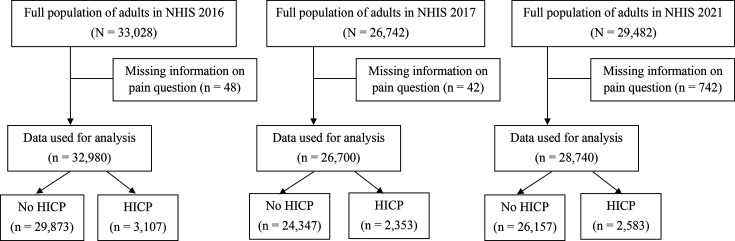
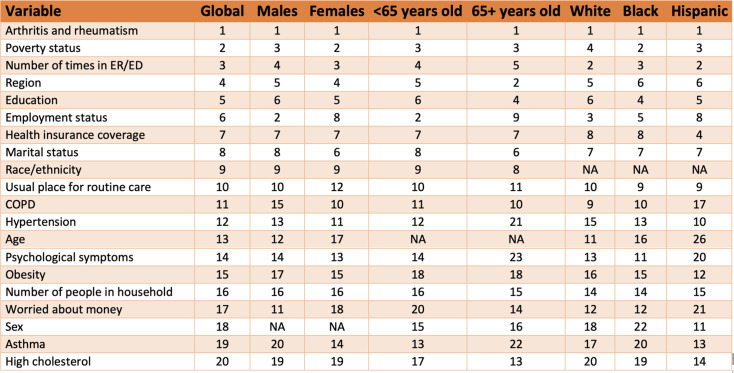
Methods: We leveraged the National Health Interview Survey (NHIS) from 2016 (n=32,980), 2017 (n=26,700), and 2021 (n=28,740) to validate and develop analytical models for HICP. Initial models (2016 NHIS data) identified correlates associated with HICP, including hospital stays, diagnosis of specific diseases, psychological symptoms, and employment status. We assessed the models' generalizability and drew comparisons across time. We constructed five validation scenarios to account for variations in the availability of predictor variables across datasets and different time frames for pain assessment questions. We used logistic regression with LASSO and random forest techniques. We assessed model discrimination, calibration, and overall performance using metrics such as area under the curve (AUC), calibration slope, and Brier score.
Results: Scenario 1, validating the NHIS 2016 model against 2017 data, demonstrated excellent discrimination with an AUC of 0.89 (95% CI: 0.88-0.90) for both LASSO and random forest models. Subgroup-specific performance varied, with the lowest AUC among adults aged ≥65 years (0.81, 95% CI: 0.78-0.82) and the highest among Hispanic respondents (0.91, 95% CI: 0.88-0.94). Model calibration was generally robust, although underfitting was observed for Hispanic respondents (calibration slope: 1.31). Scenario 3, testing the NHIS 2016 model on 2021 data, showed reduced discrimination (AUC: 0.82, 95% CI: 0.81-0.83) and overfitting (calibration slopes < 1). De novo models based on 2021 data showed comparable discrimination (AUC: 0.86, 95% CI: 0.85-0.87) but poorer calibration when validated against older datasets.
Conclusion: These findings underscore the potential of these models to guide personalized medicine strategies for HICP, aiming for more preventive rather than reactive healthcare. However, the model's broader applicability requires further validation in varied settings and global populations.





 京公网安备 11010802042870号
京ICP备2023020795号-1
京公网安备 11010802042870号
京ICP备2023020795号-1

 分享
分享

 求助内容:
求助内容: 应助结果提醒方式:
 扫码关注我们
