Md Estak Ahmed, Richard J Staples, Thomas R Cundari, Timothy H Warren
{"title":"吡啶取代二茂铁电催化氨氧化研究。","authors":"Md Estak Ahmed, Richard J Staples, Thomas R Cundari, Timothy H Warren","doi":"10.1021/jacs.4c14483","DOIUrl":null,"url":null,"abstract":"<p><p>Ammonia (NH<sub>3</sub>) is a promising carbon-free fuel when prepared from sustainable resources. First-row transition metal electrocatalysts for ammonia oxidation are an enabling technology for sustainable energy production. We describe electrocatalytic ammonia oxidation using robust molecular complexes based on Earth-abundant iron. Electrochemical studies of ferrocenes with covalently attached pyridine arms reveal facile ammonia oxidation in DMSO (2.4 M NH<sub>3</sub>) with modest overpotentials (η = 770-820 mV) and turnover frequencies (125-560 h<sup>-1</sup>). Experimental and computational studies indicate that the pendant pyridyl base serves as an H-bond acceptor with an N-H bond of ammonia that transfers a proton to the pyridine following oxidation by the attached ferrocenium moiety in a proton-coupled electron transfer (PCET) step. This generates an amidyl (<sup>•</sup>NH<sub>2</sub>) radical stabilized via H-bonding to a pendant pyridinium moiety that rapidly dimerizes to hydrazine (H<sub>2</sub>N-NH<sub>2</sub>), which is easily oxidized to nitrogen (N<sub>2</sub>) at the glassy carbon working electrode. This report identifies a general strategy to oxidize ammonia via H-bonding to a base (B:), thereby activating [B···H-NH<sub>2</sub>] toward PCET by a proximal oxidant to form [BH···NH<sub>2</sub>]<sup>+/•</sup> radical cations, which are susceptible to dimerization to form easily oxidized hydrazine.</p>","PeriodicalId":49,"journal":{"name":"Journal of the American Chemical Society","volume":" ","pages":"6514-6522"},"PeriodicalIF":16.6000,"publicationDate":"2025-02-26","publicationTypes":"Journal Article","fieldsOfStudy":null,"isOpenAccess":false,"openAccessPdf":"https://www.ncbi.nlm.nih.gov/pmc/articles/PMC11869277/pdf/","citationCount":"0","resultStr":"{\"title\":\"Electrocatalytic Ammonia Oxidation by Pyridyl-Substituted Ferrocenes.\",\"authors\":\"Md Estak Ahmed, Richard J Staples, Thomas R Cundari, Timothy H Warren\",\"doi\":\"10.1021/jacs.4c14483\",\"DOIUrl\":null,\"url\":null,\"abstract\":\"<p><p>Ammonia (NH<sub>3</sub>) is a promising carbon-free fuel when prepared from sustainable resources. First-row transition metal electrocatalysts for ammonia oxidation are an enabling technology for sustainable energy production. We describe electrocatalytic ammonia oxidation using robust molecular complexes based on Earth-abundant iron. Electrochemical studies of ferrocenes with covalently attached pyridine arms reveal facile ammonia oxidation in DMSO (2.4 M NH<sub>3</sub>) with modest overpotentials (η = 770-820 mV) and turnover frequencies (125-560 h<sup>-1</sup>). Experimental and computational studies indicate that the pendant pyridyl base serves as an H-bond acceptor with an N-H bond of ammonia that transfers a proton to the pyridine following oxidation by the attached ferrocenium moiety in a proton-coupled electron transfer (PCET) step. This generates an amidyl (<sup>•</sup>NH<sub>2</sub>) radical stabilized via H-bonding to a pendant pyridinium moiety that rapidly dimerizes to hydrazine (H<sub>2</sub>N-NH<sub>2</sub>), which is easily oxidized to nitrogen (N<sub>2</sub>) at the glassy carbon working electrode. This report identifies a general strategy to oxidize ammonia via H-bonding to a base (B:), thereby activating [B···H-NH<sub>2</sub>] toward PCET by a proximal oxidant to form [BH···NH<sub>2</sub>]<sup>+/•</sup> radical cations, which are susceptible to dimerization to form easily oxidized hydrazine.</p>\",\"PeriodicalId\":49,\"journal\":{\"name\":\"Journal of the American Chemical Society\",\"volume\":\" \",\"pages\":\"6514-6522\"},\"PeriodicalIF\":16.6000,\"publicationDate\":\"2025-02-26\",\"publicationTypes\":\"Journal Article\",\"fieldsOfStudy\":null,\"isOpenAccess\":false,\"openAccessPdf\":\"https://www.ncbi.nlm.nih.gov/pmc/articles/PMC11869277/pdf/\",\"citationCount\":\"0\",\"resultStr\":null,\"platform\":\"Semanticscholar\",\"paperid\":null,\"PeriodicalName\":\"Journal of the American Chemical Society\",\"FirstCategoryId\":\"92\",\"ListUrlMain\":\"https://doi.org/10.1021/jacs.4c14483\",\"RegionNum\":1,\"RegionCategory\":\"化学\",\"ArticlePicture\":[],\"TitleCN\":null,\"AbstractTextCN\":null,\"PMCID\":null,\"EPubDate\":\"2025/2/14 0:00:00\",\"PubModel\":\"Epub\",\"JCR\":\"Q1\",\"JCRName\":\"CHEMISTRY, MULTIDISCIPLINARY\",\"Score\":null,\"Total\":0}","platform":"Semanticscholar","paperid":null,"PeriodicalName":"Journal of the American Chemical Society","FirstCategoryId":"92","ListUrlMain":"https://doi.org/10.1021/jacs.4c14483","RegionNum":1,"RegionCategory":"化学","ArticlePicture":[],"TitleCN":null,"AbstractTextCN":null,"PMCID":null,"EPubDate":"2025/2/14 0:00:00","PubModel":"Epub","JCR":"Q1","JCRName":"CHEMISTRY, MULTIDISCIPLINARY","Score":null,"Total":0}
Electrocatalytic Ammonia Oxidation by Pyridyl-Substituted Ferrocenes.
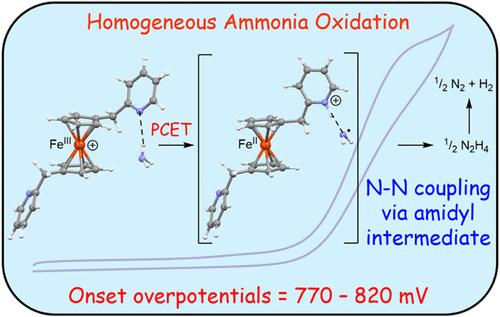
Ammonia (NH3) is a promising carbon-free fuel when prepared from sustainable resources. First-row transition metal electrocatalysts for ammonia oxidation are an enabling technology for sustainable energy production. We describe electrocatalytic ammonia oxidation using robust molecular complexes based on Earth-abundant iron. Electrochemical studies of ferrocenes with covalently attached pyridine arms reveal facile ammonia oxidation in DMSO (2.4 M NH3) with modest overpotentials (η = 770-820 mV) and turnover frequencies (125-560 h-1). Experimental and computational studies indicate that the pendant pyridyl base serves as an H-bond acceptor with an N-H bond of ammonia that transfers a proton to the pyridine following oxidation by the attached ferrocenium moiety in a proton-coupled electron transfer (PCET) step. This generates an amidyl (•NH2) radical stabilized via H-bonding to a pendant pyridinium moiety that rapidly dimerizes to hydrazine (H2N-NH2), which is easily oxidized to nitrogen (N2) at the glassy carbon working electrode. This report identifies a general strategy to oxidize ammonia via H-bonding to a base (B:), thereby activating [B···H-NH2] toward PCET by a proximal oxidant to form [BH···NH2]+/• radical cations, which are susceptible to dimerization to form easily oxidized hydrazine.
期刊介绍:
The flagship journal of the American Chemical Society, known as the Journal of the American Chemical Society (JACS), has been a prestigious publication since its establishment in 1879. It holds a preeminent position in the field of chemistry and related interdisciplinary sciences. JACS is committed to disseminating cutting-edge research papers, covering a wide range of topics, and encompasses approximately 19,000 pages of Articles, Communications, and Perspectives annually. With a weekly publication frequency, JACS plays a vital role in advancing the field of chemistry by providing essential research.




 京公网安备 11010802042870号
京ICP备2023020795号-1
京公网安备 11010802042870号
京ICP备2023020795号-1

 分享
分享
 求助内容:
求助内容: 应助结果提醒方式:
 扫码关注我们
