Ya Gao , Jing Zhang , Yirong Wang , Qingtao Jiang , Xingli Zou , Xionggang Lu , Mohd Ubaidullah , Reinaldo F. Teófilo , Yufeng Zhao
{"title":"单个锌原子和分层孔结构共同提高了氧还原电催化性能","authors":"Ya Gao , Jing Zhang , Yirong Wang , Qingtao Jiang , Xingli Zou , Xionggang Lu , Mohd Ubaidullah , Reinaldo F. Teófilo , Yufeng Zhao","doi":"10.1016/j.ces.2025.121376","DOIUrl":null,"url":null,"abstract":"<div><div>Investigations on high-efficiency single atom catalysts (SACs) for oxygen reduction reaction (ORR) have aroused widespread concern, particularly for transition metals. However, the inherent catalytic performance is greatly affected by metal types and pore structure of carbon substrates. Herein, a non-noble Zn-based single-atom electrocatalyst (Zn-N-C) is proposed and confirmed that atomically dispersed Zn is anchored onto the amply micro/mesoporous support decorated with nitrogen doping. Benefit from the pore structure and single-atom site, Zn-N-C reveals superior ORR behavior with high <em>E<sub>1/2</sub></em> (0.874 V) and low Tafel slope (68.8 mV dec<sup>-1</sup>) in 0.1 M KOH, markedly surpassing state-of-the-art Pt/C. EXAFS and DFT results show that Zn-N<sub>4</sub> coordination configuration decreases the free energies of oxygen-containing intermediates (*OOH and *OH) and the theoretical overpotential is as low as 0.45 eV. As a result, the self-assembled Zn-air battery performs well in peak power density (226.4 mW cm<sup>−2</sup>), specific capacity (746.4 mAh g<sup>−1</sup>) and long-term durability.</div></div>","PeriodicalId":271,"journal":{"name":"Chemical Engineering Science","volume":"307 ","pages":"Article 121376"},"PeriodicalIF":4.3000,"publicationDate":"2025-03-15","publicationTypes":"Journal Article","fieldsOfStudy":null,"isOpenAccess":false,"openAccessPdf":"","citationCount":"0","resultStr":"{\"title\":\"Single Zn atoms and hierarchical pore architecture jointly improve oxygen reduction electrocatalysis\",\"authors\":\"Ya Gao , Jing Zhang , Yirong Wang , Qingtao Jiang , Xingli Zou , Xionggang Lu , Mohd Ubaidullah , Reinaldo F. Teófilo , Yufeng Zhao\",\"doi\":\"10.1016/j.ces.2025.121376\",\"DOIUrl\":null,\"url\":null,\"abstract\":\"<div><div>Investigations on high-efficiency single atom catalysts (SACs) for oxygen reduction reaction (ORR) have aroused widespread concern, particularly for transition metals. However, the inherent catalytic performance is greatly affected by metal types and pore structure of carbon substrates. Herein, a non-noble Zn-based single-atom electrocatalyst (Zn-N-C) is proposed and confirmed that atomically dispersed Zn is anchored onto the amply micro/mesoporous support decorated with nitrogen doping. Benefit from the pore structure and single-atom site, Zn-N-C reveals superior ORR behavior with high <em>E<sub>1/2</sub></em> (0.874 V) and low Tafel slope (68.8 mV dec<sup>-1</sup>) in 0.1 M KOH, markedly surpassing state-of-the-art Pt/C. EXAFS and DFT results show that Zn-N<sub>4</sub> coordination configuration decreases the free energies of oxygen-containing intermediates (*OOH and *OH) and the theoretical overpotential is as low as 0.45 eV. As a result, the self-assembled Zn-air battery performs well in peak power density (226.4 mW cm<sup>−2</sup>), specific capacity (746.4 mAh g<sup>−1</sup>) and long-term durability.</div></div>\",\"PeriodicalId\":271,\"journal\":{\"name\":\"Chemical Engineering Science\",\"volume\":\"307 \",\"pages\":\"Article 121376\"},\"PeriodicalIF\":4.3000,\"publicationDate\":\"2025-03-15\",\"publicationTypes\":\"Journal Article\",\"fieldsOfStudy\":null,\"isOpenAccess\":false,\"openAccessPdf\":\"\",\"citationCount\":\"0\",\"resultStr\":null,\"platform\":\"Semanticscholar\",\"paperid\":null,\"PeriodicalName\":\"Chemical Engineering Science\",\"FirstCategoryId\":\"5\",\"ListUrlMain\":\"https://www.sciencedirect.com/science/article/pii/S000925092500199X\",\"RegionNum\":2,\"RegionCategory\":\"工程技术\",\"ArticlePicture\":[],\"TitleCN\":null,\"AbstractTextCN\":null,\"PMCID\":null,\"EPubDate\":\"2025/2/15 0:00:00\",\"PubModel\":\"Epub\",\"JCR\":\"Q2\",\"JCRName\":\"ENGINEERING, CHEMICAL\",\"Score\":null,\"Total\":0}","platform":"Semanticscholar","paperid":null,"PeriodicalName":"Chemical Engineering Science","FirstCategoryId":"5","ListUrlMain":"https://www.sciencedirect.com/science/article/pii/S000925092500199X","RegionNum":2,"RegionCategory":"工程技术","ArticlePicture":[],"TitleCN":null,"AbstractTextCN":null,"PMCID":null,"EPubDate":"2025/2/15 0:00:00","PubModel":"Epub","JCR":"Q2","JCRName":"ENGINEERING, CHEMICAL","Score":null,"Total":0}
引用次数: 0
摘要
氧还原反应(ORR)中高效单原子催化剂(SACs)的研究引起了人们的广泛关注,尤其是过渡金属催化剂。然而,其固有的催化性能受碳基体的金属类型和孔隙结构的影响很大。本文提出了一种非贵金属锌基单原子电催化剂(Zn- n- c),并证实了原子分散的Zn被锚定在氮掺杂修饰的充足的微/介孔载体上。得益于孔隙结构和单原子位置,Zn-N-C在0.1 M KOH下表现出优异的ORR行为,具有高E1/2 v(0.874 v)和低Tafel斜率(68.8 mV dec1),明显优于目前最先进的Pt/C。EXAFS和DFT结果表明,Zn-N4配位构型降低了含氧中间体(*OOH和*OH)的自由能,理论过电位低至0.45 eV。结果表明,自组装锌空气电池在峰值功率密度(226.4 mW cm−2)、比容量(746.4 mAh g−1)和长期耐用性方面表现良好。
Single Zn atoms and hierarchical pore architecture jointly improve oxygen reduction electrocatalysis
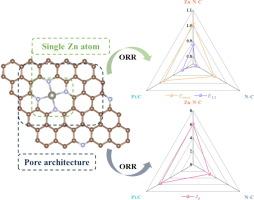
Investigations on high-efficiency single atom catalysts (SACs) for oxygen reduction reaction (ORR) have aroused widespread concern, particularly for transition metals. However, the inherent catalytic performance is greatly affected by metal types and pore structure of carbon substrates. Herein, a non-noble Zn-based single-atom electrocatalyst (Zn-N-C) is proposed and confirmed that atomically dispersed Zn is anchored onto the amply micro/mesoporous support decorated with nitrogen doping. Benefit from the pore structure and single-atom site, Zn-N-C reveals superior ORR behavior with high E1/2 (0.874 V) and low Tafel slope (68.8 mV dec-1) in 0.1 M KOH, markedly surpassing state-of-the-art Pt/C. EXAFS and DFT results show that Zn-N4 coordination configuration decreases the free energies of oxygen-containing intermediates (*OOH and *OH) and the theoretical overpotential is as low as 0.45 eV. As a result, the self-assembled Zn-air battery performs well in peak power density (226.4 mW cm−2), specific capacity (746.4 mAh g−1) and long-term durability.
期刊介绍:
Chemical engineering enables the transformation of natural resources and energy into useful products for society. It draws on and applies natural sciences, mathematics and economics, and has developed fundamental engineering science that underpins the discipline.
Chemical Engineering Science (CES) has been publishing papers on the fundamentals of chemical engineering since 1951. CES is the platform where the most significant advances in the discipline have ever since been published. Chemical Engineering Science has accompanied and sustained chemical engineering through its development into the vibrant and broad scientific discipline it is today.





 京公网安备 11010802042870号
京ICP备2023020795号-1
京公网安备 11010802042870号
京ICP备2023020795号-1

 分享
分享
 求助内容:
求助内容: 应助结果提醒方式:
 扫码关注我们
