Chiara Bosetti , Dionysis Kampasis , Shoshy A. Brinch , Albert Galera-Prat , Maria Karelou , Saurabh S. Dhakar , Juho Alaviuhkola , Jo Waaler , Lari Lehtiö , Ioannis K. Kostakis
{"title":"喹唑啉-4-酮的C-8位取代提高了烟酰胺位点结合罐酶抑制剂的效价","authors":"Chiara Bosetti , Dionysis Kampasis , Shoshy A. Brinch , Albert Galera-Prat , Maria Karelou , Saurabh S. Dhakar , Juho Alaviuhkola , Jo Waaler , Lari Lehtiö , Ioannis K. Kostakis","doi":"10.1016/j.ejmech.2025.117397","DOIUrl":null,"url":null,"abstract":"<div><div>Human diphtheria toxin-like ADP-ribosyltransferases, PARPs and tankyrases, transfer ADP-ribosyl groups to other macromolecules, thereby controlling various signaling events in cells. They are considered promising drug targets, especially in oncology, and a vast number of inhibitors have already been successfully developed. These inhibitors typically occupy the nicotinamide binding site and extend along the NAD<sup>+</sup> binding groove of the catalytic domain. Quinazolin-4-ones have been explored as compelling scaffolds for such inhibitors and we have identified a new position within the catalytic domain that has not been extensively studied yet. In this study, we investigate larger substituents at the C-8 position and, using X-ray crystallography, we demonstrate that nitro- and diol-substituents engage in new interactions with TNKS2, improving both affinity and selectivity. Both diol- and nitro-substituents exhibit intriguing inhibition of TNKS2, with the diol-based compound <strong>EXQ-1e</strong> displaying a pIC<sub>50</sub> of 7.19, while the nitro-based compound <strong>EXQ-2d</strong>'s pIC<sub>50</sub> value is 7.86. Both analogues impact and attenuate the tankyrase-controlled WNT/β-catenin signaling with sub-micromolar IC<sub>50</sub>. When tested against a wider panel of enzymes, the nitro-based compound <strong>EXQ-2d</strong> displayed high selectivity towards tankyrases, whereas the diol-based compound <strong>EXQ-1e</strong> also inhibited other PARPs. Compound <strong>EXQ-2d</strong> displays <em>in vitro</em> cell growth inhibition of the colon cancer cell line COLO 320DM, while compound <strong>EXQ-1e</strong> displays nonspecific cell toxicity. Collectively, the results offer new insights for inhibitor development targeting tankyrases and PARPs by focusing on the subsite between a mobile active site loop and the canonical nicotinamide binding site.</div></div>","PeriodicalId":314,"journal":{"name":"European Journal of Medicinal Chemistry","volume":"288 ","pages":"Article 117397"},"PeriodicalIF":6.7000,"publicationDate":"2025-04-15","publicationTypes":"Journal Article","fieldsOfStudy":null,"isOpenAccess":false,"openAccessPdf":"","citationCount":"0","resultStr":"{\"title\":\"Substitutions at the C-8 position of quinazolin-4-ones improve the potency of nicotinamide site binding tankyrase inhibitors\",\"authors\":\"Chiara Bosetti , Dionysis Kampasis , Shoshy A. Brinch , Albert Galera-Prat , Maria Karelou , Saurabh S. Dhakar , Juho Alaviuhkola , Jo Waaler , Lari Lehtiö , Ioannis K. Kostakis\",\"doi\":\"10.1016/j.ejmech.2025.117397\",\"DOIUrl\":null,\"url\":null,\"abstract\":\"<div><div>Human diphtheria toxin-like ADP-ribosyltransferases, PARPs and tankyrases, transfer ADP-ribosyl groups to other macromolecules, thereby controlling various signaling events in cells. They are considered promising drug targets, especially in oncology, and a vast number of inhibitors have already been successfully developed. These inhibitors typically occupy the nicotinamide binding site and extend along the NAD<sup>+</sup> binding groove of the catalytic domain. Quinazolin-4-ones have been explored as compelling scaffolds for such inhibitors and we have identified a new position within the catalytic domain that has not been extensively studied yet. In this study, we investigate larger substituents at the C-8 position and, using X-ray crystallography, we demonstrate that nitro- and diol-substituents engage in new interactions with TNKS2, improving both affinity and selectivity. Both diol- and nitro-substituents exhibit intriguing inhibition of TNKS2, with the diol-based compound <strong>EXQ-1e</strong> displaying a pIC<sub>50</sub> of 7.19, while the nitro-based compound <strong>EXQ-2d</strong>'s pIC<sub>50</sub> value is 7.86. Both analogues impact and attenuate the tankyrase-controlled WNT/β-catenin signaling with sub-micromolar IC<sub>50</sub>. When tested against a wider panel of enzymes, the nitro-based compound <strong>EXQ-2d</strong> displayed high selectivity towards tankyrases, whereas the diol-based compound <strong>EXQ-1e</strong> also inhibited other PARPs. Compound <strong>EXQ-2d</strong> displays <em>in vitro</em> cell growth inhibition of the colon cancer cell line COLO 320DM, while compound <strong>EXQ-1e</strong> displays nonspecific cell toxicity. Collectively, the results offer new insights for inhibitor development targeting tankyrases and PARPs by focusing on the subsite between a mobile active site loop and the canonical nicotinamide binding site.</div></div>\",\"PeriodicalId\":314,\"journal\":{\"name\":\"European Journal of Medicinal Chemistry\",\"volume\":\"288 \",\"pages\":\"Article 117397\"},\"PeriodicalIF\":6.7000,\"publicationDate\":\"2025-04-15\",\"publicationTypes\":\"Journal Article\",\"fieldsOfStudy\":null,\"isOpenAccess\":false,\"openAccessPdf\":\"\",\"citationCount\":\"0\",\"resultStr\":null,\"platform\":\"Semanticscholar\",\"paperid\":null,\"PeriodicalName\":\"European Journal of Medicinal Chemistry\",\"FirstCategoryId\":\"3\",\"ListUrlMain\":\"https://www.sciencedirect.com/science/article/pii/S022352342500162X\",\"RegionNum\":2,\"RegionCategory\":\"医学\",\"ArticlePicture\":[],\"TitleCN\":null,\"AbstractTextCN\":null,\"PMCID\":null,\"EPubDate\":\"2025/2/15 0:00:00\",\"PubModel\":\"Epub\",\"JCR\":\"Q1\",\"JCRName\":\"CHEMISTRY, MEDICINAL\",\"Score\":null,\"Total\":0}","platform":"Semanticscholar","paperid":null,"PeriodicalName":"European Journal of Medicinal Chemistry","FirstCategoryId":"3","ListUrlMain":"https://www.sciencedirect.com/science/article/pii/S022352342500162X","RegionNum":2,"RegionCategory":"医学","ArticlePicture":[],"TitleCN":null,"AbstractTextCN":null,"PMCID":null,"EPubDate":"2025/2/15 0:00:00","PubModel":"Epub","JCR":"Q1","JCRName":"CHEMISTRY, MEDICINAL","Score":null,"Total":0}
Substitutions at the C-8 position of quinazolin-4-ones improve the potency of nicotinamide site binding tankyrase inhibitors
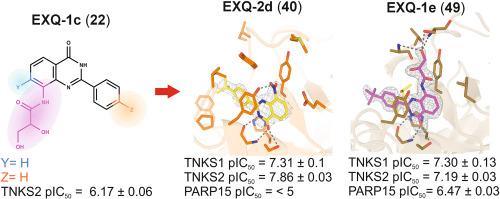
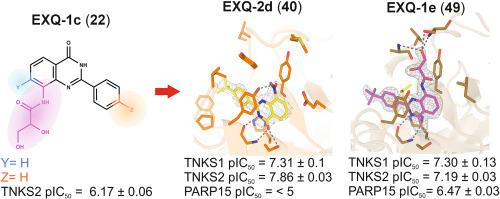
Human diphtheria toxin-like ADP-ribosyltransferases, PARPs and tankyrases, transfer ADP-ribosyl groups to other macromolecules, thereby controlling various signaling events in cells. They are considered promising drug targets, especially in oncology, and a vast number of inhibitors have already been successfully developed. These inhibitors typically occupy the nicotinamide binding site and extend along the NAD+ binding groove of the catalytic domain. Quinazolin-4-ones have been explored as compelling scaffolds for such inhibitors and we have identified a new position within the catalytic domain that has not been extensively studied yet. In this study, we investigate larger substituents at the C-8 position and, using X-ray crystallography, we demonstrate that nitro- and diol-substituents engage in new interactions with TNKS2, improving both affinity and selectivity. Both diol- and nitro-substituents exhibit intriguing inhibition of TNKS2, with the diol-based compound EXQ-1e displaying a pIC50 of 7.19, while the nitro-based compound EXQ-2d's pIC50 value is 7.86. Both analogues impact and attenuate the tankyrase-controlled WNT/β-catenin signaling with sub-micromolar IC50. When tested against a wider panel of enzymes, the nitro-based compound EXQ-2d displayed high selectivity towards tankyrases, whereas the diol-based compound EXQ-1e also inhibited other PARPs. Compound EXQ-2d displays in vitro cell growth inhibition of the colon cancer cell line COLO 320DM, while compound EXQ-1e displays nonspecific cell toxicity. Collectively, the results offer new insights for inhibitor development targeting tankyrases and PARPs by focusing on the subsite between a mobile active site loop and the canonical nicotinamide binding site.
期刊介绍:
The European Journal of Medicinal Chemistry is a global journal that publishes studies on all aspects of medicinal chemistry. It provides a medium for publication of original papers and also welcomes critical review papers.
A typical paper would report on the organic synthesis, characterization and pharmacological evaluation of compounds. Other topics of interest are drug design, QSAR, molecular modeling, drug-receptor interactions, molecular aspects of drug metabolism, prodrug synthesis and drug targeting. The journal expects manuscripts to present the rational for a study, provide insight into the design of compounds or understanding of mechanism, or clarify the targets.




 京公网安备 11010802042870号
京ICP备2023020795号-1
京公网安备 11010802042870号
京ICP备2023020795号-1

 分享
分享
 求助内容:
求助内容: 应助结果提醒方式:
 扫码关注我们
