Steffen Kümmel, Cecilie F. Ottosen, Mikael E. Olsson, Mette M. Broholm, Poul L. Bjerg, Hans H. Richnow
{"title":"磺胺嘧啶δ13C和δ34S同位素分析方法的建立及其在地下水系统中痕量污染物转化的潜力","authors":"Steffen Kümmel, Cecilie F. Ottosen, Mikael E. Olsson, Mette M. Broholm, Poul L. Bjerg, Hans H. Richnow","doi":"10.1021/acs.analchem.4c05625","DOIUrl":null,"url":null,"abstract":"The widespread occurrence of micropollutants like the antibiotic sulfadimidine in the environment has become a growing concern. Compound-specific stable isotope analysis (CSIA) offers a powerful tool for tracking the fate of such pollutants, but its application is often limited by low sensitivity. To address this limitation, a large-scale solid-phase extraction method was developed to extract, enrich, and isolate sulfadimidine for δ<sup>13</sup>C- and δ<sup>34</sup>S-CSIA. Each step of the method was carefully evaluated, ensuring no detectable isotope artifacts. The limit of quantification was determined as 1.1 nmol of carbon and 1.2 nmol of sulfur directly injected on the column. Applied to groundwater samples from a contaminated site in Denmark, the method allowed for the analysis of concentrations as low as 0.17 mg/L, with a concentration factor of up to 10,000 used to enrich sulfadimidine. This is the first study to analyze δ<sup>13</sup>C and δ<sup>34</sup>S for sulfadimidine in aquifer water samples and highlights the potential of CSIA for tracking sulfadimidine transformations in contaminated water environments.","PeriodicalId":27,"journal":{"name":"Analytical Chemistry","volume":"80 1","pages":""},"PeriodicalIF":7.3000,"publicationDate":"2025-02-14","publicationTypes":"Journal Article","fieldsOfStudy":null,"isOpenAccess":false,"openAccessPdf":"","citationCount":"0","resultStr":"{\"title\":\"Development of a δ13C and δ34S Isotope Analysis Method for Sulfadimidine and Its Potential to Trace Contaminant Transformation in Groundwater Systems\",\"authors\":\"Steffen Kümmel, Cecilie F. Ottosen, Mikael E. Olsson, Mette M. Broholm, Poul L. Bjerg, Hans H. Richnow\",\"doi\":\"10.1021/acs.analchem.4c05625\",\"DOIUrl\":null,\"url\":null,\"abstract\":\"The widespread occurrence of micropollutants like the antibiotic sulfadimidine in the environment has become a growing concern. Compound-specific stable isotope analysis (CSIA) offers a powerful tool for tracking the fate of such pollutants, but its application is often limited by low sensitivity. To address this limitation, a large-scale solid-phase extraction method was developed to extract, enrich, and isolate sulfadimidine for δ<sup>13</sup>C- and δ<sup>34</sup>S-CSIA. Each step of the method was carefully evaluated, ensuring no detectable isotope artifacts. The limit of quantification was determined as 1.1 nmol of carbon and 1.2 nmol of sulfur directly injected on the column. Applied to groundwater samples from a contaminated site in Denmark, the method allowed for the analysis of concentrations as low as 0.17 mg/L, with a concentration factor of up to 10,000 used to enrich sulfadimidine. This is the first study to analyze δ<sup>13</sup>C and δ<sup>34</sup>S for sulfadimidine in aquifer water samples and highlights the potential of CSIA for tracking sulfadimidine transformations in contaminated water environments.\",\"PeriodicalId\":27,\"journal\":{\"name\":\"Analytical Chemistry\",\"volume\":\"80 1\",\"pages\":\"\"},\"PeriodicalIF\":7.3000,\"publicationDate\":\"2025-02-14\",\"publicationTypes\":\"Journal Article\",\"fieldsOfStudy\":null,\"isOpenAccess\":false,\"openAccessPdf\":\"\",\"citationCount\":\"0\",\"resultStr\":null,\"platform\":\"Semanticscholar\",\"paperid\":null,\"PeriodicalName\":\"Analytical Chemistry\",\"FirstCategoryId\":\"92\",\"ListUrlMain\":\"https://doi.org/10.1021/acs.analchem.4c05625\",\"RegionNum\":1,\"RegionCategory\":\"化学\",\"ArticlePicture\":[],\"TitleCN\":null,\"AbstractTextCN\":null,\"PMCID\":null,\"EPubDate\":\"\",\"PubModel\":\"\",\"JCR\":\"Q1\",\"JCRName\":\"CHEMISTRY, ANALYTICAL\",\"Score\":null,\"Total\":0}","platform":"Semanticscholar","paperid":null,"PeriodicalName":"Analytical Chemistry","FirstCategoryId":"92","ListUrlMain":"https://doi.org/10.1021/acs.analchem.4c05625","RegionNum":1,"RegionCategory":"化学","ArticlePicture":[],"TitleCN":null,"AbstractTextCN":null,"PMCID":null,"EPubDate":"","PubModel":"","JCR":"Q1","JCRName":"CHEMISTRY, ANALYTICAL","Score":null,"Total":0}
Development of a δ13C and δ34S Isotope Analysis Method for Sulfadimidine and Its Potential to Trace Contaminant Transformation in Groundwater Systems
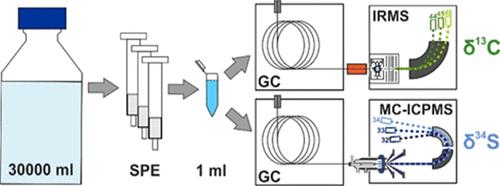
The widespread occurrence of micropollutants like the antibiotic sulfadimidine in the environment has become a growing concern. Compound-specific stable isotope analysis (CSIA) offers a powerful tool for tracking the fate of such pollutants, but its application is often limited by low sensitivity. To address this limitation, a large-scale solid-phase extraction method was developed to extract, enrich, and isolate sulfadimidine for δ13C- and δ34S-CSIA. Each step of the method was carefully evaluated, ensuring no detectable isotope artifacts. The limit of quantification was determined as 1.1 nmol of carbon and 1.2 nmol of sulfur directly injected on the column. Applied to groundwater samples from a contaminated site in Denmark, the method allowed for the analysis of concentrations as low as 0.17 mg/L, with a concentration factor of up to 10,000 used to enrich sulfadimidine. This is the first study to analyze δ13C and δ34S for sulfadimidine in aquifer water samples and highlights the potential of CSIA for tracking sulfadimidine transformations in contaminated water environments.
期刊介绍:
Analytical Chemistry, a peer-reviewed research journal, focuses on disseminating new and original knowledge across all branches of analytical chemistry. Fundamental articles may explore general principles of chemical measurement science and need not directly address existing or potential analytical methodology. They can be entirely theoretical or report experimental results. Contributions may cover various phases of analytical operations, including sampling, bioanalysis, electrochemistry, mass spectrometry, microscale and nanoscale systems, environmental analysis, separations, spectroscopy, chemical reactions and selectivity, instrumentation, imaging, surface analysis, and data processing. Papers discussing known analytical methods should present a significant, original application of the method, a notable improvement, or results on an important analyte.




 京公网安备 11010802042870号
京ICP备2023020795号-1
京公网安备 11010802042870号
京ICP备2023020795号-1

 分享
分享
 求助内容:
求助内容: 应助结果提醒方式:
 扫码关注我们
