Lin Zhu, Yaorong He, Hui Huang, Wei Zhao, Tong Su, Xiao Wang, Shengya Zhang, Peiyao Du, Xiaoquan Lu
{"title":"氧空位和零偏铁电极化辅助下异质结中PEC活性的协同增强:机制研究和超灵敏检测的实现","authors":"Lin Zhu, Yaorong He, Hui Huang, Wei Zhao, Tong Su, Xiao Wang, Shengya Zhang, Peiyao Du, Xiaoquan Lu","doi":"10.1021/acs.analchem.4c06538","DOIUrl":null,"url":null,"abstract":"The utilization of ferroelectric polarization-assisted photoelectrochemical (PEC) systems holds huge promise for solving the issue of high recombination of photogenerated electron–hole pairs. Monitoring their intricate charge-transfer process can offer profound insights into the advancement of highly active photoelectrodes. In this work, the hydrothermally synthesized titanium dioxide nanorod arrays (TiO<sub>2</sub> NRAs) are subjected to <i>in situ</i> etching to introduce oxygen vacancies (Ov), and subsequently loaded with barium titanate (BaTiO<sub>3</sub>, BTO) nanoparticles to form a ferroelectric polarization effect-assisted type-II heterojunction. The resulting Ov-TiO<sub>2</sub>/BTO demonstrates an ultrahigh photocurrent of 102 μA and outstanding stability over 7200 s, far surpassing majority of recently reported PEC photoanodes operating at a bias voltage of 0 V (vs Ag/AgCl). Notably, the photoinduced charge transfer in ferroelectric Ov-TiO<sub>2</sub>/BTO was monitored at the microscale by advanced scanning photoelectrochemical microscopy (SPECM). As a showcase, the aptamer-coupled self-powered PEC biosensor for kanamycin presents excellent sensitivity and good anti-interference ability. This study not only elucidates the intrinsic mechanism of the synergistic amplification of photoelectric signals by oxygen vacancies and ferroelectric heterojunctions but also provides a reliable platform for the ultrasensitive detection of biological molecules.","PeriodicalId":27,"journal":{"name":"Analytical Chemistry","volume":"105 1","pages":""},"PeriodicalIF":7.3000,"publicationDate":"2025-02-14","publicationTypes":"Journal Article","fieldsOfStudy":null,"isOpenAccess":false,"openAccessPdf":"","citationCount":"0","resultStr":"{\"title\":\"Synergistic Enhancement of PEC Activity in Heterojunction Assisted by Oxygen Vacancies and Ferroelectric Polarization at Zero Bias: Mechanism Study and Achievement of Ultrasensitive Detection\",\"authors\":\"Lin Zhu, Yaorong He, Hui Huang, Wei Zhao, Tong Su, Xiao Wang, Shengya Zhang, Peiyao Du, Xiaoquan Lu\",\"doi\":\"10.1021/acs.analchem.4c06538\",\"DOIUrl\":null,\"url\":null,\"abstract\":\"The utilization of ferroelectric polarization-assisted photoelectrochemical (PEC) systems holds huge promise for solving the issue of high recombination of photogenerated electron–hole pairs. Monitoring their intricate charge-transfer process can offer profound insights into the advancement of highly active photoelectrodes. In this work, the hydrothermally synthesized titanium dioxide nanorod arrays (TiO<sub>2</sub> NRAs) are subjected to <i>in situ</i> etching to introduce oxygen vacancies (Ov), and subsequently loaded with barium titanate (BaTiO<sub>3</sub>, BTO) nanoparticles to form a ferroelectric polarization effect-assisted type-II heterojunction. The resulting Ov-TiO<sub>2</sub>/BTO demonstrates an ultrahigh photocurrent of 102 μA and outstanding stability over 7200 s, far surpassing majority of recently reported PEC photoanodes operating at a bias voltage of 0 V (vs Ag/AgCl). Notably, the photoinduced charge transfer in ferroelectric Ov-TiO<sub>2</sub>/BTO was monitored at the microscale by advanced scanning photoelectrochemical microscopy (SPECM). As a showcase, the aptamer-coupled self-powered PEC biosensor for kanamycin presents excellent sensitivity and good anti-interference ability. This study not only elucidates the intrinsic mechanism of the synergistic amplification of photoelectric signals by oxygen vacancies and ferroelectric heterojunctions but also provides a reliable platform for the ultrasensitive detection of biological molecules.\",\"PeriodicalId\":27,\"journal\":{\"name\":\"Analytical Chemistry\",\"volume\":\"105 1\",\"pages\":\"\"},\"PeriodicalIF\":7.3000,\"publicationDate\":\"2025-02-14\",\"publicationTypes\":\"Journal Article\",\"fieldsOfStudy\":null,\"isOpenAccess\":false,\"openAccessPdf\":\"\",\"citationCount\":\"0\",\"resultStr\":null,\"platform\":\"Semanticscholar\",\"paperid\":null,\"PeriodicalName\":\"Analytical Chemistry\",\"FirstCategoryId\":\"92\",\"ListUrlMain\":\"https://doi.org/10.1021/acs.analchem.4c06538\",\"RegionNum\":1,\"RegionCategory\":\"化学\",\"ArticlePicture\":[],\"TitleCN\":null,\"AbstractTextCN\":null,\"PMCID\":null,\"EPubDate\":\"\",\"PubModel\":\"\",\"JCR\":\"Q1\",\"JCRName\":\"CHEMISTRY, ANALYTICAL\",\"Score\":null,\"Total\":0}","platform":"Semanticscholar","paperid":null,"PeriodicalName":"Analytical Chemistry","FirstCategoryId":"92","ListUrlMain":"https://doi.org/10.1021/acs.analchem.4c06538","RegionNum":1,"RegionCategory":"化学","ArticlePicture":[],"TitleCN":null,"AbstractTextCN":null,"PMCID":null,"EPubDate":"","PubModel":"","JCR":"Q1","JCRName":"CHEMISTRY, ANALYTICAL","Score":null,"Total":0}
引用次数: 0
摘要
利用铁电极化辅助光电化学(PEC)系统对解决光生电子-空穴对的高复合问题具有巨大的前景。监测其复杂的电荷转移过程可以为高活性光电极的发展提供深刻的见解。在这项工作中,水热合成的二氧化钛纳米棒阵列(TiO2 NRAs)进行原位蚀刻以引入氧空位(Ov),随后负载钛酸钡(BaTiO3, BTO)纳米颗粒形成铁电极化效应辅助的ii型异质结。得到的Ov-TiO2/BTO具有102 μA的超高光电流和7200 s的稳定性,远远超过了最近报道的大多数在0 V (vs Ag/AgCl)偏置电压下工作的PEC光阳极。值得注意的是,利用先进的扫描光电化学显微镜(SPECM)在微观尺度上监测了铁电Ov-TiO2/BTO的光致电荷转移。作为样板,配体耦合的自供电型PEC卡那霉素生物传感器具有优异的灵敏度和良好的抗干扰能力。本研究不仅阐明了氧空位和铁电异质结协同放大光电信号的内在机制,而且为生物分子的超灵敏检测提供了可靠的平台。
Synergistic Enhancement of PEC Activity in Heterojunction Assisted by Oxygen Vacancies and Ferroelectric Polarization at Zero Bias: Mechanism Study and Achievement of Ultrasensitive Detection
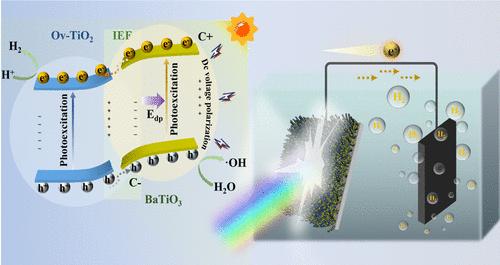
The utilization of ferroelectric polarization-assisted photoelectrochemical (PEC) systems holds huge promise for solving the issue of high recombination of photogenerated electron–hole pairs. Monitoring their intricate charge-transfer process can offer profound insights into the advancement of highly active photoelectrodes. In this work, the hydrothermally synthesized titanium dioxide nanorod arrays (TiO2 NRAs) are subjected to in situ etching to introduce oxygen vacancies (Ov), and subsequently loaded with barium titanate (BaTiO3, BTO) nanoparticles to form a ferroelectric polarization effect-assisted type-II heterojunction. The resulting Ov-TiO2/BTO demonstrates an ultrahigh photocurrent of 102 μA and outstanding stability over 7200 s, far surpassing majority of recently reported PEC photoanodes operating at a bias voltage of 0 V (vs Ag/AgCl). Notably, the photoinduced charge transfer in ferroelectric Ov-TiO2/BTO was monitored at the microscale by advanced scanning photoelectrochemical microscopy (SPECM). As a showcase, the aptamer-coupled self-powered PEC biosensor for kanamycin presents excellent sensitivity and good anti-interference ability. This study not only elucidates the intrinsic mechanism of the synergistic amplification of photoelectric signals by oxygen vacancies and ferroelectric heterojunctions but also provides a reliable platform for the ultrasensitive detection of biological molecules.
期刊介绍:
Analytical Chemistry, a peer-reviewed research journal, focuses on disseminating new and original knowledge across all branches of analytical chemistry. Fundamental articles may explore general principles of chemical measurement science and need not directly address existing or potential analytical methodology. They can be entirely theoretical or report experimental results. Contributions may cover various phases of analytical operations, including sampling, bioanalysis, electrochemistry, mass spectrometry, microscale and nanoscale systems, environmental analysis, separations, spectroscopy, chemical reactions and selectivity, instrumentation, imaging, surface analysis, and data processing. Papers discussing known analytical methods should present a significant, original application of the method, a notable improvement, or results on an important analyte.




 京公网安备 11010802042870号
京ICP备2023020795号-1
京公网安备 11010802042870号
京ICP备2023020795号-1

 分享
分享
 求助内容:
求助内容: 应助结果提醒方式:
 扫码关注我们
