Yaping Wang*, Yixin Zhou, Mingfei Chen, Li Wang and Yifang Zhang*,
{"title":"废锂离子电池阴极回收制备多金属磷化物用于高效析氧反应","authors":"Yaping Wang*, Yixin Zhou, Mingfei Chen, Li Wang and Yifang Zhang*, ","doi":"10.1021/acssuschemeng.4c08960","DOIUrl":null,"url":null,"abstract":"<p >Surge in lithium-ion battery (LIB) production predicts that massive spent LIBs will be produced in the future. Hence, rational utilization of spent LIBs is a win-win strategy to protect the environment, recycle resources, and reverse the dilemma of the current energy challenges. In this work, different decommissioned layered oxide cathodes were recovered and converted into a novel NiCoMn phosphides–nickel foam (NCM-P) electrode for the OER using acid leaching to extract valuable metals and then carrying out a hydrothermal process and phosphating. The enhanced inherent catalytic activity can be achieved by regulating intermetallic interactions with adjusting the stoichiometric ratio of transition metal. Additionally, the NCM 111-P catalyst obtained from the spent LiNi<sub>0.33</sub>Co<sub>0.33</sub>Mn<sub>0.33</sub>O<sub>2</sub> cathode has a special nanosheet–nanoneedle hierarchical structure, resulting in abundant active sites and stimulative detachment of gases in the OER course. Consequently, the NCM 111-P exhibits competitive catalytic performance (overpotential of 277 mV at 10 mA cm<sup>–2</sup>, electrolytic durability of 246 h). The research furnishes a positive way to recycle spent LIBs and promotes the development of electrolytic water.</p>","PeriodicalId":25,"journal":{"name":"ACS Sustainable Chemistry & Engineering","volume":"13 6","pages":"2477–2486 2477–2486"},"PeriodicalIF":7.3000,"publicationDate":"2025-02-06","publicationTypes":"Journal Article","fieldsOfStudy":null,"isOpenAccess":false,"openAccessPdf":"","citationCount":"0","resultStr":"{\"title\":\"Recycling Spent Lithium-Ion Battery Cathodes to Multimetallic Phosphides for High-Efficiency Oxygen Evolution Reaction\",\"authors\":\"Yaping Wang*, Yixin Zhou, Mingfei Chen, Li Wang and Yifang Zhang*, \",\"doi\":\"10.1021/acssuschemeng.4c08960\",\"DOIUrl\":null,\"url\":null,\"abstract\":\"<p >Surge in lithium-ion battery (LIB) production predicts that massive spent LIBs will be produced in the future. Hence, rational utilization of spent LIBs is a win-win strategy to protect the environment, recycle resources, and reverse the dilemma of the current energy challenges. In this work, different decommissioned layered oxide cathodes were recovered and converted into a novel NiCoMn phosphides–nickel foam (NCM-P) electrode for the OER using acid leaching to extract valuable metals and then carrying out a hydrothermal process and phosphating. The enhanced inherent catalytic activity can be achieved by regulating intermetallic interactions with adjusting the stoichiometric ratio of transition metal. Additionally, the NCM 111-P catalyst obtained from the spent LiNi<sub>0.33</sub>Co<sub>0.33</sub>Mn<sub>0.33</sub>O<sub>2</sub> cathode has a special nanosheet–nanoneedle hierarchical structure, resulting in abundant active sites and stimulative detachment of gases in the OER course. Consequently, the NCM 111-P exhibits competitive catalytic performance (overpotential of 277 mV at 10 mA cm<sup>–2</sup>, electrolytic durability of 246 h). The research furnishes a positive way to recycle spent LIBs and promotes the development of electrolytic water.</p>\",\"PeriodicalId\":25,\"journal\":{\"name\":\"ACS Sustainable Chemistry & Engineering\",\"volume\":\"13 6\",\"pages\":\"2477–2486 2477–2486\"},\"PeriodicalIF\":7.3000,\"publicationDate\":\"2025-02-06\",\"publicationTypes\":\"Journal Article\",\"fieldsOfStudy\":null,\"isOpenAccess\":false,\"openAccessPdf\":\"\",\"citationCount\":\"0\",\"resultStr\":null,\"platform\":\"Semanticscholar\",\"paperid\":null,\"PeriodicalName\":\"ACS Sustainable Chemistry & Engineering\",\"FirstCategoryId\":\"92\",\"ListUrlMain\":\"https://pubs.acs.org/doi/10.1021/acssuschemeng.4c08960\",\"RegionNum\":1,\"RegionCategory\":\"化学\",\"ArticlePicture\":[],\"TitleCN\":null,\"AbstractTextCN\":null,\"PMCID\":null,\"EPubDate\":\"\",\"PubModel\":\"\",\"JCR\":\"Q1\",\"JCRName\":\"CHEMISTRY, MULTIDISCIPLINARY\",\"Score\":null,\"Total\":0}","platform":"Semanticscholar","paperid":null,"PeriodicalName":"ACS Sustainable Chemistry & Engineering","FirstCategoryId":"92","ListUrlMain":"https://pubs.acs.org/doi/10.1021/acssuschemeng.4c08960","RegionNum":1,"RegionCategory":"化学","ArticlePicture":[],"TitleCN":null,"AbstractTextCN":null,"PMCID":null,"EPubDate":"","PubModel":"","JCR":"Q1","JCRName":"CHEMISTRY, MULTIDISCIPLINARY","Score":null,"Total":0}
引用次数: 0
摘要
随着锂离子电池(LIB)产量的激增,预计未来将生产大量废锂电池。因此,合理利用废旧lib是保护环境、回收资源、扭转当前能源挑战困境的双赢策略。在这项工作中,回收了不同的退役层状氧化物阴极,并将其转化为用于OER的新型NiCoMn磷化-泡沫镍(NCM-P)电极,采用酸浸法提取有价金属,然后进行水热工艺和磷化。通过调节过渡金属的化学计量比来调节金属间的相互作用,从而提高催化剂的固有催化活性。此外,从废LiNi0.33Co0.33Mn0.33O2阴极中获得的NCM 111-P催化剂具有特殊的纳米片-纳米针级联结构,在OER过程中具有丰富的活性位点和促进气体分离。因此,NCM 111-P表现出竞争性的催化性能(在10 mA cm-2下过电位为277 mV,电解耐久性为246 h)。该研究为废lib的回收利用提供了积极的途径,促进了电解水的发展。
Recycling Spent Lithium-Ion Battery Cathodes to Multimetallic Phosphides for High-Efficiency Oxygen Evolution Reaction
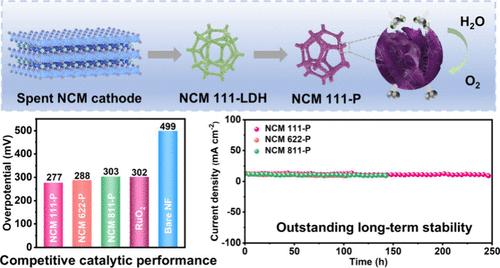
Surge in lithium-ion battery (LIB) production predicts that massive spent LIBs will be produced in the future. Hence, rational utilization of spent LIBs is a win-win strategy to protect the environment, recycle resources, and reverse the dilemma of the current energy challenges. In this work, different decommissioned layered oxide cathodes were recovered and converted into a novel NiCoMn phosphides–nickel foam (NCM-P) electrode for the OER using acid leaching to extract valuable metals and then carrying out a hydrothermal process and phosphating. The enhanced inherent catalytic activity can be achieved by regulating intermetallic interactions with adjusting the stoichiometric ratio of transition metal. Additionally, the NCM 111-P catalyst obtained from the spent LiNi0.33Co0.33Mn0.33O2 cathode has a special nanosheet–nanoneedle hierarchical structure, resulting in abundant active sites and stimulative detachment of gases in the OER course. Consequently, the NCM 111-P exhibits competitive catalytic performance (overpotential of 277 mV at 10 mA cm–2, electrolytic durability of 246 h). The research furnishes a positive way to recycle spent LIBs and promotes the development of electrolytic water.
期刊介绍:
ACS Sustainable Chemistry & Engineering is a prestigious weekly peer-reviewed scientific journal published by the American Chemical Society. Dedicated to advancing the principles of green chemistry and green engineering, it covers a wide array of research topics including green chemistry, green engineering, biomass, alternative energy, and life cycle assessment.
The journal welcomes submissions in various formats, including Letters, Articles, Features, and Perspectives (Reviews), that address the challenges of sustainability in the chemical enterprise and contribute to the advancement of sustainable practices. Join us in shaping the future of sustainable chemistry and engineering.



 京公网安备 11010802042870号
京ICP备2023020795号-1
京公网安备 11010802042870号
京ICP备2023020795号-1

 分享
分享
 求助内容:
求助内容: 应助结果提醒方式:
 扫码关注我们
