Samar Mujeeb , Kuldeep Singh , Martha K. Al-Zrkani , Dhurgham Al-Fahad , Syed Misbahul Hasan , Marwah Al Shouber , Fuzail Ahmad , Husian Njem Hameed , Danish Iqbal , Mehnaz Kamal
{"title":"铬-希夫碱衍生物作为潜在的抗结核药物:硅研究、合成和生物学评价","authors":"Samar Mujeeb , Kuldeep Singh , Martha K. Al-Zrkani , Dhurgham Al-Fahad , Syed Misbahul Hasan , Marwah Al Shouber , Fuzail Ahmad , Husian Njem Hameed , Danish Iqbal , Mehnaz Kamal","doi":"10.1016/j.bioorg.2025.108249","DOIUrl":null,"url":null,"abstract":"<div><div>Tuberculosis (TB) continues to pose a significant public health challenge worldwide. Hydrazide-containing compounds have demonstrated considerable potential as anti- tubercular agents. In this study, we designed, synthesized, and evaluated a series of chroman- Schiff base derivatives, integrating a chroman scaffold with substituted phenyl moieties, as potential therapeutic candidates against TB. <em>In silico</em> studies were conducted to assess the binding interactions of the synthesized derivatives, specifically their R- and S-isomers, with the tuberculosis target protein InhA (PDB ID: 1ZID). Molecular docking revealed that two R-isomer derivatives, <strong>SM-5A</strong> and <strong>SM-6A</strong>, exhibited superior binding affinities (−10.6 kcal/mol) compared to the reference ligand INH-NADH (−10.3 kcal/mol) and the natural substrate NADH (−7.5 kcal/mol). Molecular dynamics simulations confirmed the long-term stability of these compound-protein complexes over a 100 ns trajectory, further substantiating their potential as stable inhibitors. The structures of the synthesized derivatives were validated using spectroscopic techniques, including FTIR, <sup>13</sup>C NMR, <sup>1</sup>H NMR, and HR-MS. Biological evaluation via <em>in vitro</em> anti-tubercular assays against Mycobacterium tuberculosis <em>H<sub>37</sub>Rv</em> (using the Microplate Alamar Blue Assay) demonstrated that several RRR-isomers displayed notable activity. Among them, <strong>SM-2</strong> and <strong>SM-5</strong> showed the most potent effects, with minimum inhibitory concentrations (MIC) of 32 µg/mL, comparable to standard anti-tubercular drugs such as isoniazid, ethambutol, and rifampicin. These findings highlight the chroman-schiff base scaffold as a promising foundation for the development of novel anti-tubercular agents. The integration of computational and experimental approaches in this study underscores the potential of these derivatives for further optimization and development into effective anti-tubercular therapeutics.</div></div>","PeriodicalId":257,"journal":{"name":"Bioorganic Chemistry","volume":"157 ","pages":"Article 108249"},"PeriodicalIF":5.1000,"publicationDate":"2025-04-01","publicationTypes":"Journal Article","fieldsOfStudy":null,"isOpenAccess":false,"openAccessPdf":"","citationCount":"0","resultStr":"{\"title\":\"Chroman-Schiff base derivatives as potential Anti-Tubercular Agents: In silico studies, Synthesis, and Biological evaluation\",\"authors\":\"Samar Mujeeb , Kuldeep Singh , Martha K. Al-Zrkani , Dhurgham Al-Fahad , Syed Misbahul Hasan , Marwah Al Shouber , Fuzail Ahmad , Husian Njem Hameed , Danish Iqbal , Mehnaz Kamal\",\"doi\":\"10.1016/j.bioorg.2025.108249\",\"DOIUrl\":null,\"url\":null,\"abstract\":\"<div><div>Tuberculosis (TB) continues to pose a significant public health challenge worldwide. Hydrazide-containing compounds have demonstrated considerable potential as anti- tubercular agents. In this study, we designed, synthesized, and evaluated a series of chroman- Schiff base derivatives, integrating a chroman scaffold with substituted phenyl moieties, as potential therapeutic candidates against TB. <em>In silico</em> studies were conducted to assess the binding interactions of the synthesized derivatives, specifically their R- and S-isomers, with the tuberculosis target protein InhA (PDB ID: 1ZID). Molecular docking revealed that two R-isomer derivatives, <strong>SM-5A</strong> and <strong>SM-6A</strong>, exhibited superior binding affinities (−10.6 kcal/mol) compared to the reference ligand INH-NADH (−10.3 kcal/mol) and the natural substrate NADH (−7.5 kcal/mol). Molecular dynamics simulations confirmed the long-term stability of these compound-protein complexes over a 100 ns trajectory, further substantiating their potential as stable inhibitors. The structures of the synthesized derivatives were validated using spectroscopic techniques, including FTIR, <sup>13</sup>C NMR, <sup>1</sup>H NMR, and HR-MS. Biological evaluation via <em>in vitro</em> anti-tubercular assays against Mycobacterium tuberculosis <em>H<sub>37</sub>Rv</em> (using the Microplate Alamar Blue Assay) demonstrated that several RRR-isomers displayed notable activity. Among them, <strong>SM-2</strong> and <strong>SM-5</strong> showed the most potent effects, with minimum inhibitory concentrations (MIC) of 32 µg/mL, comparable to standard anti-tubercular drugs such as isoniazid, ethambutol, and rifampicin. These findings highlight the chroman-schiff base scaffold as a promising foundation for the development of novel anti-tubercular agents. The integration of computational and experimental approaches in this study underscores the potential of these derivatives for further optimization and development into effective anti-tubercular therapeutics.</div></div>\",\"PeriodicalId\":257,\"journal\":{\"name\":\"Bioorganic Chemistry\",\"volume\":\"157 \",\"pages\":\"Article 108249\"},\"PeriodicalIF\":5.1000,\"publicationDate\":\"2025-04-01\",\"publicationTypes\":\"Journal Article\",\"fieldsOfStudy\":null,\"isOpenAccess\":false,\"openAccessPdf\":\"\",\"citationCount\":\"0\",\"resultStr\":null,\"platform\":\"Semanticscholar\",\"paperid\":null,\"PeriodicalName\":\"Bioorganic Chemistry\",\"FirstCategoryId\":\"92\",\"ListUrlMain\":\"https://www.sciencedirect.com/science/article/pii/S0045206825001294\",\"RegionNum\":2,\"RegionCategory\":\"医学\",\"ArticlePicture\":[],\"TitleCN\":null,\"AbstractTextCN\":null,\"PMCID\":null,\"EPubDate\":\"2025/2/7 0:00:00\",\"PubModel\":\"Epub\",\"JCR\":\"Q1\",\"JCRName\":\"BIOCHEMISTRY & MOLECULAR BIOLOGY\",\"Score\":null,\"Total\":0}","platform":"Semanticscholar","paperid":null,"PeriodicalName":"Bioorganic Chemistry","FirstCategoryId":"92","ListUrlMain":"https://www.sciencedirect.com/science/article/pii/S0045206825001294","RegionNum":2,"RegionCategory":"医学","ArticlePicture":[],"TitleCN":null,"AbstractTextCN":null,"PMCID":null,"EPubDate":"2025/2/7 0:00:00","PubModel":"Epub","JCR":"Q1","JCRName":"BIOCHEMISTRY & MOLECULAR BIOLOGY","Score":null,"Total":0}
Chroman-Schiff base derivatives as potential Anti-Tubercular Agents: In silico studies, Synthesis, and Biological evaluation
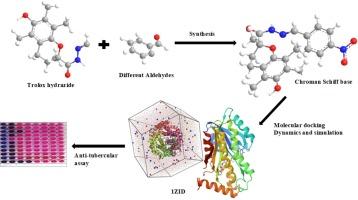
Tuberculosis (TB) continues to pose a significant public health challenge worldwide. Hydrazide-containing compounds have demonstrated considerable potential as anti- tubercular agents. In this study, we designed, synthesized, and evaluated a series of chroman- Schiff base derivatives, integrating a chroman scaffold with substituted phenyl moieties, as potential therapeutic candidates against TB. In silico studies were conducted to assess the binding interactions of the synthesized derivatives, specifically their R- and S-isomers, with the tuberculosis target protein InhA (PDB ID: 1ZID). Molecular docking revealed that two R-isomer derivatives, SM-5A and SM-6A, exhibited superior binding affinities (−10.6 kcal/mol) compared to the reference ligand INH-NADH (−10.3 kcal/mol) and the natural substrate NADH (−7.5 kcal/mol). Molecular dynamics simulations confirmed the long-term stability of these compound-protein complexes over a 100 ns trajectory, further substantiating their potential as stable inhibitors. The structures of the synthesized derivatives were validated using spectroscopic techniques, including FTIR, 13C NMR, 1H NMR, and HR-MS. Biological evaluation via in vitro anti-tubercular assays against Mycobacterium tuberculosis H37Rv (using the Microplate Alamar Blue Assay) demonstrated that several RRR-isomers displayed notable activity. Among them, SM-2 and SM-5 showed the most potent effects, with minimum inhibitory concentrations (MIC) of 32 µg/mL, comparable to standard anti-tubercular drugs such as isoniazid, ethambutol, and rifampicin. These findings highlight the chroman-schiff base scaffold as a promising foundation for the development of novel anti-tubercular agents. The integration of computational and experimental approaches in this study underscores the potential of these derivatives for further optimization and development into effective anti-tubercular therapeutics.
期刊介绍:
Bioorganic Chemistry publishes research that addresses biological questions at the molecular level, using organic chemistry and principles of physical organic chemistry. The scope of the journal covers a range of topics at the organic chemistry-biology interface, including: enzyme catalysis, biotransformation and enzyme inhibition; nucleic acids chemistry; medicinal chemistry; natural product chemistry, natural product synthesis and natural product biosynthesis; antimicrobial agents; lipid and peptide chemistry; biophysical chemistry; biological probes; bio-orthogonal chemistry and biomimetic chemistry.
For manuscripts dealing with synthetic bioactive compounds, the Journal requires that the molecular target of the compounds described must be known, and must be demonstrated experimentally in the manuscript. For studies involving natural products, if the molecular target is unknown, some data beyond simple cell-based toxicity studies to provide insight into the mechanism of action is required. Studies supported by molecular docking are welcome, but must be supported by experimental data. The Journal does not consider manuscripts that are purely theoretical or computational in nature.
The Journal publishes regular articles, short communications and reviews. Reviews are normally invited by Editors or Editorial Board members. Authors of unsolicited reviews should first contact an Editor or Editorial Board member to determine whether the proposed article is within the scope of the Journal.




 京公网安备 11010802042870号
京ICP备2023020795号-1
京公网安备 11010802042870号
京ICP备2023020795号-1

 分享
分享
 求助内容:
求助内容: 应助结果提醒方式:
 扫码关注我们
