Jiasheng Lu , Yumeng Sui , Xin Liu , Jiawang Wang , Jiatong Li , Baohua Kong , Qian Chen , Weiwei Yang
{"title":"外源DPD对植物乳杆菌HRB1体外和干肠模型发酵特性和风味形成的影响:来自群体感应系统的见解","authors":"Jiasheng Lu , Yumeng Sui , Xin Liu , Jiawang Wang , Jiatong Li , Baohua Kong , Qian Chen , Weiwei Yang","doi":"10.1016/j.lwt.2025.117516","DOIUrl":null,"url":null,"abstract":"<div><div>The present study aimed to investigate the impact of 4,5-dihydroxy-2,3-pentanedione (DPD; 0, 300, 600, and 900 nmol/L), a crucial precursor in the <em>LuxS/</em>AI-2 quorum sensing system, on flavour formation by <em>Lactiplantibacillus plantarum</em> HRB1 both <em>in vitro</em> and dry-sausage model. Firstly, <em>L. plantarum</em> HRB1 was selected from 18 strains of lactic acid bacteria due to its superior AI-2 and protease activity. <em>In vitro</em>, DPD significantly increased the activity of the AI-2 and the protease activity of <em>L. plantarum</em> HRB1. In the fermented dry-sausage, free amino acid content was significantly higher in the treatment with 600 nmol/L DPD compared to the other treatments. Notably, the dry sausage treated with 600 nmol/L DPD exhibited the highest concentrations of aldehydes (558.50 μg/kg), ketones (192.41 μg/kg), alcohols (1175.56 μg/kg), acids (202.27 μg/kg), esters (1504.48 μg/kg), and terpenes (1319.82 μg/kg). Sensory analysis revealed that the dry sausage treated with 600 nmol/L DPD had the most pronounced fermented and fatty odour. These results suggest that 600 nmol/L DPD enhances the flavour formation of <em>L. plantarum</em> HRB1. This research provides a theoretical foundation for utilizing the <em>LuxS</em>/AI-2 QS to optimize microbial fermentation processes and improve fermented food quality, especially flavour.</div></div>","PeriodicalId":382,"journal":{"name":"LWT - Food Science and Technology","volume":"218 ","pages":"Article 117516"},"PeriodicalIF":6.6000,"publicationDate":"2025-02-15","publicationTypes":"Journal Article","fieldsOfStudy":null,"isOpenAccess":false,"openAccessPdf":"","citationCount":"0","resultStr":"{\"title\":\"Effect of exogenous DPD on fermentation characteristics and flavour formation of Lactiplantibacillus plantarum HRB1 in vitro and in a dry sausage model: Insights from the quorum sensing system\",\"authors\":\"Jiasheng Lu , Yumeng Sui , Xin Liu , Jiawang Wang , Jiatong Li , Baohua Kong , Qian Chen , Weiwei Yang\",\"doi\":\"10.1016/j.lwt.2025.117516\",\"DOIUrl\":null,\"url\":null,\"abstract\":\"<div><div>The present study aimed to investigate the impact of 4,5-dihydroxy-2,3-pentanedione (DPD; 0, 300, 600, and 900 nmol/L), a crucial precursor in the <em>LuxS/</em>AI-2 quorum sensing system, on flavour formation by <em>Lactiplantibacillus plantarum</em> HRB1 both <em>in vitro</em> and dry-sausage model. Firstly, <em>L. plantarum</em> HRB1 was selected from 18 strains of lactic acid bacteria due to its superior AI-2 and protease activity. <em>In vitro</em>, DPD significantly increased the activity of the AI-2 and the protease activity of <em>L. plantarum</em> HRB1. In the fermented dry-sausage, free amino acid content was significantly higher in the treatment with 600 nmol/L DPD compared to the other treatments. Notably, the dry sausage treated with 600 nmol/L DPD exhibited the highest concentrations of aldehydes (558.50 μg/kg), ketones (192.41 μg/kg), alcohols (1175.56 μg/kg), acids (202.27 μg/kg), esters (1504.48 μg/kg), and terpenes (1319.82 μg/kg). Sensory analysis revealed that the dry sausage treated with 600 nmol/L DPD had the most pronounced fermented and fatty odour. These results suggest that 600 nmol/L DPD enhances the flavour formation of <em>L. plantarum</em> HRB1. This research provides a theoretical foundation for utilizing the <em>LuxS</em>/AI-2 QS to optimize microbial fermentation processes and improve fermented food quality, especially flavour.</div></div>\",\"PeriodicalId\":382,\"journal\":{\"name\":\"LWT - Food Science and Technology\",\"volume\":\"218 \",\"pages\":\"Article 117516\"},\"PeriodicalIF\":6.6000,\"publicationDate\":\"2025-02-15\",\"publicationTypes\":\"Journal Article\",\"fieldsOfStudy\":null,\"isOpenAccess\":false,\"openAccessPdf\":\"\",\"citationCount\":\"0\",\"resultStr\":null,\"platform\":\"Semanticscholar\",\"paperid\":null,\"PeriodicalName\":\"LWT - Food Science and Technology\",\"FirstCategoryId\":\"97\",\"ListUrlMain\":\"https://www.sciencedirect.com/science/article/pii/S0023643825002002\",\"RegionNum\":1,\"RegionCategory\":\"农林科学\",\"ArticlePicture\":[],\"TitleCN\":null,\"AbstractTextCN\":null,\"PMCID\":null,\"EPubDate\":\"2025/2/11 0:00:00\",\"PubModel\":\"Epub\",\"JCR\":\"Q1\",\"JCRName\":\"FOOD SCIENCE & TECHNOLOGY\",\"Score\":null,\"Total\":0}","platform":"Semanticscholar","paperid":null,"PeriodicalName":"LWT - Food Science and Technology","FirstCategoryId":"97","ListUrlMain":"https://www.sciencedirect.com/science/article/pii/S0023643825002002","RegionNum":1,"RegionCategory":"农林科学","ArticlePicture":[],"TitleCN":null,"AbstractTextCN":null,"PMCID":null,"EPubDate":"2025/2/11 0:00:00","PubModel":"Epub","JCR":"Q1","JCRName":"FOOD SCIENCE & TECHNOLOGY","Score":null,"Total":0}
Effect of exogenous DPD on fermentation characteristics and flavour formation of Lactiplantibacillus plantarum HRB1 in vitro and in a dry sausage model: Insights from the quorum sensing system
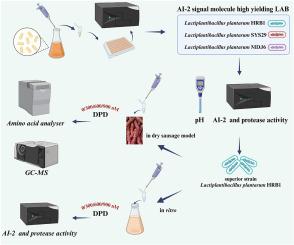
The present study aimed to investigate the impact of 4,5-dihydroxy-2,3-pentanedione (DPD; 0, 300, 600, and 900 nmol/L), a crucial precursor in the LuxS/AI-2 quorum sensing system, on flavour formation by Lactiplantibacillus plantarum HRB1 both in vitro and dry-sausage model. Firstly, L. plantarum HRB1 was selected from 18 strains of lactic acid bacteria due to its superior AI-2 and protease activity. In vitro, DPD significantly increased the activity of the AI-2 and the protease activity of L. plantarum HRB1. In the fermented dry-sausage, free amino acid content was significantly higher in the treatment with 600 nmol/L DPD compared to the other treatments. Notably, the dry sausage treated with 600 nmol/L DPD exhibited the highest concentrations of aldehydes (558.50 μg/kg), ketones (192.41 μg/kg), alcohols (1175.56 μg/kg), acids (202.27 μg/kg), esters (1504.48 μg/kg), and terpenes (1319.82 μg/kg). Sensory analysis revealed that the dry sausage treated with 600 nmol/L DPD had the most pronounced fermented and fatty odour. These results suggest that 600 nmol/L DPD enhances the flavour formation of L. plantarum HRB1. This research provides a theoretical foundation for utilizing the LuxS/AI-2 QS to optimize microbial fermentation processes and improve fermented food quality, especially flavour.
期刊介绍:
LWT - Food Science and Technology is an international journal that publishes innovative papers in the fields of food chemistry, biochemistry, microbiology, technology and nutrition. The work described should be innovative either in the approach or in the methods used. The significance of the results either for the science community or for the food industry must also be specified. Contributions written in English are welcomed in the form of review articles, short reviews, research papers, and research notes. Papers featuring animal trials and cell cultures are outside the scope of the journal and will not be considered for publication.




 京公网安备 11010802042870号
京ICP备2023020795号-1
京公网安备 11010802042870号
京ICP备2023020795号-1

 分享
分享
 求助内容:
求助内容: 应助结果提醒方式:
 扫码关注我们
