Yimiao He , Feng Gong , Kebing Yi , Yu Feng , Ziwen Tang , Fuxiang Zhou , Xinghu Ji , Zhike He
{"title":"冷冻辅助和亲和介导的偶联策略:提高金纳米颗粒上的蛋白质负载以增强免疫分析性能","authors":"Yimiao He , Feng Gong , Kebing Yi , Yu Feng , Ziwen Tang , Fuxiang Zhou , Xinghu Ji , Zhike He","doi":"10.1016/j.talanta.2025.127737","DOIUrl":null,"url":null,"abstract":"<div><div>Protein-conjugated gold nanoparticles (protein-Au NPs) have been extensively applied in the field of biochemistry due to their unique properties. It is of great significance to regulate the protein loading, reduce the loss of protein activity, and enhance the stability and accessibility of protein-Au NPs for their biochemical application. Herein, we investigated the freezing-assisted strategy for binding proteins to Au NPs, which was effective for various proteins and Au NPs with different sizes. The protein-Au NPs prepared by this freezing strategy exhibited better stability and higher protein loading compared to those prepared by typical direct adsorption (shaking) strategy. Based on this, we proposed a freezing-assisted and affinity-mediated strategy to conjugate proteins to Au NPs. In this strategy, biotinylated BSA (BSA-Bio) was employed as a mediator to bind protein to Au NPs through bioaffinity interaction. By attaching streptavidin-conjugated HRP (SA-HRP) onto Au NPs in this way, a nanoparticle denoted as Au NPs@BSA-Bio@SA-HRP was obtained. And we discovered that the protein loading of this nanoparticle prepared with 68 nm Au NPs was astonishingly 253 times higher than that of shaking strategy under the same conditions. In view of the advantages of this freezing-assisted and affinity-mediated strategy, we prepared antibody- and BSA-Bio-conjugated Au NPs for the immunoassay of interleukin-6 (IL-6). A limit of detection of 3.39 pg/mL was achieved, which was 7.4 times more sensitive than the conventional method. This study offered a new insight for protein conjugation and demonstrated a great potential for practical applications.</div></div>","PeriodicalId":435,"journal":{"name":"Talanta","volume":"288 ","pages":"Article 127737"},"PeriodicalIF":6.1000,"publicationDate":"2025-06-01","publicationTypes":"Journal Article","fieldsOfStudy":null,"isOpenAccess":false,"openAccessPdf":"","citationCount":"0","resultStr":"{\"title\":\"Freezing-assisted and affinity-mediated conjugation strategy: Boosting protein loading on gold nanoparticles for enhanced immunoassay performance\",\"authors\":\"Yimiao He , Feng Gong , Kebing Yi , Yu Feng , Ziwen Tang , Fuxiang Zhou , Xinghu Ji , Zhike He\",\"doi\":\"10.1016/j.talanta.2025.127737\",\"DOIUrl\":null,\"url\":null,\"abstract\":\"<div><div>Protein-conjugated gold nanoparticles (protein-Au NPs) have been extensively applied in the field of biochemistry due to their unique properties. It is of great significance to regulate the protein loading, reduce the loss of protein activity, and enhance the stability and accessibility of protein-Au NPs for their biochemical application. Herein, we investigated the freezing-assisted strategy for binding proteins to Au NPs, which was effective for various proteins and Au NPs with different sizes. The protein-Au NPs prepared by this freezing strategy exhibited better stability and higher protein loading compared to those prepared by typical direct adsorption (shaking) strategy. Based on this, we proposed a freezing-assisted and affinity-mediated strategy to conjugate proteins to Au NPs. In this strategy, biotinylated BSA (BSA-Bio) was employed as a mediator to bind protein to Au NPs through bioaffinity interaction. By attaching streptavidin-conjugated HRP (SA-HRP) onto Au NPs in this way, a nanoparticle denoted as Au NPs@BSA-Bio@SA-HRP was obtained. And we discovered that the protein loading of this nanoparticle prepared with 68 nm Au NPs was astonishingly 253 times higher than that of shaking strategy under the same conditions. In view of the advantages of this freezing-assisted and affinity-mediated strategy, we prepared antibody- and BSA-Bio-conjugated Au NPs for the immunoassay of interleukin-6 (IL-6). A limit of detection of 3.39 pg/mL was achieved, which was 7.4 times more sensitive than the conventional method. This study offered a new insight for protein conjugation and demonstrated a great potential for practical applications.</div></div>\",\"PeriodicalId\":435,\"journal\":{\"name\":\"Talanta\",\"volume\":\"288 \",\"pages\":\"Article 127737\"},\"PeriodicalIF\":6.1000,\"publicationDate\":\"2025-06-01\",\"publicationTypes\":\"Journal Article\",\"fieldsOfStudy\":null,\"isOpenAccess\":false,\"openAccessPdf\":\"\",\"citationCount\":\"0\",\"resultStr\":null,\"platform\":\"Semanticscholar\",\"paperid\":null,\"PeriodicalName\":\"Talanta\",\"FirstCategoryId\":\"92\",\"ListUrlMain\":\"https://www.sciencedirect.com/science/article/pii/S0039914025002279\",\"RegionNum\":1,\"RegionCategory\":\"化学\",\"ArticlePicture\":[],\"TitleCN\":null,\"AbstractTextCN\":null,\"PMCID\":null,\"EPubDate\":\"2025/2/16 0:00:00\",\"PubModel\":\"Epub\",\"JCR\":\"Q1\",\"JCRName\":\"CHEMISTRY, ANALYTICAL\",\"Score\":null,\"Total\":0}","platform":"Semanticscholar","paperid":null,"PeriodicalName":"Talanta","FirstCategoryId":"92","ListUrlMain":"https://www.sciencedirect.com/science/article/pii/S0039914025002279","RegionNum":1,"RegionCategory":"化学","ArticlePicture":[],"TitleCN":null,"AbstractTextCN":null,"PMCID":null,"EPubDate":"2025/2/16 0:00:00","PubModel":"Epub","JCR":"Q1","JCRName":"CHEMISTRY, ANALYTICAL","Score":null,"Total":0}
引用次数: 0
摘要
蛋白质偶联金纳米颗粒(protein-Au NPs)由于其独特的性质在生物化学领域得到了广泛的应用。调节蛋白质负载,减少蛋白质活性损失,提高蛋白质- au NPs的稳定性和可及性对其生化应用具有重要意义。在此,我们研究了冷冻辅助蛋白与Au NPs结合的策略,该策略对各种蛋白质和不同大小的Au NPs都有效。与典型的直接吸附(摇吸)法制备的蛋白质- au NPs相比,该冷冻策略制备的蛋白质- au NPs具有更好的稳定性和更高的蛋白质负载。基于此,我们提出了一种冷冻辅助和亲和介导的策略来将蛋白质结合到Au NPs上。在该策略中,生物素化BSA (BSA- bio)被用作通过生物亲和相互作用将蛋白与Au NPs结合的介质。通过这种方式将链亲和素偶联的HRP (SA-HRP)附着在Au NPs上,得到的纳米颗粒为Au NPs@BSA-Bio@SA-HRP。我们发现,在相同的条件下,用68 nm Au NPs制备的纳米颗粒的蛋白质载量比摇动策略高253倍。鉴于这种冷冻辅助和亲和介导策略的优势,我们制备了抗体和bsa生物偶联的Au NPs用于白细胞介素-6 (IL-6)的免疫测定。检测限为3.39 pg/mL,灵敏度是常规方法的7.4倍。该研究为蛋白质偶联提供了新的见解,并显示了巨大的实际应用潜力。
Freezing-assisted and affinity-mediated conjugation strategy: Boosting protein loading on gold nanoparticles for enhanced immunoassay performance
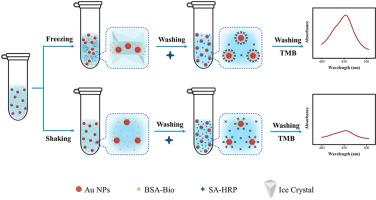
Protein-conjugated gold nanoparticles (protein-Au NPs) have been extensively applied in the field of biochemistry due to their unique properties. It is of great significance to regulate the protein loading, reduce the loss of protein activity, and enhance the stability and accessibility of protein-Au NPs for their biochemical application. Herein, we investigated the freezing-assisted strategy for binding proteins to Au NPs, which was effective for various proteins and Au NPs with different sizes. The protein-Au NPs prepared by this freezing strategy exhibited better stability and higher protein loading compared to those prepared by typical direct adsorption (shaking) strategy. Based on this, we proposed a freezing-assisted and affinity-mediated strategy to conjugate proteins to Au NPs. In this strategy, biotinylated BSA (BSA-Bio) was employed as a mediator to bind protein to Au NPs through bioaffinity interaction. By attaching streptavidin-conjugated HRP (SA-HRP) onto Au NPs in this way, a nanoparticle denoted as Au NPs@BSA-Bio@SA-HRP was obtained. And we discovered that the protein loading of this nanoparticle prepared with 68 nm Au NPs was astonishingly 253 times higher than that of shaking strategy under the same conditions. In view of the advantages of this freezing-assisted and affinity-mediated strategy, we prepared antibody- and BSA-Bio-conjugated Au NPs for the immunoassay of interleukin-6 (IL-6). A limit of detection of 3.39 pg/mL was achieved, which was 7.4 times more sensitive than the conventional method. This study offered a new insight for protein conjugation and demonstrated a great potential for practical applications.
期刊介绍:
Talanta provides a forum for the publication of original research papers, short communications, and critical reviews in all branches of pure and applied analytical chemistry. Papers are evaluated based on established guidelines, including the fundamental nature of the study, scientific novelty, substantial improvement or advantage over existing technology or methods, and demonstrated analytical applicability. Original research papers on fundamental studies, and on novel sensor and instrumentation developments, are encouraged. Novel or improved applications in areas such as clinical and biological chemistry, environmental analysis, geochemistry, materials science and engineering, and analytical platforms for omics development are welcome.
Analytical performance of methods should be determined, including interference and matrix effects, and methods should be validated by comparison with a standard method, or analysis of a certified reference material. Simple spiking recoveries may not be sufficient. The developed method should especially comprise information on selectivity, sensitivity, detection limits, accuracy, and reliability. However, applying official validation or robustness studies to a routine method or technique does not necessarily constitute novelty. Proper statistical treatment of the data should be provided. Relevant literature should be cited, including related publications by the authors, and authors should discuss how their proposed methodology compares with previously reported methods.




 京公网安备 11010802042870号
京ICP备2023020795号-1
京公网安备 11010802042870号
京ICP备2023020795号-1

 分享
分享
 求助内容:
求助内容: 应助结果提醒方式:
 扫码关注我们
