Chen Han , Qi Zheng , Kun Xiang , Min Zhang , Mao-Sheng Cao
{"title":"用于电磁衰减的一维钴碳自组装旋转介电特性","authors":"Chen Han , Qi Zheng , Kun Xiang , Min Zhang , Mao-Sheng Cao","doi":"10.1016/j.carbon.2025.120103","DOIUrl":null,"url":null,"abstract":"<div><div>An in situ self-assembly strategy for core-shell nanostructures in a nanofiber is proposed to tailor the electromagnetic attenuation performance of cobalt-carbon heterogeneous materials. Due to the atomic step induction on the surface of the cobalt nanoparticles and the interaction of the cobalt electron orbitals with the unsaturated <em>sp</em><sup>2</sup> orbitals of the graphitized structure island, self-assembly of the shell initiates by incorporating carbon atoms. With the process of self-assembly, electron transport channels and heterogeneous interfaces can be tailored to synergistically modulate the conductivity and polarization relaxation. Combining the dual modulating effect, impedance matching and electromagnetic attenuation performance can be dominated. As a result, an optimal reflection loss (RL) of −50.3 dB and shielding effectiveness (SE) of 32.4 dB are obtained, demonstrating the versatility and adjustability of the nanofiber. This work provides an in-depth analysis of the relationship between crystal engineering and electromagnetic properties of the core-shell nanomaterials.</div></div>","PeriodicalId":262,"journal":{"name":"Carbon","volume":"236 ","pages":"Article 120103"},"PeriodicalIF":11.6000,"publicationDate":"2025-03-20","publicationTypes":"Journal Article","fieldsOfStudy":null,"isOpenAccess":false,"openAccessPdf":"","citationCount":"0","resultStr":"{\"title\":\"Self-assembly of one-dimensional cobalt-carbon to turn dielectric properties for electromagnetic attenuation\",\"authors\":\"Chen Han , Qi Zheng , Kun Xiang , Min Zhang , Mao-Sheng Cao\",\"doi\":\"10.1016/j.carbon.2025.120103\",\"DOIUrl\":null,\"url\":null,\"abstract\":\"<div><div>An in situ self-assembly strategy for core-shell nanostructures in a nanofiber is proposed to tailor the electromagnetic attenuation performance of cobalt-carbon heterogeneous materials. Due to the atomic step induction on the surface of the cobalt nanoparticles and the interaction of the cobalt electron orbitals with the unsaturated <em>sp</em><sup>2</sup> orbitals of the graphitized structure island, self-assembly of the shell initiates by incorporating carbon atoms. With the process of self-assembly, electron transport channels and heterogeneous interfaces can be tailored to synergistically modulate the conductivity and polarization relaxation. Combining the dual modulating effect, impedance matching and electromagnetic attenuation performance can be dominated. As a result, an optimal reflection loss (RL) of −50.3 dB and shielding effectiveness (SE) of 32.4 dB are obtained, demonstrating the versatility and adjustability of the nanofiber. This work provides an in-depth analysis of the relationship between crystal engineering and electromagnetic properties of the core-shell nanomaterials.</div></div>\",\"PeriodicalId\":262,\"journal\":{\"name\":\"Carbon\",\"volume\":\"236 \",\"pages\":\"Article 120103\"},\"PeriodicalIF\":11.6000,\"publicationDate\":\"2025-03-20\",\"publicationTypes\":\"Journal Article\",\"fieldsOfStudy\":null,\"isOpenAccess\":false,\"openAccessPdf\":\"\",\"citationCount\":\"0\",\"resultStr\":null,\"platform\":\"Semanticscholar\",\"paperid\":null,\"PeriodicalName\":\"Carbon\",\"FirstCategoryId\":\"88\",\"ListUrlMain\":\"https://www.sciencedirect.com/science/article/pii/S0008622325001198\",\"RegionNum\":2,\"RegionCategory\":\"材料科学\",\"ArticlePicture\":[],\"TitleCN\":null,\"AbstractTextCN\":null,\"PMCID\":null,\"EPubDate\":\"2025/2/11 0:00:00\",\"PubModel\":\"Epub\",\"JCR\":\"Q1\",\"JCRName\":\"CHEMISTRY, PHYSICAL\",\"Score\":null,\"Total\":0}","platform":"Semanticscholar","paperid":null,"PeriodicalName":"Carbon","FirstCategoryId":"88","ListUrlMain":"https://www.sciencedirect.com/science/article/pii/S0008622325001198","RegionNum":2,"RegionCategory":"材料科学","ArticlePicture":[],"TitleCN":null,"AbstractTextCN":null,"PMCID":null,"EPubDate":"2025/2/11 0:00:00","PubModel":"Epub","JCR":"Q1","JCRName":"CHEMISTRY, PHYSICAL","Score":null,"Total":0}
Self-assembly of one-dimensional cobalt-carbon to turn dielectric properties for electromagnetic attenuation
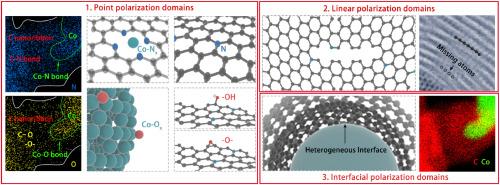
An in situ self-assembly strategy for core-shell nanostructures in a nanofiber is proposed to tailor the electromagnetic attenuation performance of cobalt-carbon heterogeneous materials. Due to the atomic step induction on the surface of the cobalt nanoparticles and the interaction of the cobalt electron orbitals with the unsaturated sp2 orbitals of the graphitized structure island, self-assembly of the shell initiates by incorporating carbon atoms. With the process of self-assembly, electron transport channels and heterogeneous interfaces can be tailored to synergistically modulate the conductivity and polarization relaxation. Combining the dual modulating effect, impedance matching and electromagnetic attenuation performance can be dominated. As a result, an optimal reflection loss (RL) of −50.3 dB and shielding effectiveness (SE) of 32.4 dB are obtained, demonstrating the versatility and adjustability of the nanofiber. This work provides an in-depth analysis of the relationship between crystal engineering and electromagnetic properties of the core-shell nanomaterials.
期刊介绍:
The journal Carbon is an international multidisciplinary forum for communicating scientific advances in the field of carbon materials. It reports new findings related to the formation, structure, properties, behaviors, and technological applications of carbons. Carbons are a broad class of ordered or disordered solid phases composed primarily of elemental carbon, including but not limited to carbon black, carbon fibers and filaments, carbon nanotubes, diamond and diamond-like carbon, fullerenes, glassy carbon, graphite, graphene, graphene-oxide, porous carbons, pyrolytic carbon, and other sp2 and non-sp2 hybridized carbon systems. Carbon is the companion title to the open access journal Carbon Trends. Relevant application areas for carbon materials include biology and medicine, catalysis, electronic, optoelectronic, spintronic, high-frequency, and photonic devices, energy storage and conversion systems, environmental applications and water treatment, smart materials and systems, and structural and thermal applications.




 京公网安备 11010802042870号
京ICP备2023020795号-1
京公网安备 11010802042870号
京ICP备2023020795号-1

 分享
分享
 求助内容:
求助内容: 应助结果提醒方式:
 扫码关注我们
