Huijuan Sun , Yu Wang , Geyu Deng , Rui Gao , Mengmeng Zhang , Lin Huang , Wenjie He , Zhendong Zhang , Donghua Yu , Pingping Chen , Fang Lu , Shumin Liu
{"title":"通过增强氧化磷酸化诱导的皮质双胞胺肝毒性:来自整合转录组学、蛋白质组学和代谢组学分析的见解","authors":"Huijuan Sun , Yu Wang , Geyu Deng , Rui Gao , Mengmeng Zhang , Lin Huang , Wenjie He , Zhendong Zhang , Donghua Yu , Pingping Chen , Fang Lu , Shumin Liu","doi":"10.1016/j.phymed.2025.156511","DOIUrl":null,"url":null,"abstract":"<div><h3>Background</h3><div>Cortex Dictamni (CD) is a traditional Chinese medicine that is commonly used to treat various skin diseases. Recently, clinical reports have highlighted its potential to induce severe hepatotoxicity. However, the underlying mechanisms of toxicity remain inadequately explored.</div></div><div><h3>Purpose</h3><div>The aim of this study was to elucidate the intrinsic mechanisms of CD-induced hepatotoxicity.</div></div><div><h3>Study design</h3><div>Hepatotoxicity was assessed in SD rats, and human primary hepatocytes (HPHs) and differentiated HepaRG (dHepaRG) cells were used for in vitro testing.</div></div><div><h3>Methods</h3><div>The major components of CD were determined using ultra-performance liquid chromatography (UPLC). Rats were randomly divided into control, CD-high (CD-H), CD-middle (CD-M), CD-low (CD-L), and isoniazid (INH) groups and administered oral gavage for four weeks. Serum biochemical indices, histopathological changes, apoptotic markers, and liver function were evaluated to assess hepatotoxicity. A comprehensive analysis of rat liver samples was performed using transcriptomic, proteomic, and metabolomic approaches to identify key pathways involved in CD-induced hepatotoxicity. In vitro toxicity validation of CD was performed using HPHs and dHepaRG cells. The key pathway was validated in vivo and in vitro.</div></div><div><h3>Results</h3><div>CD primarily contained obacunone, fraxinellone, and dictamine. Administration of CD-H (9 times the maximum daily clinical dose in adults) and CD-M (3 times the maximum daily clinical dose in adults) for 4 weeks induced varying degrees of hepatotoxicity in rats. The CD-H group presented increased absolute and relative liver weights, reduced alanine aminotransferase (ALT) and bile acid transporter levels, and increased albumin (ALB) and cytochrome P450 (CYP) 3A4 levels, indicating significant hepatotoxicity in rats. Integrated multiomics analysis revealed that NADH dehydrogenase (ubiquinone) Fe-S protein 2 (Ndufs2) is a critical regulator of CD-induced hepatotoxicity involving oxidative phosphorylation (OXPHOS). CD inhibited the viability of HPHs and dHepaRG cells, demonstrating its significant cytotoxicity. Mechanistic validation revealed that CD upregulated Ndufs2, reactive oxygen species (ROS) and mitochondrial respiratory chain complex (MRCC) I, leading to nuclear factor erythroid 2-related factor 2 (Nrf2) pathway activation, apoptosis, mitochondrial dysfunction, and hepatotoxicity.</div></div><div><h3>Conclusion</h3><div>In summary, our study presents a comprehensive picture of the toxicity of CD in terms of dose and sex and reveals, for the first time, the central role of Ndufs2-regulated OXPHOS in CD-induced hepatotoxicity.</div></div>","PeriodicalId":20212,"journal":{"name":"Phytomedicine","volume":"139 ","pages":"Article 156511"},"PeriodicalIF":11.3000,"publicationDate":"2025-04-01","publicationTypes":"Journal Article","fieldsOfStudy":null,"isOpenAccess":false,"openAccessPdf":"","citationCount":"0","resultStr":"{\"title\":\"Cortex Dictamni-induced hepatotoxicity by enhanced oxidative phosphorylation: Insights from integrative transcriptomics, proteomics, and metabolomics analyses\",\"authors\":\"Huijuan Sun , Yu Wang , Geyu Deng , Rui Gao , Mengmeng Zhang , Lin Huang , Wenjie He , Zhendong Zhang , Donghua Yu , Pingping Chen , Fang Lu , Shumin Liu\",\"doi\":\"10.1016/j.phymed.2025.156511\",\"DOIUrl\":null,\"url\":null,\"abstract\":\"<div><h3>Background</h3><div>Cortex Dictamni (CD) is a traditional Chinese medicine that is commonly used to treat various skin diseases. Recently, clinical reports have highlighted its potential to induce severe hepatotoxicity. However, the underlying mechanisms of toxicity remain inadequately explored.</div></div><div><h3>Purpose</h3><div>The aim of this study was to elucidate the intrinsic mechanisms of CD-induced hepatotoxicity.</div></div><div><h3>Study design</h3><div>Hepatotoxicity was assessed in SD rats, and human primary hepatocytes (HPHs) and differentiated HepaRG (dHepaRG) cells were used for in vitro testing.</div></div><div><h3>Methods</h3><div>The major components of CD were determined using ultra-performance liquid chromatography (UPLC). Rats were randomly divided into control, CD-high (CD-H), CD-middle (CD-M), CD-low (CD-L), and isoniazid (INH) groups and administered oral gavage for four weeks. Serum biochemical indices, histopathological changes, apoptotic markers, and liver function were evaluated to assess hepatotoxicity. A comprehensive analysis of rat liver samples was performed using transcriptomic, proteomic, and metabolomic approaches to identify key pathways involved in CD-induced hepatotoxicity. In vitro toxicity validation of CD was performed using HPHs and dHepaRG cells. The key pathway was validated in vivo and in vitro.</div></div><div><h3>Results</h3><div>CD primarily contained obacunone, fraxinellone, and dictamine. Administration of CD-H (9 times the maximum daily clinical dose in adults) and CD-M (3 times the maximum daily clinical dose in adults) for 4 weeks induced varying degrees of hepatotoxicity in rats. The CD-H group presented increased absolute and relative liver weights, reduced alanine aminotransferase (ALT) and bile acid transporter levels, and increased albumin (ALB) and cytochrome P450 (CYP) 3A4 levels, indicating significant hepatotoxicity in rats. Integrated multiomics analysis revealed that NADH dehydrogenase (ubiquinone) Fe-S protein 2 (Ndufs2) is a critical regulator of CD-induced hepatotoxicity involving oxidative phosphorylation (OXPHOS). CD inhibited the viability of HPHs and dHepaRG cells, demonstrating its significant cytotoxicity. Mechanistic validation revealed that CD upregulated Ndufs2, reactive oxygen species (ROS) and mitochondrial respiratory chain complex (MRCC) I, leading to nuclear factor erythroid 2-related factor 2 (Nrf2) pathway activation, apoptosis, mitochondrial dysfunction, and hepatotoxicity.</div></div><div><h3>Conclusion</h3><div>In summary, our study presents a comprehensive picture of the toxicity of CD in terms of dose and sex and reveals, for the first time, the central role of Ndufs2-regulated OXPHOS in CD-induced hepatotoxicity.</div></div>\",\"PeriodicalId\":20212,\"journal\":{\"name\":\"Phytomedicine\",\"volume\":\"139 \",\"pages\":\"Article 156511\"},\"PeriodicalIF\":11.3000,\"publicationDate\":\"2025-04-01\",\"publicationTypes\":\"Journal Article\",\"fieldsOfStudy\":null,\"isOpenAccess\":false,\"openAccessPdf\":\"\",\"citationCount\":\"0\",\"resultStr\":null,\"platform\":\"Semanticscholar\",\"paperid\":null,\"PeriodicalName\":\"Phytomedicine\",\"FirstCategoryId\":\"3\",\"ListUrlMain\":\"https://www.sciencedirect.com/science/article/pii/S0944711325001527\",\"RegionNum\":1,\"RegionCategory\":\"医学\",\"ArticlePicture\":[],\"TitleCN\":null,\"AbstractTextCN\":null,\"PMCID\":null,\"EPubDate\":\"2025/2/12 0:00:00\",\"PubModel\":\"Epub\",\"JCR\":\"Q1\",\"JCRName\":\"CHEMISTRY, MEDICINAL\",\"Score\":null,\"Total\":0}","platform":"Semanticscholar","paperid":null,"PeriodicalName":"Phytomedicine","FirstCategoryId":"3","ListUrlMain":"https://www.sciencedirect.com/science/article/pii/S0944711325001527","RegionNum":1,"RegionCategory":"医学","ArticlePicture":[],"TitleCN":null,"AbstractTextCN":null,"PMCID":null,"EPubDate":"2025/2/12 0:00:00","PubModel":"Epub","JCR":"Q1","JCRName":"CHEMISTRY, MEDICINAL","Score":null,"Total":0}
Cortex Dictamni-induced hepatotoxicity by enhanced oxidative phosphorylation: Insights from integrative transcriptomics, proteomics, and metabolomics analyses
Background
Cortex Dictamni (CD) is a traditional Chinese medicine that is commonly used to treat various skin diseases. Recently, clinical reports have highlighted its potential to induce severe hepatotoxicity. However, the underlying mechanisms of toxicity remain inadequately explored.
Purpose
The aim of this study was to elucidate the intrinsic mechanisms of CD-induced hepatotoxicity.
Study design
Hepatotoxicity was assessed in SD rats, and human primary hepatocytes (HPHs) and differentiated HepaRG (dHepaRG) cells were used for in vitro testing.
Methods
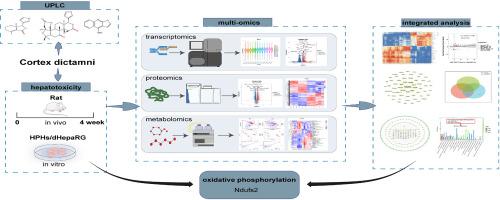
The major components of CD were determined using ultra-performance liquid chromatography (UPLC). Rats were randomly divided into control, CD-high (CD-H), CD-middle (CD-M), CD-low (CD-L), and isoniazid (INH) groups and administered oral gavage for four weeks. Serum biochemical indices, histopathological changes, apoptotic markers, and liver function were evaluated to assess hepatotoxicity. A comprehensive analysis of rat liver samples was performed using transcriptomic, proteomic, and metabolomic approaches to identify key pathways involved in CD-induced hepatotoxicity. In vitro toxicity validation of CD was performed using HPHs and dHepaRG cells. The key pathway was validated in vivo and in vitro.
Results
CD primarily contained obacunone, fraxinellone, and dictamine. Administration of CD-H (9 times the maximum daily clinical dose in adults) and CD-M (3 times the maximum daily clinical dose in adults) for 4 weeks induced varying degrees of hepatotoxicity in rats. The CD-H group presented increased absolute and relative liver weights, reduced alanine aminotransferase (ALT) and bile acid transporter levels, and increased albumin (ALB) and cytochrome P450 (CYP) 3A4 levels, indicating significant hepatotoxicity in rats. Integrated multiomics analysis revealed that NADH dehydrogenase (ubiquinone) Fe-S protein 2 (Ndufs2) is a critical regulator of CD-induced hepatotoxicity involving oxidative phosphorylation (OXPHOS). CD inhibited the viability of HPHs and dHepaRG cells, demonstrating its significant cytotoxicity. Mechanistic validation revealed that CD upregulated Ndufs2, reactive oxygen species (ROS) and mitochondrial respiratory chain complex (MRCC) I, leading to nuclear factor erythroid 2-related factor 2 (Nrf2) pathway activation, apoptosis, mitochondrial dysfunction, and hepatotoxicity.
Conclusion
In summary, our study presents a comprehensive picture of the toxicity of CD in terms of dose and sex and reveals, for the first time, the central role of Ndufs2-regulated OXPHOS in CD-induced hepatotoxicity.
期刊介绍:
Phytomedicine is a therapy-oriented journal that publishes innovative studies on the efficacy, safety, quality, and mechanisms of action of specified plant extracts, phytopharmaceuticals, and their isolated constituents. This includes clinical, pharmacological, pharmacokinetic, and toxicological studies of herbal medicinal products, preparations, and purified compounds with defined and consistent quality, ensuring reproducible pharmacological activity. Founded in 1994, Phytomedicine aims to focus and stimulate research in this field and establish internationally accepted scientific standards for pharmacological studies, proof of clinical efficacy, and safety of phytomedicines.





 京公网安备 11010802042870号
京ICP备2023020795号-1
京公网安备 11010802042870号
京ICP备2023020795号-1

 分享
分享
 求助内容:
求助内容: 应助结果提醒方式:
 扫码关注我们
