{"title":"攻角和侧滑对低速混合翼身空气动力学的影响","authors":"S. Mohan, P. Kumar","doi":"10.1134/S0015462824603887","DOIUrl":null,"url":null,"abstract":"<p>The blended wing body (BWB) is becoming more attractive for modern-day researchers due to its capability to be more fuel efficient, less noisy, and have the better aerodynamic performance. However, a thorough flow investigation of such bodies under varying angles of attack and sideslip conditions is necessary to further enhance the above-mentioned advantages. To investigate the effect of the angle of attack and the sideslip angles, experiments and computations are conducted for a typical BWB at the free-stream velocity of 18 m/s corresponding to the Reynolds number of 58500 based on mean aerodynamic chord. The experimental work consisted of flow visualizations using oil flow techniques and measurements of the forces using an internal 5-component strain gauge balance. Computations were also made to solve numerical simulations using the commercial software Ansys Fluent. The results show a slight variation below 5% in the pressure distribution with change in the sideslip angle. Negligible variations in the lift-to-drag ratio were observed at the lower sideslip angles, whereas slight variations below 10% were observed in the higher sideslip cases. A reasonable agreement between computational and experimental oil flows was also observed, deducing a successful application of the present technique for the investigation of the angle of attack and the sideslip angle in a BWB body.</p>","PeriodicalId":560,"journal":{"name":"Fluid Dynamics","volume":"59 6","pages":"1973 - 1993"},"PeriodicalIF":0.6000,"publicationDate":"2025-02-16","publicationTypes":"Journal Article","fieldsOfStudy":null,"isOpenAccess":false,"openAccessPdf":"","citationCount":"0","resultStr":"{\"title\":\"Effect of the Angle of Attack and Sideslip on the Blended Wing Body Aerodynamics at Low Speeds\",\"authors\":\"S. Mohan, P. Kumar\",\"doi\":\"10.1134/S0015462824603887\",\"DOIUrl\":null,\"url\":null,\"abstract\":\"<p>The blended wing body (BWB) is becoming more attractive for modern-day researchers due to its capability to be more fuel efficient, less noisy, and have the better aerodynamic performance. However, a thorough flow investigation of such bodies under varying angles of attack and sideslip conditions is necessary to further enhance the above-mentioned advantages. To investigate the effect of the angle of attack and the sideslip angles, experiments and computations are conducted for a typical BWB at the free-stream velocity of 18 m/s corresponding to the Reynolds number of 58500 based on mean aerodynamic chord. The experimental work consisted of flow visualizations using oil flow techniques and measurements of the forces using an internal 5-component strain gauge balance. Computations were also made to solve numerical simulations using the commercial software Ansys Fluent. The results show a slight variation below 5% in the pressure distribution with change in the sideslip angle. Negligible variations in the lift-to-drag ratio were observed at the lower sideslip angles, whereas slight variations below 10% were observed in the higher sideslip cases. A reasonable agreement between computational and experimental oil flows was also observed, deducing a successful application of the present technique for the investigation of the angle of attack and the sideslip angle in a BWB body.</p>\",\"PeriodicalId\":560,\"journal\":{\"name\":\"Fluid Dynamics\",\"volume\":\"59 6\",\"pages\":\"1973 - 1993\"},\"PeriodicalIF\":0.6000,\"publicationDate\":\"2025-02-16\",\"publicationTypes\":\"Journal Article\",\"fieldsOfStudy\":null,\"isOpenAccess\":false,\"openAccessPdf\":\"\",\"citationCount\":\"0\",\"resultStr\":null,\"platform\":\"Semanticscholar\",\"paperid\":null,\"PeriodicalName\":\"Fluid Dynamics\",\"FirstCategoryId\":\"5\",\"ListUrlMain\":\"https://link.springer.com/article/10.1134/S0015462824603887\",\"RegionNum\":4,\"RegionCategory\":\"工程技术\",\"ArticlePicture\":[],\"TitleCN\":null,\"AbstractTextCN\":null,\"PMCID\":null,\"EPubDate\":\"\",\"PubModel\":\"\",\"JCR\":\"Q4\",\"JCRName\":\"MECHANICS\",\"Score\":null,\"Total\":0}","platform":"Semanticscholar","paperid":null,"PeriodicalName":"Fluid Dynamics","FirstCategoryId":"5","ListUrlMain":"https://link.springer.com/article/10.1134/S0015462824603887","RegionNum":4,"RegionCategory":"工程技术","ArticlePicture":[],"TitleCN":null,"AbstractTextCN":null,"PMCID":null,"EPubDate":"","PubModel":"","JCR":"Q4","JCRName":"MECHANICS","Score":null,"Total":0}
Effect of the Angle of Attack and Sideslip on the Blended Wing Body Aerodynamics at Low Speeds
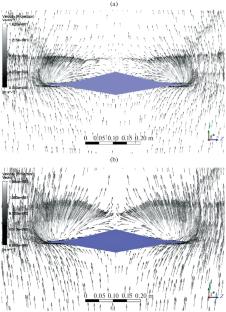
The blended wing body (BWB) is becoming more attractive for modern-day researchers due to its capability to be more fuel efficient, less noisy, and have the better aerodynamic performance. However, a thorough flow investigation of such bodies under varying angles of attack and sideslip conditions is necessary to further enhance the above-mentioned advantages. To investigate the effect of the angle of attack and the sideslip angles, experiments and computations are conducted for a typical BWB at the free-stream velocity of 18 m/s corresponding to the Reynolds number of 58500 based on mean aerodynamic chord. The experimental work consisted of flow visualizations using oil flow techniques and measurements of the forces using an internal 5-component strain gauge balance. Computations were also made to solve numerical simulations using the commercial software Ansys Fluent. The results show a slight variation below 5% in the pressure distribution with change in the sideslip angle. Negligible variations in the lift-to-drag ratio were observed at the lower sideslip angles, whereas slight variations below 10% were observed in the higher sideslip cases. A reasonable agreement between computational and experimental oil flows was also observed, deducing a successful application of the present technique for the investigation of the angle of attack and the sideslip angle in a BWB body.
期刊介绍:
Fluid Dynamics is an international peer reviewed journal that publishes theoretical, computational, and experimental research on aeromechanics, hydrodynamics, plasma dynamics, underground hydrodynamics, and biomechanics of continuous media. Special attention is given to new trends developing at the leading edge of science, such as theory and application of multi-phase flows, chemically reactive flows, liquid and gas flows in electromagnetic fields, new hydrodynamical methods of increasing oil output, new approaches to the description of turbulent flows, etc.




 京公网安备 11010802042870号
京ICP备2023020795号-1
京公网安备 11010802042870号
京ICP备2023020795号-1

 分享
分享
 求助内容:
求助内容: 应助结果提醒方式:
 扫码关注我们
