Jiechang Zhang, Lishun Xiao, Xiujuan Zhao, Peiping Wang, Chengcheng Yang
{"title":"探讨复合膳食抗氧化指数与眼部疾病之间的关系:一项横断面研究。","authors":"Jiechang Zhang, Lishun Xiao, Xiujuan Zhao, Peiping Wang, Chengcheng Yang","doi":"10.1186/s12889-025-21867-5","DOIUrl":null,"url":null,"abstract":"<p><strong>Objective: </strong>Globally, approximately 2.2 billion people suffer from visual impairments or blindness. Dietary patterns are closely associated with the prevalence of multiple ocular diseases. This study aimed to explore the association between Composite Dietary Antioxidant Index (CDAI) and ocular disorders.</p><p><strong>Methods: </strong>The data were derived from 1706 subjects aged 40 years and older who participated in the 2005-2008 National Health and Nutrition Examination Survey (NHANES), which utilized undersampling techniques. Trained staff interviewed participants to gather information about their dietary habits using the 24-h diet recall method. The CDAI, incorporating six antioxidants, was then computed using a validated method. Eye diseases were diagnosed through a combination of examinations and questionnaires. Multinomial logistic regression was used to estimate odds ratios (ORs) and 95% confidence intervals (CIs), adjusting for potential confounders.</p><p><strong>Results: </strong>After adjusting for potential confounders, higher CDAI quartiles (Q4) were significantly associated with reduced odds of diabetic retinopathy (OR: 0.55, P = 0.041), cataracts (OR: 0.37, P < 0.001), glaucoma (OR: 0.48, P = 0.003), and macular degeneration (OR: 0.19, P < 0.001). Carotenoids showed a significant negative correlation with ocular diseases, diabetic retinopathy (OR: 0.57, P < 0.001), cataracts (OR: 0.75, P = 0.014), glaucoma (OR: 0.59, P < 0.001) and macular degeneration (OR: 0.55, P < 0.001). Compared to the lowest quartile (Q1), higher quartiles (Q4) of zinc intake were associated with lower odds of DR (OR: 0.32, P < 0.001) and glaucoma (OR: 0.73, P = 0.001). Similarly, Q4 of vitamin C intake were associated with lower odds of cataracts (OR: 0.70, P = 0.001) and glaucoma (OR: 0.71, P = 0.003) compared to the Q1.</p><p><strong>Conclusion: </strong>Higher CDAI scores are correlated with a decreased odds of ocular diseases, suggesting that an antioxidant-rich dietary pattern may be associated with better ocular health. Understanding these correlations could contribute to the development of preventive strategies and intervention measures for ocular diseases.</p>","PeriodicalId":9039,"journal":{"name":"BMC Public Health","volume":"25 1","pages":"625"},"PeriodicalIF":3.6000,"publicationDate":"2025-02-14","publicationTypes":"Journal Article","fieldsOfStudy":null,"isOpenAccess":false,"openAccessPdf":"https://www.ncbi.nlm.nih.gov/pmc/articles/PMC11829354/pdf/","citationCount":"0","resultStr":"{\"title\":\"Exploring the association between composite dietary antioxidant index and ocular diseases: a cross-sectional study.\",\"authors\":\"Jiechang Zhang, Lishun Xiao, Xiujuan Zhao, Peiping Wang, Chengcheng Yang\",\"doi\":\"10.1186/s12889-025-21867-5\",\"DOIUrl\":null,\"url\":null,\"abstract\":\"<p><strong>Objective: </strong>Globally, approximately 2.2 billion people suffer from visual impairments or blindness. Dietary patterns are closely associated with the prevalence of multiple ocular diseases. This study aimed to explore the association between Composite Dietary Antioxidant Index (CDAI) and ocular disorders.</p><p><strong>Methods: </strong>The data were derived from 1706 subjects aged 40 years and older who participated in the 2005-2008 National Health and Nutrition Examination Survey (NHANES), which utilized undersampling techniques. Trained staff interviewed participants to gather information about their dietary habits using the 24-h diet recall method. The CDAI, incorporating six antioxidants, was then computed using a validated method. Eye diseases were diagnosed through a combination of examinations and questionnaires. Multinomial logistic regression was used to estimate odds ratios (ORs) and 95% confidence intervals (CIs), adjusting for potential confounders.</p><p><strong>Results: </strong>After adjusting for potential confounders, higher CDAI quartiles (Q4) were significantly associated with reduced odds of diabetic retinopathy (OR: 0.55, P = 0.041), cataracts (OR: 0.37, P < 0.001), glaucoma (OR: 0.48, P = 0.003), and macular degeneration (OR: 0.19, P < 0.001). Carotenoids showed a significant negative correlation with ocular diseases, diabetic retinopathy (OR: 0.57, P < 0.001), cataracts (OR: 0.75, P = 0.014), glaucoma (OR: 0.59, P < 0.001) and macular degeneration (OR: 0.55, P < 0.001). Compared to the lowest quartile (Q1), higher quartiles (Q4) of zinc intake were associated with lower odds of DR (OR: 0.32, P < 0.001) and glaucoma (OR: 0.73, P = 0.001). Similarly, Q4 of vitamin C intake were associated with lower odds of cataracts (OR: 0.70, P = 0.001) and glaucoma (OR: 0.71, P = 0.003) compared to the Q1.</p><p><strong>Conclusion: </strong>Higher CDAI scores are correlated with a decreased odds of ocular diseases, suggesting that an antioxidant-rich dietary pattern may be associated with better ocular health. Understanding these correlations could contribute to the development of preventive strategies and intervention measures for ocular diseases.</p>\",\"PeriodicalId\":9039,\"journal\":{\"name\":\"BMC Public Health\",\"volume\":\"25 1\",\"pages\":\"625\"},\"PeriodicalIF\":3.6000,\"publicationDate\":\"2025-02-14\",\"publicationTypes\":\"Journal Article\",\"fieldsOfStudy\":null,\"isOpenAccess\":false,\"openAccessPdf\":\"https://www.ncbi.nlm.nih.gov/pmc/articles/PMC11829354/pdf/\",\"citationCount\":\"0\",\"resultStr\":null,\"platform\":\"Semanticscholar\",\"paperid\":null,\"PeriodicalName\":\"BMC Public Health\",\"FirstCategoryId\":\"3\",\"ListUrlMain\":\"https://doi.org/10.1186/s12889-025-21867-5\",\"RegionNum\":2,\"RegionCategory\":\"医学\",\"ArticlePicture\":[],\"TitleCN\":null,\"AbstractTextCN\":null,\"PMCID\":null,\"EPubDate\":\"\",\"PubModel\":\"\",\"JCR\":\"Q1\",\"JCRName\":\"PUBLIC, ENVIRONMENTAL & OCCUPATIONAL HEALTH\",\"Score\":null,\"Total\":0}","platform":"Semanticscholar","paperid":null,"PeriodicalName":"BMC Public Health","FirstCategoryId":"3","ListUrlMain":"https://doi.org/10.1186/s12889-025-21867-5","RegionNum":2,"RegionCategory":"医学","ArticlePicture":[],"TitleCN":null,"AbstractTextCN":null,"PMCID":null,"EPubDate":"","PubModel":"","JCR":"Q1","JCRName":"PUBLIC, ENVIRONMENTAL & OCCUPATIONAL HEALTH","Score":null,"Total":0}
引用次数: 0
摘要
目标:全球约有22亿人患有视力障碍或失明。饮食模式与多种眼部疾病的患病率密切相关。本研究旨在探讨复合膳食抗氧化指数(CDAI)与眼部疾病的关系。方法:采用欠抽样方法,对参加2005-2008年全国健康与营养调查(NHANES)的年龄在40岁及以上的1706名调查对象进行数据分析。训练有素的工作人员采访了参与者,使用24小时饮食回忆法收集他们的饮食习惯信息。然后使用一种经过验证的方法计算含有六种抗氧化剂的CDAI。眼部疾病通过检查和问卷调查相结合的方式进行诊断。使用多项逻辑回归估计比值比(ORs)和95%置信区间(ci),调整潜在混杂因素。结果:在调整了潜在的混杂因素后,较高的CDAI四分位数(Q4)与糖尿病视网膜病变(OR: 0.55, P = 0.041)和白内障(OR: 0.37, P)的几率降低显著相关。结论:较高的CDAI评分与眼部疾病的几率降低相关,这表明富含抗氧化剂的饮食模式可能与更好的眼部健康有关。了解这些相关性有助于制定眼部疾病的预防策略和干预措施。
Exploring the association between composite dietary antioxidant index and ocular diseases: a cross-sectional study.
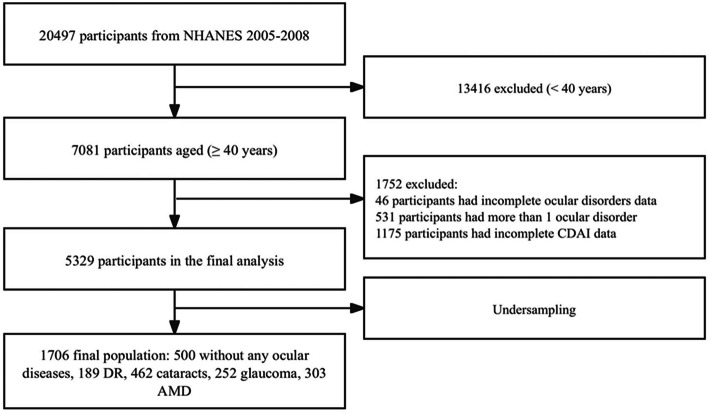
Objective: Globally, approximately 2.2 billion people suffer from visual impairments or blindness. Dietary patterns are closely associated with the prevalence of multiple ocular diseases. This study aimed to explore the association between Composite Dietary Antioxidant Index (CDAI) and ocular disorders.
Methods: The data were derived from 1706 subjects aged 40 years and older who participated in the 2005-2008 National Health and Nutrition Examination Survey (NHANES), which utilized undersampling techniques. Trained staff interviewed participants to gather information about their dietary habits using the 24-h diet recall method. The CDAI, incorporating six antioxidants, was then computed using a validated method. Eye diseases were diagnosed through a combination of examinations and questionnaires. Multinomial logistic regression was used to estimate odds ratios (ORs) and 95% confidence intervals (CIs), adjusting for potential confounders.
Results: After adjusting for potential confounders, higher CDAI quartiles (Q4) were significantly associated with reduced odds of diabetic retinopathy (OR: 0.55, P = 0.041), cataracts (OR: 0.37, P < 0.001), glaucoma (OR: 0.48, P = 0.003), and macular degeneration (OR: 0.19, P < 0.001). Carotenoids showed a significant negative correlation with ocular diseases, diabetic retinopathy (OR: 0.57, P < 0.001), cataracts (OR: 0.75, P = 0.014), glaucoma (OR: 0.59, P < 0.001) and macular degeneration (OR: 0.55, P < 0.001). Compared to the lowest quartile (Q1), higher quartiles (Q4) of zinc intake were associated with lower odds of DR (OR: 0.32, P < 0.001) and glaucoma (OR: 0.73, P = 0.001). Similarly, Q4 of vitamin C intake were associated with lower odds of cataracts (OR: 0.70, P = 0.001) and glaucoma (OR: 0.71, P = 0.003) compared to the Q1.
Conclusion: Higher CDAI scores are correlated with a decreased odds of ocular diseases, suggesting that an antioxidant-rich dietary pattern may be associated with better ocular health. Understanding these correlations could contribute to the development of preventive strategies and intervention measures for ocular diseases.
期刊介绍:
BMC Public Health is an open access, peer-reviewed journal that considers articles on the epidemiology of disease and the understanding of all aspects of public health. The journal has a special focus on the social determinants of health, the environmental, behavioral, and occupational correlates of health and disease, and the impact of health policies, practices and interventions on the community.





 京公网安备 11010802042870号
京ICP备2023020795号-1
京公网安备 11010802042870号
京ICP备2023020795号-1

 分享
分享
 求助内容:
求助内容: 应助结果提醒方式:
 扫码关注我们
