{"title":"血红素进入可溶性胍基环化酶需要血红素氧化还原变化,并通过不同的机制受到NO和Hsp90的调节。","authors":"Yue Dai, Dennis J Stuehr","doi":"10.1016/j.jbc.2025.108315","DOIUrl":null,"url":null,"abstract":"<p><p>Nitric oxide (NO) signaling often relies on it activating cGMP production by the heterodimeric enzyme soluble guanylyl cyclase (sGC). To mature to function, an sGCβ subunit must first incorporate heme and then form a heterodimer with a partner α subunit. Our previous studies in cells showed that glyceraldehyde 3-phosphate dehydrogenase (GAPDH) supplies heme to the apo-sGCβ subunit, which is complexed with the cell chaperone Hsp90. Through its ATP hydrolysis, Hsp90 then promotes heme insertion into apo-sGCβ and consequent formation of a functional heterodimer. NO at physiologic levels somehow stimulates cell heme allocation into apo-sGCβ by this process. To gain insight, we utilized purified apo-sGCβ and GAPDH reporter proteins whose heme contents can be followed by fluorescence and determined the impact of Hsp90 and NO on heme transfer between them. Results show that heme transfer out of GAPDH and into apo-sGCβ is tightly coupled in all circumstances and is limited by the ability of the apo-sGCβ to incorporate the heme, which in turn relies on a ferric to ferrous heme transition taking place inside the sGCβ. Hsp90 can influence the heme transfer kinetics in a negative or positive manner through its conformational effects on apo-sGCβ, while NO speeds heme transfer by binding to the heme iron and thus speeding heme dissociation from GAPDH. Our findings provide new mechanistic understanding of sGC maturation and how Hsp90 and NO combine to dynamically regulate heme incorporation for sGC heterodimer formation and consequent cGMP production in biological settings.</p>","PeriodicalId":15140,"journal":{"name":"Journal of Biological Chemistry","volume":" ","pages":"108315"},"PeriodicalIF":4.0000,"publicationDate":"2025-03-01","publicationTypes":"Journal Article","fieldsOfStudy":null,"isOpenAccess":false,"openAccessPdf":"https://www.ncbi.nlm.nih.gov/pmc/articles/PMC11938259/pdf/","citationCount":"0","resultStr":"{\"title\":\"Heme delivery into soluble guanylyl cyclase requires a heme redox change and is regulated by NO and Hsp90 by distinct mechanisms.\",\"authors\":\"Yue Dai, Dennis J Stuehr\",\"doi\":\"10.1016/j.jbc.2025.108315\",\"DOIUrl\":null,\"url\":null,\"abstract\":\"<p><p>Nitric oxide (NO) signaling often relies on it activating cGMP production by the heterodimeric enzyme soluble guanylyl cyclase (sGC). To mature to function, an sGCβ subunit must first incorporate heme and then form a heterodimer with a partner α subunit. Our previous studies in cells showed that glyceraldehyde 3-phosphate dehydrogenase (GAPDH) supplies heme to the apo-sGCβ subunit, which is complexed with the cell chaperone Hsp90. Through its ATP hydrolysis, Hsp90 then promotes heme insertion into apo-sGCβ and consequent formation of a functional heterodimer. NO at physiologic levels somehow stimulates cell heme allocation into apo-sGCβ by this process. To gain insight, we utilized purified apo-sGCβ and GAPDH reporter proteins whose heme contents can be followed by fluorescence and determined the impact of Hsp90 and NO on heme transfer between them. Results show that heme transfer out of GAPDH and into apo-sGCβ is tightly coupled in all circumstances and is limited by the ability of the apo-sGCβ to incorporate the heme, which in turn relies on a ferric to ferrous heme transition taking place inside the sGCβ. Hsp90 can influence the heme transfer kinetics in a negative or positive manner through its conformational effects on apo-sGCβ, while NO speeds heme transfer by binding to the heme iron and thus speeding heme dissociation from GAPDH. Our findings provide new mechanistic understanding of sGC maturation and how Hsp90 and NO combine to dynamically regulate heme incorporation for sGC heterodimer formation and consequent cGMP production in biological settings.</p>\",\"PeriodicalId\":15140,\"journal\":{\"name\":\"Journal of Biological Chemistry\",\"volume\":\" \",\"pages\":\"108315\"},\"PeriodicalIF\":4.0000,\"publicationDate\":\"2025-03-01\",\"publicationTypes\":\"Journal Article\",\"fieldsOfStudy\":null,\"isOpenAccess\":false,\"openAccessPdf\":\"https://www.ncbi.nlm.nih.gov/pmc/articles/PMC11938259/pdf/\",\"citationCount\":\"0\",\"resultStr\":null,\"platform\":\"Semanticscholar\",\"paperid\":null,\"PeriodicalName\":\"Journal of Biological Chemistry\",\"FirstCategoryId\":\"99\",\"ListUrlMain\":\"https://doi.org/10.1016/j.jbc.2025.108315\",\"RegionNum\":2,\"RegionCategory\":\"生物学\",\"ArticlePicture\":[],\"TitleCN\":null,\"AbstractTextCN\":null,\"PMCID\":null,\"EPubDate\":\"2025/2/13 0:00:00\",\"PubModel\":\"Epub\",\"JCR\":\"Q2\",\"JCRName\":\"BIOCHEMISTRY & MOLECULAR BIOLOGY\",\"Score\":null,\"Total\":0}","platform":"Semanticscholar","paperid":null,"PeriodicalName":"Journal of Biological Chemistry","FirstCategoryId":"99","ListUrlMain":"https://doi.org/10.1016/j.jbc.2025.108315","RegionNum":2,"RegionCategory":"生物学","ArticlePicture":[],"TitleCN":null,"AbstractTextCN":null,"PMCID":null,"EPubDate":"2025/2/13 0:00:00","PubModel":"Epub","JCR":"Q2","JCRName":"BIOCHEMISTRY & MOLECULAR BIOLOGY","Score":null,"Total":0}
Heme delivery into soluble guanylyl cyclase requires a heme redox change and is regulated by NO and Hsp90 by distinct mechanisms.
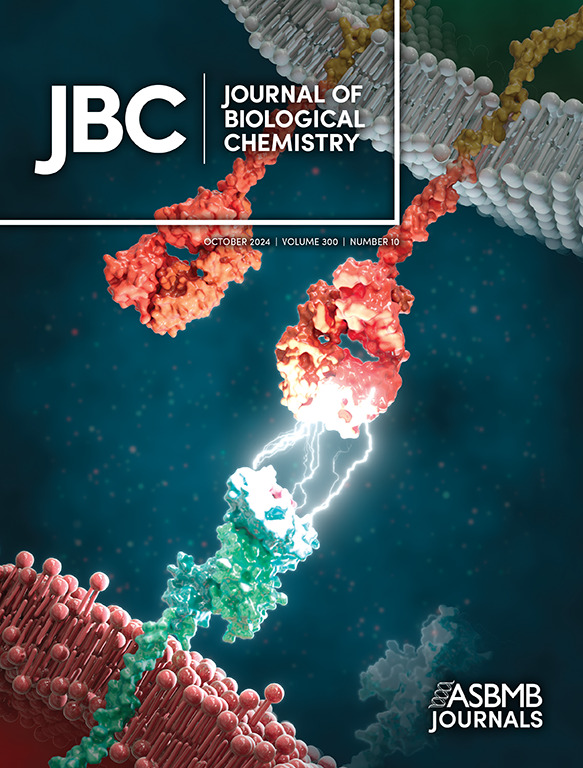
Nitric oxide (NO) signaling often relies on it activating cGMP production by the heterodimeric enzyme soluble guanylyl cyclase (sGC). To mature to function, an sGCβ subunit must first incorporate heme and then form a heterodimer with a partner α subunit. Our previous studies in cells showed that glyceraldehyde 3-phosphate dehydrogenase (GAPDH) supplies heme to the apo-sGCβ subunit, which is complexed with the cell chaperone Hsp90. Through its ATP hydrolysis, Hsp90 then promotes heme insertion into apo-sGCβ and consequent formation of a functional heterodimer. NO at physiologic levels somehow stimulates cell heme allocation into apo-sGCβ by this process. To gain insight, we utilized purified apo-sGCβ and GAPDH reporter proteins whose heme contents can be followed by fluorescence and determined the impact of Hsp90 and NO on heme transfer between them. Results show that heme transfer out of GAPDH and into apo-sGCβ is tightly coupled in all circumstances and is limited by the ability of the apo-sGCβ to incorporate the heme, which in turn relies on a ferric to ferrous heme transition taking place inside the sGCβ. Hsp90 can influence the heme transfer kinetics in a negative or positive manner through its conformational effects on apo-sGCβ, while NO speeds heme transfer by binding to the heme iron and thus speeding heme dissociation from GAPDH. Our findings provide new mechanistic understanding of sGC maturation and how Hsp90 and NO combine to dynamically regulate heme incorporation for sGC heterodimer formation and consequent cGMP production in biological settings.
期刊介绍:
The Journal of Biological Chemistry welcomes high-quality science that seeks to elucidate the molecular and cellular basis of biological processes. Papers published in JBC can therefore fall under the umbrellas of not only biological chemistry, chemical biology, or biochemistry, but also allied disciplines such as biophysics, systems biology, RNA biology, immunology, microbiology, neurobiology, epigenetics, computational biology, ’omics, and many more. The outcome of our focus on papers that contribute novel and important mechanistic insights, rather than on a particular topic area, is that JBC is truly a melting pot for scientists across disciplines. In addition, JBC welcomes papers that describe methods that will help scientists push their biochemical inquiries forward and resources that will be of use to the research community.




 京公网安备 11010802042870号
京ICP备2023020795号-1
京公网安备 11010802042870号
京ICP备2023020795号-1

 分享
分享
 求助内容:
求助内容: 应助结果提醒方式:
 扫码关注我们
