Seongkoo Kang, Jihyun Kim, Youngju Choi, Suwon Lee, Leo W. Gordon, Euan N. Bassey, Jean-Claude Badot, Olaf J. Borkiewicz, Olivier Dubrunfaut, Raphaële J. Clément, Yong-Mook Kang
{"title":"层状锰酸钠阴极层间无序向可逆相变的控制","authors":"Seongkoo Kang, Jihyun Kim, Youngju Choi, Suwon Lee, Leo W. Gordon, Euan N. Bassey, Jean-Claude Badot, Olaf J. Borkiewicz, Olivier Dubrunfaut, Raphaële J. Clément, Yong-Mook Kang","doi":"10.1021/jacs.4c15913","DOIUrl":null,"url":null,"abstract":"Sodium manganese oxides are promising Na-ion battery cathodes but they suffer from irreversible phase transitions during electrochemical reactions. Most strategies to date have aimed to suppress the phase transitions by stabilizing their layered structures through limiting the content of extractable Na<sup>+</sup>. Here, we conversely increase atomic disorder in the Na-birnessite, a layered sodium manganese oxide, and thereby modulate its phase transition behavior toward improved electrochemical reversibility. Our study reveals that Mn vacancies and Mn migrated into the interlayer affect interlayer local environment of Na<sup>+</sup> and water molecules consequently enhancing Na<sup>+</sup> mobility. We observe better capacity retention for disordered “D-Na-birnessite”, which undergoes a reversible phase transition from the birnessite-type structure to an O′3-type α-Na<sub><i>x</i></sub>MnO<sub>2</sub>-like structure through another intermediate metastable birnessite-type phase. This research highlights the positive effects of atomic disorder to regulate phase transition routes for achieving superior electrochemical reversibility, finally paving the way to overcoming the limits of layered oxide cathodes.","PeriodicalId":49,"journal":{"name":"Journal of the American Chemical Society","volume":"14 1","pages":""},"PeriodicalIF":15.6000,"publicationDate":"2025-02-17","publicationTypes":"Journal Article","fieldsOfStudy":null,"isOpenAccess":false,"openAccessPdf":"","citationCount":"0","resultStr":"{\"title\":\"Controlling Interlayer Disorder Toward Reversible Phase Transition in a Layered Sodium Manganese Oxide Cathode\",\"authors\":\"Seongkoo Kang, Jihyun Kim, Youngju Choi, Suwon Lee, Leo W. Gordon, Euan N. Bassey, Jean-Claude Badot, Olaf J. Borkiewicz, Olivier Dubrunfaut, Raphaële J. Clément, Yong-Mook Kang\",\"doi\":\"10.1021/jacs.4c15913\",\"DOIUrl\":null,\"url\":null,\"abstract\":\"Sodium manganese oxides are promising Na-ion battery cathodes but they suffer from irreversible phase transitions during electrochemical reactions. Most strategies to date have aimed to suppress the phase transitions by stabilizing their layered structures through limiting the content of extractable Na<sup>+</sup>. Here, we conversely increase atomic disorder in the Na-birnessite, a layered sodium manganese oxide, and thereby modulate its phase transition behavior toward improved electrochemical reversibility. Our study reveals that Mn vacancies and Mn migrated into the interlayer affect interlayer local environment of Na<sup>+</sup> and water molecules consequently enhancing Na<sup>+</sup> mobility. We observe better capacity retention for disordered “D-Na-birnessite”, which undergoes a reversible phase transition from the birnessite-type structure to an O′3-type α-Na<sub><i>x</i></sub>MnO<sub>2</sub>-like structure through another intermediate metastable birnessite-type phase. This research highlights the positive effects of atomic disorder to regulate phase transition routes for achieving superior electrochemical reversibility, finally paving the way to overcoming the limits of layered oxide cathodes.\",\"PeriodicalId\":49,\"journal\":{\"name\":\"Journal of the American Chemical Society\",\"volume\":\"14 1\",\"pages\":\"\"},\"PeriodicalIF\":15.6000,\"publicationDate\":\"2025-02-17\",\"publicationTypes\":\"Journal Article\",\"fieldsOfStudy\":null,\"isOpenAccess\":false,\"openAccessPdf\":\"\",\"citationCount\":\"0\",\"resultStr\":null,\"platform\":\"Semanticscholar\",\"paperid\":null,\"PeriodicalName\":\"Journal of the American Chemical Society\",\"FirstCategoryId\":\"92\",\"ListUrlMain\":\"https://doi.org/10.1021/jacs.4c15913\",\"RegionNum\":1,\"RegionCategory\":\"化学\",\"ArticlePicture\":[],\"TitleCN\":null,\"AbstractTextCN\":null,\"PMCID\":null,\"EPubDate\":\"\",\"PubModel\":\"\",\"JCR\":\"Q1\",\"JCRName\":\"CHEMISTRY, MULTIDISCIPLINARY\",\"Score\":null,\"Total\":0}","platform":"Semanticscholar","paperid":null,"PeriodicalName":"Journal of the American Chemical Society","FirstCategoryId":"92","ListUrlMain":"https://doi.org/10.1021/jacs.4c15913","RegionNum":1,"RegionCategory":"化学","ArticlePicture":[],"TitleCN":null,"AbstractTextCN":null,"PMCID":null,"EPubDate":"","PubModel":"","JCR":"Q1","JCRName":"CHEMISTRY, MULTIDISCIPLINARY","Score":null,"Total":0}
引用次数: 0
摘要
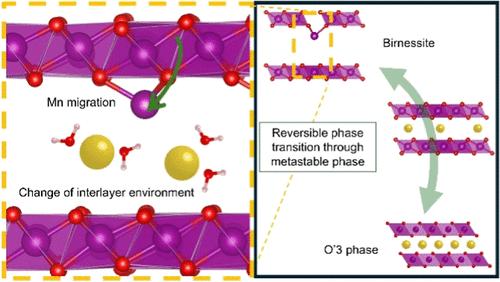
钠锰氧化物是一种很有前途的钠离子电池阴极材料,但在电化学反应过程中存在不可逆相变。迄今为止,大多数策略的目的是通过限制可提取Na+的含量来稳定其层状结构,从而抑制相变。在这里,我们反过来增加了Na-birnessite(一种层状锰酸钠)的原子无序性,从而调节了其相变行为,以提高电化学可逆性。我们的研究表明,Mn空位和Mn迁移到层间影响了Na+和水分子的层间局部环境,从而增强了Na+的迁移率。我们观察到无序的“d - na - birnite”的容量保持较好,它通过另一个中间亚稳birnite型相经历了从birnite型结构到O ' 3型α- naxmno2样结构的可逆相变。本研究强调了原子无序对调节相变路线的积极作用,以实现优异的电化学可逆性,最终为克服层状氧化物阴极的局限性铺平了道路。
Controlling Interlayer Disorder Toward Reversible Phase Transition in a Layered Sodium Manganese Oxide Cathode
Sodium manganese oxides are promising Na-ion battery cathodes but they suffer from irreversible phase transitions during electrochemical reactions. Most strategies to date have aimed to suppress the phase transitions by stabilizing their layered structures through limiting the content of extractable Na+. Here, we conversely increase atomic disorder in the Na-birnessite, a layered sodium manganese oxide, and thereby modulate its phase transition behavior toward improved electrochemical reversibility. Our study reveals that Mn vacancies and Mn migrated into the interlayer affect interlayer local environment of Na+ and water molecules consequently enhancing Na+ mobility. We observe better capacity retention for disordered “D-Na-birnessite”, which undergoes a reversible phase transition from the birnessite-type structure to an O′3-type α-NaxMnO2-like structure through another intermediate metastable birnessite-type phase. This research highlights the positive effects of atomic disorder to regulate phase transition routes for achieving superior electrochemical reversibility, finally paving the way to overcoming the limits of layered oxide cathodes.
期刊介绍:
The flagship journal of the American Chemical Society, known as the Journal of the American Chemical Society (JACS), has been a prestigious publication since its establishment in 1879. It holds a preeminent position in the field of chemistry and related interdisciplinary sciences. JACS is committed to disseminating cutting-edge research papers, covering a wide range of topics, and encompasses approximately 19,000 pages of Articles, Communications, and Perspectives annually. With a weekly publication frequency, JACS plays a vital role in advancing the field of chemistry by providing essential research.




 京公网安备 11010802042870号
京ICP备2023020795号-1
京公网安备 11010802042870号
京ICP备2023020795号-1

 分享
分享
 求助内容:
求助内容: 应助结果提醒方式:
 扫码关注我们
