Juana Goulart Stollmaier, Briana Abigail R. Czarnecki, David W. Christianson
{"title":"硒氰酸酯对组蛋白去乙酰化酶6的抑制机制受氧化还原调节的影响","authors":"Juana Goulart Stollmaier, Briana Abigail R. Czarnecki, David W. Christianson","doi":"10.1021/jacs.5c00157","DOIUrl":null,"url":null,"abstract":"Organoselenocyanates have attracted considerable attention in recent years due to their therapeutic potential and versatility in medicinal chemistry. Here, we report on the mechanism of inhibition by 5-phenylcarbamoylpentyl selenocyanide (SelSA-2), an analogue of the well-characterized histone deacetylase inhibitor suberoylanilide hydroxamic acid (SAHA, a.k.a. Vorinostat). We show that histone deacetylases 6 and 10 promote selenocyanate hydrolysis to generate a selenolate anion, and we explore the redox chemistry of selenium as it modulates inhibitory activity through reversible formation of the diselenide. The 2.15 Å-resolution crystal structure of histone deacetylase 6 cocrystallized with SelSA-2 conclusively demonstrates that it is not the selenocyanate, but instead a zinc-bound selenolate anion, that is the active pharmacophore responsible for enzyme inhibition.","PeriodicalId":49,"journal":{"name":"Journal of the American Chemical Society","volume":"80 1 1","pages":""},"PeriodicalIF":15.6000,"publicationDate":"2025-02-17","publicationTypes":"Journal Article","fieldsOfStudy":null,"isOpenAccess":false,"openAccessPdf":"","citationCount":"0","resultStr":"{\"title\":\"Mechanism-Based Inhibition of Histone Deacetylase 6 by a Selenocyanate Is Subject to Redox Modulation\",\"authors\":\"Juana Goulart Stollmaier, Briana Abigail R. Czarnecki, David W. Christianson\",\"doi\":\"10.1021/jacs.5c00157\",\"DOIUrl\":null,\"url\":null,\"abstract\":\"Organoselenocyanates have attracted considerable attention in recent years due to their therapeutic potential and versatility in medicinal chemistry. Here, we report on the mechanism of inhibition by 5-phenylcarbamoylpentyl selenocyanide (SelSA-2), an analogue of the well-characterized histone deacetylase inhibitor suberoylanilide hydroxamic acid (SAHA, a.k.a. Vorinostat). We show that histone deacetylases 6 and 10 promote selenocyanate hydrolysis to generate a selenolate anion, and we explore the redox chemistry of selenium as it modulates inhibitory activity through reversible formation of the diselenide. The 2.15 Å-resolution crystal structure of histone deacetylase 6 cocrystallized with SelSA-2 conclusively demonstrates that it is not the selenocyanate, but instead a zinc-bound selenolate anion, that is the active pharmacophore responsible for enzyme inhibition.\",\"PeriodicalId\":49,\"journal\":{\"name\":\"Journal of the American Chemical Society\",\"volume\":\"80 1 1\",\"pages\":\"\"},\"PeriodicalIF\":15.6000,\"publicationDate\":\"2025-02-17\",\"publicationTypes\":\"Journal Article\",\"fieldsOfStudy\":null,\"isOpenAccess\":false,\"openAccessPdf\":\"\",\"citationCount\":\"0\",\"resultStr\":null,\"platform\":\"Semanticscholar\",\"paperid\":null,\"PeriodicalName\":\"Journal of the American Chemical Society\",\"FirstCategoryId\":\"92\",\"ListUrlMain\":\"https://doi.org/10.1021/jacs.5c00157\",\"RegionNum\":1,\"RegionCategory\":\"化学\",\"ArticlePicture\":[],\"TitleCN\":null,\"AbstractTextCN\":null,\"PMCID\":null,\"EPubDate\":\"\",\"PubModel\":\"\",\"JCR\":\"Q1\",\"JCRName\":\"CHEMISTRY, MULTIDISCIPLINARY\",\"Score\":null,\"Total\":0}","platform":"Semanticscholar","paperid":null,"PeriodicalName":"Journal of the American Chemical Society","FirstCategoryId":"92","ListUrlMain":"https://doi.org/10.1021/jacs.5c00157","RegionNum":1,"RegionCategory":"化学","ArticlePicture":[],"TitleCN":null,"AbstractTextCN":null,"PMCID":null,"EPubDate":"","PubModel":"","JCR":"Q1","JCRName":"CHEMISTRY, MULTIDISCIPLINARY","Score":null,"Total":0}
Mechanism-Based Inhibition of Histone Deacetylase 6 by a Selenocyanate Is Subject to Redox Modulation
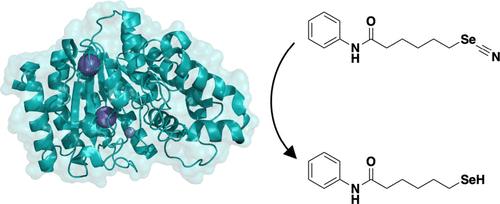
Organoselenocyanates have attracted considerable attention in recent years due to their therapeutic potential and versatility in medicinal chemistry. Here, we report on the mechanism of inhibition by 5-phenylcarbamoylpentyl selenocyanide (SelSA-2), an analogue of the well-characterized histone deacetylase inhibitor suberoylanilide hydroxamic acid (SAHA, a.k.a. Vorinostat). We show that histone deacetylases 6 and 10 promote selenocyanate hydrolysis to generate a selenolate anion, and we explore the redox chemistry of selenium as it modulates inhibitory activity through reversible formation of the diselenide. The 2.15 Å-resolution crystal structure of histone deacetylase 6 cocrystallized with SelSA-2 conclusively demonstrates that it is not the selenocyanate, but instead a zinc-bound selenolate anion, that is the active pharmacophore responsible for enzyme inhibition.
期刊介绍:
The flagship journal of the American Chemical Society, known as the Journal of the American Chemical Society (JACS), has been a prestigious publication since its establishment in 1879. It holds a preeminent position in the field of chemistry and related interdisciplinary sciences. JACS is committed to disseminating cutting-edge research papers, covering a wide range of topics, and encompasses approximately 19,000 pages of Articles, Communications, and Perspectives annually. With a weekly publication frequency, JACS plays a vital role in advancing the field of chemistry by providing essential research.




 京公网安备 11010802042870号
京ICP备2023020795号-1
京公网安备 11010802042870号
京ICP备2023020795号-1

 分享
分享
 求助内容:
求助内容: 应助结果提醒方式:
 扫码关注我们
