Guo-Quan Huang, Ri-Qin Xia, Xu Chen, Hu Yang, Yong-Liang Huang, Kun Wu, Ji Zheng, Weigang Lu, Dan Li
{"title":"近单位量子产率的Cu(I)环三核配合物热激发延迟磷光的实现","authors":"Guo-Quan Huang, Ri-Qin Xia, Xu Chen, Hu Yang, Yong-Liang Huang, Kun Wu, Ji Zheng, Weigang Lu, Dan Li","doi":"10.1021/jacs.4c09907","DOIUrl":null,"url":null,"abstract":"Thermally stimulated delayed phosphorescence (TSDP) emission has recently been discovered in several Au(I)/Au(III) complexes, featuring thermally enhanced emission intensities and notable quantum yields (QYs). Developing earth-abundant metal-based TSDP emitters with further increased QYs holds significant promise for practical applications. Herein, we present a halogen bonding approach to achieve TSDP emission in bromo-substituted Cu(I) cyclic trinuclear complexes (CTCs). Photophysical analysis and theoretical calculations reveal the crucial role of halogen bonding in suppressing the excited-state distortions and reducing energy differences between the first and second triplet excited states (T<sub>1</sub> and T<sub>2</sub>). This enables efficient spin-allowed reverse internal conversion, leading to the TSDP behavior. Additionally, the low internal reorganization energy and rigid halogen-bonded network in bromo-substituted Cu(I) CTCs result in significantly suppressed nonradiative decay and high QYs, with one approaching near-unity. This work provides an innovative approach to extend the TSDP behavior from Au(I)/Au(III) to Cu(I) complexes with high QYs.","PeriodicalId":49,"journal":{"name":"Journal of the American Chemical Society","volume":"15 1","pages":""},"PeriodicalIF":15.6000,"publicationDate":"2025-02-17","publicationTypes":"Journal Article","fieldsOfStudy":null,"isOpenAccess":false,"openAccessPdf":"","citationCount":"0","resultStr":"{\"title\":\"Enabling Thermally Stimulated Delayed Phosphorescence in Cu(I) Cyclic Trinuclear Complexes with Near-Unity Quantum Yield\",\"authors\":\"Guo-Quan Huang, Ri-Qin Xia, Xu Chen, Hu Yang, Yong-Liang Huang, Kun Wu, Ji Zheng, Weigang Lu, Dan Li\",\"doi\":\"10.1021/jacs.4c09907\",\"DOIUrl\":null,\"url\":null,\"abstract\":\"Thermally stimulated delayed phosphorescence (TSDP) emission has recently been discovered in several Au(I)/Au(III) complexes, featuring thermally enhanced emission intensities and notable quantum yields (QYs). Developing earth-abundant metal-based TSDP emitters with further increased QYs holds significant promise for practical applications. Herein, we present a halogen bonding approach to achieve TSDP emission in bromo-substituted Cu(I) cyclic trinuclear complexes (CTCs). Photophysical analysis and theoretical calculations reveal the crucial role of halogen bonding in suppressing the excited-state distortions and reducing energy differences between the first and second triplet excited states (T<sub>1</sub> and T<sub>2</sub>). This enables efficient spin-allowed reverse internal conversion, leading to the TSDP behavior. Additionally, the low internal reorganization energy and rigid halogen-bonded network in bromo-substituted Cu(I) CTCs result in significantly suppressed nonradiative decay and high QYs, with one approaching near-unity. This work provides an innovative approach to extend the TSDP behavior from Au(I)/Au(III) to Cu(I) complexes with high QYs.\",\"PeriodicalId\":49,\"journal\":{\"name\":\"Journal of the American Chemical Society\",\"volume\":\"15 1\",\"pages\":\"\"},\"PeriodicalIF\":15.6000,\"publicationDate\":\"2025-02-17\",\"publicationTypes\":\"Journal Article\",\"fieldsOfStudy\":null,\"isOpenAccess\":false,\"openAccessPdf\":\"\",\"citationCount\":\"0\",\"resultStr\":null,\"platform\":\"Semanticscholar\",\"paperid\":null,\"PeriodicalName\":\"Journal of the American Chemical Society\",\"FirstCategoryId\":\"92\",\"ListUrlMain\":\"https://doi.org/10.1021/jacs.4c09907\",\"RegionNum\":1,\"RegionCategory\":\"化学\",\"ArticlePicture\":[],\"TitleCN\":null,\"AbstractTextCN\":null,\"PMCID\":null,\"EPubDate\":\"\",\"PubModel\":\"\",\"JCR\":\"Q1\",\"JCRName\":\"CHEMISTRY, MULTIDISCIPLINARY\",\"Score\":null,\"Total\":0}","platform":"Semanticscholar","paperid":null,"PeriodicalName":"Journal of the American Chemical Society","FirstCategoryId":"92","ListUrlMain":"https://doi.org/10.1021/jacs.4c09907","RegionNum":1,"RegionCategory":"化学","ArticlePicture":[],"TitleCN":null,"AbstractTextCN":null,"PMCID":null,"EPubDate":"","PubModel":"","JCR":"Q1","JCRName":"CHEMISTRY, MULTIDISCIPLINARY","Score":null,"Total":0}
Enabling Thermally Stimulated Delayed Phosphorescence in Cu(I) Cyclic Trinuclear Complexes with Near-Unity Quantum Yield
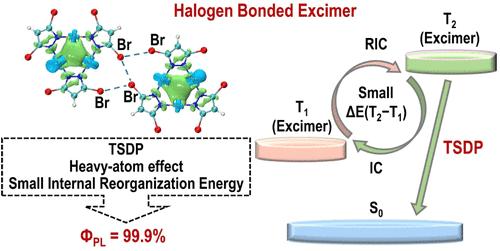
Thermally stimulated delayed phosphorescence (TSDP) emission has recently been discovered in several Au(I)/Au(III) complexes, featuring thermally enhanced emission intensities and notable quantum yields (QYs). Developing earth-abundant metal-based TSDP emitters with further increased QYs holds significant promise for practical applications. Herein, we present a halogen bonding approach to achieve TSDP emission in bromo-substituted Cu(I) cyclic trinuclear complexes (CTCs). Photophysical analysis and theoretical calculations reveal the crucial role of halogen bonding in suppressing the excited-state distortions and reducing energy differences between the first and second triplet excited states (T1 and T2). This enables efficient spin-allowed reverse internal conversion, leading to the TSDP behavior. Additionally, the low internal reorganization energy and rigid halogen-bonded network in bromo-substituted Cu(I) CTCs result in significantly suppressed nonradiative decay and high QYs, with one approaching near-unity. This work provides an innovative approach to extend the TSDP behavior from Au(I)/Au(III) to Cu(I) complexes with high QYs.
期刊介绍:
The flagship journal of the American Chemical Society, known as the Journal of the American Chemical Society (JACS), has been a prestigious publication since its establishment in 1879. It holds a preeminent position in the field of chemistry and related interdisciplinary sciences. JACS is committed to disseminating cutting-edge research papers, covering a wide range of topics, and encompasses approximately 19,000 pages of Articles, Communications, and Perspectives annually. With a weekly publication frequency, JACS plays a vital role in advancing the field of chemistry by providing essential research.




 京公网安备 11010802042870号
京ICP备2023020795号-1
京公网安备 11010802042870号
京ICP备2023020795号-1

 分享
分享
 求助内容:
求助内容: 应助结果提醒方式:
 扫码关注我们
