Ronald T. Jerozal, Jaehwan Kim, Carolyn Ma, Tristan A. Pitt, Jung-Hoon Lee, Phillip J. Milner
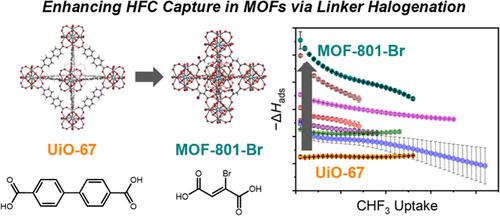
{"title":"通过金属-有机框架的卤化增强选择性氢氟碳温室气体捕获","authors":"Ronald T. Jerozal, Jaehwan Kim, Carolyn Ma, Tristan A. Pitt, Jung-Hoon Lee, Phillip J. Milner","doi":"10.1021/jacs.5c00393","DOIUrl":null,"url":null,"abstract":"Hydrofluorocarbons (HFCs) are anthropogenically produced greenhouse gases with longer atmospheric lifetimes and higher global warming potentials than those of carbon dioxide. General strategies to abate their emissions from industrial point sources, such as via adsorptive capture, remain scarce. Herein, we uncover the key structure–property relationships that lead to strong binding of HFCs such as fluoroform (CHF<sub>3</sub>) and difluoromethane (CH<sub>2</sub>F<sub>2</sub>) in metal–organic frameworks (MOFs) under the low pressures relevant to flue gas scrubbing. Extensive gas sorption and computational studies support that the Zr-based microporous framework MOF-801-Br or HHU-2-Br (HHU = Heinrich-Heine-University Düsseldorf) strongly binds HFCs due to its synergistic combination of Zr-OH sites on the nodes and bromine sites on the linkers. As such, MOF-801-Br demonstrates a record-setting performance for separating CHF<sub>3</sub> from N<sub>2</sub> under dilute conditions. Our work highlights that the combination of multiple hydrogen-bonding sites in microporous MOFs represents a generalizable strategy for HFC capture, enabling their selective removal from industrial waste streams.","PeriodicalId":49,"journal":{"name":"Journal of the American Chemical Society","volume":"23 1","pages":""},"PeriodicalIF":15.6000,"publicationDate":"2025-02-16","publicationTypes":"Journal Article","fieldsOfStudy":null,"isOpenAccess":false,"openAccessPdf":"","citationCount":"0","resultStr":"{\"title\":\"Enhancing Selective Hydrofluorocarbon Greenhouse Gas Capture via Halogenation of Metal–Organic Frameworks\",\"authors\":\"Ronald T. Jerozal, Jaehwan Kim, Carolyn Ma, Tristan A. Pitt, Jung-Hoon Lee, Phillip J. Milner\",\"doi\":\"10.1021/jacs.5c00393\",\"DOIUrl\":null,\"url\":null,\"abstract\":\"Hydrofluorocarbons (HFCs) are anthropogenically produced greenhouse gases with longer atmospheric lifetimes and higher global warming potentials than those of carbon dioxide. General strategies to abate their emissions from industrial point sources, such as via adsorptive capture, remain scarce. Herein, we uncover the key structure–property relationships that lead to strong binding of HFCs such as fluoroform (CHF<sub>3</sub>) and difluoromethane (CH<sub>2</sub>F<sub>2</sub>) in metal–organic frameworks (MOFs) under the low pressures relevant to flue gas scrubbing. Extensive gas sorption and computational studies support that the Zr-based microporous framework MOF-801-Br or HHU-2-Br (HHU = Heinrich-Heine-University Düsseldorf) strongly binds HFCs due to its synergistic combination of Zr-OH sites on the nodes and bromine sites on the linkers. As such, MOF-801-Br demonstrates a record-setting performance for separating CHF<sub>3</sub> from N<sub>2</sub> under dilute conditions. Our work highlights that the combination of multiple hydrogen-bonding sites in microporous MOFs represents a generalizable strategy for HFC capture, enabling their selective removal from industrial waste streams.\",\"PeriodicalId\":49,\"journal\":{\"name\":\"Journal of the American Chemical Society\",\"volume\":\"23 1\",\"pages\":\"\"},\"PeriodicalIF\":15.6000,\"publicationDate\":\"2025-02-16\",\"publicationTypes\":\"Journal Article\",\"fieldsOfStudy\":null,\"isOpenAccess\":false,\"openAccessPdf\":\"\",\"citationCount\":\"0\",\"resultStr\":null,\"platform\":\"Semanticscholar\",\"paperid\":null,\"PeriodicalName\":\"Journal of the American Chemical Society\",\"FirstCategoryId\":\"92\",\"ListUrlMain\":\"https://doi.org/10.1021/jacs.5c00393\",\"RegionNum\":1,\"RegionCategory\":\"化学\",\"ArticlePicture\":[],\"TitleCN\":null,\"AbstractTextCN\":null,\"PMCID\":null,\"EPubDate\":\"\",\"PubModel\":\"\",\"JCR\":\"Q1\",\"JCRName\":\"CHEMISTRY, MULTIDISCIPLINARY\",\"Score\":null,\"Total\":0}","platform":"Semanticscholar","paperid":null,"PeriodicalName":"Journal of the American Chemical Society","FirstCategoryId":"92","ListUrlMain":"https://doi.org/10.1021/jacs.5c00393","RegionNum":1,"RegionCategory":"化学","ArticlePicture":[],"TitleCN":null,"AbstractTextCN":null,"PMCID":null,"EPubDate":"","PubModel":"","JCR":"Q1","JCRName":"CHEMISTRY, MULTIDISCIPLINARY","Score":null,"Total":0}
引用次数: 0
摘要
氢氟碳化合物是一种人为产生的温室气体,与二氧化碳相比,其在大气中的寿命更长,全球变暖潜能值更高。减少工业点源排放的一般战略,例如通过吸附捕集,仍然很少。在此,我们揭示了在与烟气洗涤相关的低压下,导致氢氟碳化物(如氟甲烷(CHF3)和二氟甲烷(CH2F2))在金属-有机框架(mof)中强结合的关键结构-性质关系。大量的气体吸附和计算研究表明,基于zr的微孔框架MOF-801-Br或HHU-2- br (HHU = Heinrich-Heine-University d sseldorf)由于其节点上的Zr-OH位点和连接体上的溴位点的协同结合而强结合hfc。因此,MOF-801-Br在稀条件下从N2中分离CHF3表现出创纪录的性能。我们的工作强调了微孔mof中多个氢键位点的组合代表了一种通用的HFC捕获策略,使其能够从工业废水中选择性去除。
Enhancing Selective Hydrofluorocarbon Greenhouse Gas Capture via Halogenation of Metal–Organic Frameworks
Hydrofluorocarbons (HFCs) are anthropogenically produced greenhouse gases with longer atmospheric lifetimes and higher global warming potentials than those of carbon dioxide. General strategies to abate their emissions from industrial point sources, such as via adsorptive capture, remain scarce. Herein, we uncover the key structure–property relationships that lead to strong binding of HFCs such as fluoroform (CHF3) and difluoromethane (CH2F2) in metal–organic frameworks (MOFs) under the low pressures relevant to flue gas scrubbing. Extensive gas sorption and computational studies support that the Zr-based microporous framework MOF-801-Br or HHU-2-Br (HHU = Heinrich-Heine-University Düsseldorf) strongly binds HFCs due to its synergistic combination of Zr-OH sites on the nodes and bromine sites on the linkers. As such, MOF-801-Br demonstrates a record-setting performance for separating CHF3 from N2 under dilute conditions. Our work highlights that the combination of multiple hydrogen-bonding sites in microporous MOFs represents a generalizable strategy for HFC capture, enabling their selective removal from industrial waste streams.
期刊介绍:
The flagship journal of the American Chemical Society, known as the Journal of the American Chemical Society (JACS), has been a prestigious publication since its establishment in 1879. It holds a preeminent position in the field of chemistry and related interdisciplinary sciences. JACS is committed to disseminating cutting-edge research papers, covering a wide range of topics, and encompasses approximately 19,000 pages of Articles, Communications, and Perspectives annually. With a weekly publication frequency, JACS plays a vital role in advancing the field of chemistry by providing essential research.




 京公网安备 11010802042870号
京ICP备2023020795号-1
京公网安备 11010802042870号
京ICP备2023020795号-1

 分享
分享
 求助内容:
求助内容: 应助结果提醒方式:
 扫码关注我们
