Hao Tang , Luyao Li , Qin Yu , Linjie Chen , Xiaoxia Xu , Ziyao Meng , Yuqing Zeng , Fan Chen , Hammad Muzaffar , Wei Wang , Xia Zhao , Guang Liang
{"title":"Sclareol通过与CDK9相互作用抑制小胶质细胞炎症,改善阿尔茨海默病的病理","authors":"Hao Tang , Luyao Li , Qin Yu , Linjie Chen , Xiaoxia Xu , Ziyao Meng , Yuqing Zeng , Fan Chen , Hammad Muzaffar , Wei Wang , Xia Zhao , Guang Liang","doi":"10.1016/j.phymed.2025.156504","DOIUrl":null,"url":null,"abstract":"<div><h3>Background</h3><div>Excessive activation of microglia triggers pro-inflammatory responses, exacerbating neuronal damage and accelerating the progression of Alzheimer's disease (AD). Thus, targeting abnormal microglial activation represents a promising therapeutic strategy for AD. In this study, we identified sclareol (SCL) through compound library screening as a potent anti-inflammatory agent capable of crossing the blood-brain barrier. However, there are currently no reports on whether SCL modulates microglial inflammation or ameliorates AD pathology.</div></div><div><h3>Objective</h3><div>To evaluate the anti-inflammatory effects and underlying molecular mechanism of SCL on microglial-mediated inflammation and neuronal damage in AD.</div></div><div><h3>Methods</h3><div>Drug Affinity Responsive Target Stability (DARTS), Liquid Chromatography-Tandem Mass Spectrometry (LC-MS), protein interaction assays, Biolayer Interferometry (BLI), and molecular docking were used to explore the interaction between SCL and cyclin-dependent kinase 9 (CDK9). Behavioral tests and immunofluorescent (IF) staining were performed to assess the effects of SCL on microglial activation and AD pathology. The molecular mechanism of the anti-inflammatory effect of SCL was analyzed by interfering with CDK9.</div></div><div><h3>Results</h3><div>SCL significantly inhibited the release of proinflammatory mediators, reduced neuronal damage, and alleviated cognitive deficits in AD model mice. Notably, SCL demonstrated the ability to cross the blood-brain barrier (BBB), highlighting its therapeutic potential. Mechanistically, SCL binds directly to CDK9, which contributes to the inflammatory response through its interaction with NF-κB. Knockdown of CDK9 reduced the NF-κB-mediated inflammatory response, but did not have an additive effect on SCL, indicating that SCL's efficacy is mediated by CDK9 inhibition and subsequent suppression of the NF-κB signaling pathway.</div></div><div><h3>Conclusion</h3><div>This study demonstrates that SCL exerts neuroprotective effects in AD mice by targeting CDK9 and downstream NF-κB signaling pathway to reduce the inflammatory activation of microglia. These findings suggest that SCL is a promising candidate for the treatment of AD, offering a novel therapeutic approach to mitigate disease progression through modulation of microglial activation.</div></div>","PeriodicalId":20212,"journal":{"name":"Phytomedicine","volume":"139 ","pages":"Article 156504"},"PeriodicalIF":8.3000,"publicationDate":"2025-04-01","publicationTypes":"Journal Article","fieldsOfStudy":null,"isOpenAccess":false,"openAccessPdf":"","citationCount":"0","resultStr":"{\"title\":\"Sclareol improves the pathology of Alzheimer's disease by inhibiting microglial inflammation via interacting with CDK9\",\"authors\":\"Hao Tang , Luyao Li , Qin Yu , Linjie Chen , Xiaoxia Xu , Ziyao Meng , Yuqing Zeng , Fan Chen , Hammad Muzaffar , Wei Wang , Xia Zhao , Guang Liang\",\"doi\":\"10.1016/j.phymed.2025.156504\",\"DOIUrl\":null,\"url\":null,\"abstract\":\"<div><h3>Background</h3><div>Excessive activation of microglia triggers pro-inflammatory responses, exacerbating neuronal damage and accelerating the progression of Alzheimer's disease (AD). Thus, targeting abnormal microglial activation represents a promising therapeutic strategy for AD. In this study, we identified sclareol (SCL) through compound library screening as a potent anti-inflammatory agent capable of crossing the blood-brain barrier. However, there are currently no reports on whether SCL modulates microglial inflammation or ameliorates AD pathology.</div></div><div><h3>Objective</h3><div>To evaluate the anti-inflammatory effects and underlying molecular mechanism of SCL on microglial-mediated inflammation and neuronal damage in AD.</div></div><div><h3>Methods</h3><div>Drug Affinity Responsive Target Stability (DARTS), Liquid Chromatography-Tandem Mass Spectrometry (LC-MS), protein interaction assays, Biolayer Interferometry (BLI), and molecular docking were used to explore the interaction between SCL and cyclin-dependent kinase 9 (CDK9). Behavioral tests and immunofluorescent (IF) staining were performed to assess the effects of SCL on microglial activation and AD pathology. The molecular mechanism of the anti-inflammatory effect of SCL was analyzed by interfering with CDK9.</div></div><div><h3>Results</h3><div>SCL significantly inhibited the release of proinflammatory mediators, reduced neuronal damage, and alleviated cognitive deficits in AD model mice. Notably, SCL demonstrated the ability to cross the blood-brain barrier (BBB), highlighting its therapeutic potential. Mechanistically, SCL binds directly to CDK9, which contributes to the inflammatory response through its interaction with NF-κB. Knockdown of CDK9 reduced the NF-κB-mediated inflammatory response, but did not have an additive effect on SCL, indicating that SCL's efficacy is mediated by CDK9 inhibition and subsequent suppression of the NF-κB signaling pathway.</div></div><div><h3>Conclusion</h3><div>This study demonstrates that SCL exerts neuroprotective effects in AD mice by targeting CDK9 and downstream NF-κB signaling pathway to reduce the inflammatory activation of microglia. These findings suggest that SCL is a promising candidate for the treatment of AD, offering a novel therapeutic approach to mitigate disease progression through modulation of microglial activation.</div></div>\",\"PeriodicalId\":20212,\"journal\":{\"name\":\"Phytomedicine\",\"volume\":\"139 \",\"pages\":\"Article 156504\"},\"PeriodicalIF\":8.3000,\"publicationDate\":\"2025-04-01\",\"publicationTypes\":\"Journal Article\",\"fieldsOfStudy\":null,\"isOpenAccess\":false,\"openAccessPdf\":\"\",\"citationCount\":\"0\",\"resultStr\":null,\"platform\":\"Semanticscholar\",\"paperid\":null,\"PeriodicalName\":\"Phytomedicine\",\"FirstCategoryId\":\"3\",\"ListUrlMain\":\"https://www.sciencedirect.com/science/article/pii/S094471132500145X\",\"RegionNum\":1,\"RegionCategory\":\"医学\",\"ArticlePicture\":[],\"TitleCN\":null,\"AbstractTextCN\":null,\"PMCID\":null,\"EPubDate\":\"2025/2/13 0:00:00\",\"PubModel\":\"Epub\",\"JCR\":\"Q1\",\"JCRName\":\"CHEMISTRY, MEDICINAL\",\"Score\":null,\"Total\":0}","platform":"Semanticscholar","paperid":null,"PeriodicalName":"Phytomedicine","FirstCategoryId":"3","ListUrlMain":"https://www.sciencedirect.com/science/article/pii/S094471132500145X","RegionNum":1,"RegionCategory":"医学","ArticlePicture":[],"TitleCN":null,"AbstractTextCN":null,"PMCID":null,"EPubDate":"2025/2/13 0:00:00","PubModel":"Epub","JCR":"Q1","JCRName":"CHEMISTRY, MEDICINAL","Score":null,"Total":0}
Sclareol improves the pathology of Alzheimer's disease by inhibiting microglial inflammation via interacting with CDK9
Background
Excessive activation of microglia triggers pro-inflammatory responses, exacerbating neuronal damage and accelerating the progression of Alzheimer's disease (AD). Thus, targeting abnormal microglial activation represents a promising therapeutic strategy for AD. In this study, we identified sclareol (SCL) through compound library screening as a potent anti-inflammatory agent capable of crossing the blood-brain barrier. However, there are currently no reports on whether SCL modulates microglial inflammation or ameliorates AD pathology.
Objective
To evaluate the anti-inflammatory effects and underlying molecular mechanism of SCL on microglial-mediated inflammation and neuronal damage in AD.
Methods
Drug Affinity Responsive Target Stability (DARTS), Liquid Chromatography-Tandem Mass Spectrometry (LC-MS), protein interaction assays, Biolayer Interferometry (BLI), and molecular docking were used to explore the interaction between SCL and cyclin-dependent kinase 9 (CDK9). Behavioral tests and immunofluorescent (IF) staining were performed to assess the effects of SCL on microglial activation and AD pathology. The molecular mechanism of the anti-inflammatory effect of SCL was analyzed by interfering with CDK9.
Results
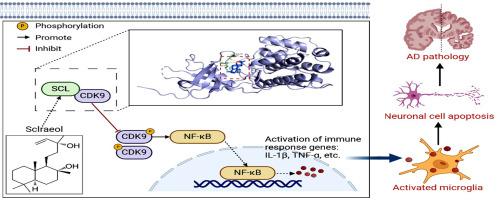
SCL significantly inhibited the release of proinflammatory mediators, reduced neuronal damage, and alleviated cognitive deficits in AD model mice. Notably, SCL demonstrated the ability to cross the blood-brain barrier (BBB), highlighting its therapeutic potential. Mechanistically, SCL binds directly to CDK9, which contributes to the inflammatory response through its interaction with NF-κB. Knockdown of CDK9 reduced the NF-κB-mediated inflammatory response, but did not have an additive effect on SCL, indicating that SCL's efficacy is mediated by CDK9 inhibition and subsequent suppression of the NF-κB signaling pathway.
Conclusion
This study demonstrates that SCL exerts neuroprotective effects in AD mice by targeting CDK9 and downstream NF-κB signaling pathway to reduce the inflammatory activation of microglia. These findings suggest that SCL is a promising candidate for the treatment of AD, offering a novel therapeutic approach to mitigate disease progression through modulation of microglial activation.
期刊介绍:
Phytomedicine is a therapy-oriented journal that publishes innovative studies on the efficacy, safety, quality, and mechanisms of action of specified plant extracts, phytopharmaceuticals, and their isolated constituents. This includes clinical, pharmacological, pharmacokinetic, and toxicological studies of herbal medicinal products, preparations, and purified compounds with defined and consistent quality, ensuring reproducible pharmacological activity. Founded in 1994, Phytomedicine aims to focus and stimulate research in this field and establish internationally accepted scientific standards for pharmacological studies, proof of clinical efficacy, and safety of phytomedicines.





 京公网安备 11010802042870号
京ICP备2023020795号-1
京公网安备 11010802042870号
京ICP备2023020795号-1

 分享
分享
 求助内容:
求助内容: 应助结果提醒方式:
 扫码关注我们
