Vishnu Murali , Hanbyeol Kim , Han Ung Kim , Jung Rae Kim , Sang Hwan Son , Young-Kwon Park , Jeong-Myeong Ha , Jungho Jae
{"title":"选择性一锅化学回收PET废料二甲苯单体:洞察Ru/TiO2催化剂设计和界面动力学在双相系统†","authors":"Vishnu Murali , Hanbyeol Kim , Han Ung Kim , Jung Rae Kim , Sang Hwan Son , Young-Kwon Park , Jeong-Myeong Ha , Jungho Jae","doi":"10.1039/d4gc04762a","DOIUrl":null,"url":null,"abstract":"<div><div>This study presents a significant advancement in the conversion of waste polyethylene terephthalate (PET) into benzene, toluene, and xylene (BTX)—valuable aromatic monomers—<em>via</em> a single-step catalytic pathway. Investigating the effect of the TiO<sub>2</sub> support's morphology revealed that commercial P25, with its hydrophilic properties, was the optimal support for BTX production. Its capability to form a stable oil/water (O/W) emulsion facilitated the efficient transport of depolymerized PET monomers to the oil phase, enhancing the hydrogenation and deoxygenation of oxygenated aromatic hydrocarbons. Examining the influence of Ru particle size (0.9–2.1 nm) on BTX production showed that smaller Ru particles enhanced activity for forming unsaturated cyclic hydrocarbons. The catalyst (2 wt% Ru/TiO<sub>2</sub>-P2-400), prepared using the polyol method, achieved nearly complete PET conversion and ∼99% selectivity for BTX under mild conditions (220 °C, 10 bar H<sub>2</sub>, 12 h). Additionally, the study highlighted the role of strong metal–support interactions (SMSIs) achieved at a reduction temperature of 400 °C, which significantly improved PET hydrodeoxygenation (HDO) efficiency by promoting C–O bond cleavage through an undercoordinated pathway. Ru nanoparticles located in the inner interfacial layer of the Pickering emulsion accelerated deoxygenation, which was crucial for BTX formation. These findings underscore the importance of optimizing catalyst design, Ru particle size, and interfacial dynamics to achieve high selectivity and efficiency in PET recycling.</div></div>","PeriodicalId":78,"journal":{"name":"Green Chemistry","volume":"27 8","pages":"Pages 2203-2219"},"PeriodicalIF":9.2000,"publicationDate":"2025-01-21","publicationTypes":"Journal Article","fieldsOfStudy":null,"isOpenAccess":false,"openAccessPdf":"","citationCount":"0","resultStr":"{\"title\":\"Selective one-pot chemical recycling of PET waste to xylene monomers: insights into a Ru/TiO2 catalyst design and interfacial dynamics in a biphasic system†\",\"authors\":\"Vishnu Murali , Hanbyeol Kim , Han Ung Kim , Jung Rae Kim , Sang Hwan Son , Young-Kwon Park , Jeong-Myeong Ha , Jungho Jae\",\"doi\":\"10.1039/d4gc04762a\",\"DOIUrl\":null,\"url\":null,\"abstract\":\"<div><div>This study presents a significant advancement in the conversion of waste polyethylene terephthalate (PET) into benzene, toluene, and xylene (BTX)—valuable aromatic monomers—<em>via</em> a single-step catalytic pathway. Investigating the effect of the TiO<sub>2</sub> support's morphology revealed that commercial P25, with its hydrophilic properties, was the optimal support for BTX production. Its capability to form a stable oil/water (O/W) emulsion facilitated the efficient transport of depolymerized PET monomers to the oil phase, enhancing the hydrogenation and deoxygenation of oxygenated aromatic hydrocarbons. Examining the influence of Ru particle size (0.9–2.1 nm) on BTX production showed that smaller Ru particles enhanced activity for forming unsaturated cyclic hydrocarbons. The catalyst (2 wt% Ru/TiO<sub>2</sub>-P2-400), prepared using the polyol method, achieved nearly complete PET conversion and ∼99% selectivity for BTX under mild conditions (220 °C, 10 bar H<sub>2</sub>, 12 h). Additionally, the study highlighted the role of strong metal–support interactions (SMSIs) achieved at a reduction temperature of 400 °C, which significantly improved PET hydrodeoxygenation (HDO) efficiency by promoting C–O bond cleavage through an undercoordinated pathway. Ru nanoparticles located in the inner interfacial layer of the Pickering emulsion accelerated deoxygenation, which was crucial for BTX formation. These findings underscore the importance of optimizing catalyst design, Ru particle size, and interfacial dynamics to achieve high selectivity and efficiency in PET recycling.</div></div>\",\"PeriodicalId\":78,\"journal\":{\"name\":\"Green Chemistry\",\"volume\":\"27 8\",\"pages\":\"Pages 2203-2219\"},\"PeriodicalIF\":9.2000,\"publicationDate\":\"2025-01-21\",\"publicationTypes\":\"Journal Article\",\"fieldsOfStudy\":null,\"isOpenAccess\":false,\"openAccessPdf\":\"\",\"citationCount\":\"0\",\"resultStr\":null,\"platform\":\"Semanticscholar\",\"paperid\":null,\"PeriodicalName\":\"Green Chemistry\",\"FirstCategoryId\":\"92\",\"ListUrlMain\":\"https://www.sciencedirect.com/org/science/article/pii/S1463926225000743\",\"RegionNum\":1,\"RegionCategory\":\"化学\",\"ArticlePicture\":[],\"TitleCN\":null,\"AbstractTextCN\":null,\"PMCID\":null,\"EPubDate\":\"\",\"PubModel\":\"\",\"JCR\":\"Q1\",\"JCRName\":\"CHEMISTRY, MULTIDISCIPLINARY\",\"Score\":null,\"Total\":0}","platform":"Semanticscholar","paperid":null,"PeriodicalName":"Green Chemistry","FirstCategoryId":"92","ListUrlMain":"https://www.sciencedirect.com/org/science/article/pii/S1463926225000743","RegionNum":1,"RegionCategory":"化学","ArticlePicture":[],"TitleCN":null,"AbstractTextCN":null,"PMCID":null,"EPubDate":"","PubModel":"","JCR":"Q1","JCRName":"CHEMISTRY, MULTIDISCIPLINARY","Score":null,"Total":0}
Selective one-pot chemical recycling of PET waste to xylene monomers: insights into a Ru/TiO2 catalyst design and interfacial dynamics in a biphasic system†
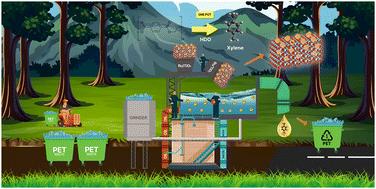
This study presents a significant advancement in the conversion of waste polyethylene terephthalate (PET) into benzene, toluene, and xylene (BTX)—valuable aromatic monomers—via a single-step catalytic pathway. Investigating the effect of the TiO2 support's morphology revealed that commercial P25, with its hydrophilic properties, was the optimal support for BTX production. Its capability to form a stable oil/water (O/W) emulsion facilitated the efficient transport of depolymerized PET monomers to the oil phase, enhancing the hydrogenation and deoxygenation of oxygenated aromatic hydrocarbons. Examining the influence of Ru particle size (0.9–2.1 nm) on BTX production showed that smaller Ru particles enhanced activity for forming unsaturated cyclic hydrocarbons. The catalyst (2 wt% Ru/TiO2-P2-400), prepared using the polyol method, achieved nearly complete PET conversion and ∼99% selectivity for BTX under mild conditions (220 °C, 10 bar H2, 12 h). Additionally, the study highlighted the role of strong metal–support interactions (SMSIs) achieved at a reduction temperature of 400 °C, which significantly improved PET hydrodeoxygenation (HDO) efficiency by promoting C–O bond cleavage through an undercoordinated pathway. Ru nanoparticles located in the inner interfacial layer of the Pickering emulsion accelerated deoxygenation, which was crucial for BTX formation. These findings underscore the importance of optimizing catalyst design, Ru particle size, and interfacial dynamics to achieve high selectivity and efficiency in PET recycling.
期刊介绍:
Green Chemistry is a journal that provides a unique forum for the publication of innovative research on the development of alternative green and sustainable technologies. The scope of Green Chemistry is based on the definition proposed by Anastas and Warner (Green Chemistry: Theory and Practice, P T Anastas and J C Warner, Oxford University Press, Oxford, 1998), which defines green chemistry as the utilisation of a set of principles that reduces or eliminates the use or generation of hazardous substances in the design, manufacture and application of chemical products. Green Chemistry aims to reduce the environmental impact of the chemical enterprise by developing a technology base that is inherently non-toxic to living things and the environment. The journal welcomes submissions on all aspects of research relating to this endeavor and publishes original and significant cutting-edge research that is likely to be of wide general appeal. For a work to be published, it must present a significant advance in green chemistry, including a comparison with existing methods and a demonstration of advantages over those methods.




 京公网安备 11010802042870号
京ICP备2023020795号-1
京公网安备 11010802042870号
京ICP备2023020795号-1

 分享
分享
 求助内容:
求助内容: 应助结果提醒方式:
 扫码关注我们
