{"title":"纤维素纳米晶负载聚乳酸/聚己二酸丁二酯共混物:纳米粒子对纳米纤维网结构和性能的影响","authors":"Handan Palak, Mahmoud Aboelkheir, Tamer Uyar, Burçak Karagüzel Kayaoğlu","doi":"10.1007/s10570-024-06343-4","DOIUrl":null,"url":null,"abstract":"<div><p>Cellulose nanocrystals (CNCs) have gained considerable attention due to their superior properties, i.e., high aspect ratio, high modulus and strength, low density, and have been widely studied as a key component in the development of green nanocomposites. In this study, electrospinning of CNC-loaded polymer blend of polylactide (PLA) and poly(butylene adipate-co-terephthalate) (PBAT) is reported for the first time. The polymer blend ratio and solvent ratio of dichloromethane (DCM)/ dimethyl sulfoxide (DMSO) was optimized based on electrospinnability of the developed solution formulations, and successful fabrication of homogeneous bead-free nanofibers. Subsequently, CNCs were incorporated into PLA/PBAT polymer blends at various loading levels, i.e., from 1 to 5 wt%, in order to explore the influence of CNC incorporation on the key properties of PLA/PBAT nanocomposite nanofibrous webs, i.e., morphological and chemical structure, melting and crystallization behavior, thermal and hydrolytic degradation, mechanical performance and wettability characteristic. The main finding of this study was that well-distributed nanoparticles in the nanofibrous webs led to improved mechanical, thermal and wettability properties, even with a low CNC loading level, i.e., 1 wt%. The outcomes provide a groundwork for future studies on the design and fabrication of biodegradable nanocomposite nanofibers from PLA/PBAT blends for a variety of applications including tissue engineering, drug delivery, active/ intelligent food packaging, by clearly elucidating the structure–property relationships.</p></div>","PeriodicalId":511,"journal":{"name":"Cellulose","volume":"32 3","pages":"1607 - 1626"},"PeriodicalIF":4.8000,"publicationDate":"2024-12-28","publicationTypes":"Journal Article","fieldsOfStudy":null,"isOpenAccess":false,"openAccessPdf":"","citationCount":"0","resultStr":"{\"title\":\"Cellulose nanocrystal-loaded polylactide/poly(butylene adipate-co-terephthalate) blends: nanoparticles’ influence on the structure and properties of nanofibrous webs\",\"authors\":\"Handan Palak, Mahmoud Aboelkheir, Tamer Uyar, Burçak Karagüzel Kayaoğlu\",\"doi\":\"10.1007/s10570-024-06343-4\",\"DOIUrl\":null,\"url\":null,\"abstract\":\"<div><p>Cellulose nanocrystals (CNCs) have gained considerable attention due to their superior properties, i.e., high aspect ratio, high modulus and strength, low density, and have been widely studied as a key component in the development of green nanocomposites. In this study, electrospinning of CNC-loaded polymer blend of polylactide (PLA) and poly(butylene adipate-co-terephthalate) (PBAT) is reported for the first time. The polymer blend ratio and solvent ratio of dichloromethane (DCM)/ dimethyl sulfoxide (DMSO) was optimized based on electrospinnability of the developed solution formulations, and successful fabrication of homogeneous bead-free nanofibers. Subsequently, CNCs were incorporated into PLA/PBAT polymer blends at various loading levels, i.e., from 1 to 5 wt%, in order to explore the influence of CNC incorporation on the key properties of PLA/PBAT nanocomposite nanofibrous webs, i.e., morphological and chemical structure, melting and crystallization behavior, thermal and hydrolytic degradation, mechanical performance and wettability characteristic. The main finding of this study was that well-distributed nanoparticles in the nanofibrous webs led to improved mechanical, thermal and wettability properties, even with a low CNC loading level, i.e., 1 wt%. The outcomes provide a groundwork for future studies on the design and fabrication of biodegradable nanocomposite nanofibers from PLA/PBAT blends for a variety of applications including tissue engineering, drug delivery, active/ intelligent food packaging, by clearly elucidating the structure–property relationships.</p></div>\",\"PeriodicalId\":511,\"journal\":{\"name\":\"Cellulose\",\"volume\":\"32 3\",\"pages\":\"1607 - 1626\"},\"PeriodicalIF\":4.8000,\"publicationDate\":\"2024-12-28\",\"publicationTypes\":\"Journal Article\",\"fieldsOfStudy\":null,\"isOpenAccess\":false,\"openAccessPdf\":\"\",\"citationCount\":\"0\",\"resultStr\":null,\"platform\":\"Semanticscholar\",\"paperid\":null,\"PeriodicalName\":\"Cellulose\",\"FirstCategoryId\":\"88\",\"ListUrlMain\":\"https://link.springer.com/article/10.1007/s10570-024-06343-4\",\"RegionNum\":2,\"RegionCategory\":\"工程技术\",\"ArticlePicture\":[],\"TitleCN\":null,\"AbstractTextCN\":null,\"PMCID\":null,\"EPubDate\":\"\",\"PubModel\":\"\",\"JCR\":\"Q1\",\"JCRName\":\"MATERIALS SCIENCE, PAPER & WOOD\",\"Score\":null,\"Total\":0}","platform":"Semanticscholar","paperid":null,"PeriodicalName":"Cellulose","FirstCategoryId":"88","ListUrlMain":"https://link.springer.com/article/10.1007/s10570-024-06343-4","RegionNum":2,"RegionCategory":"工程技术","ArticlePicture":[],"TitleCN":null,"AbstractTextCN":null,"PMCID":null,"EPubDate":"","PubModel":"","JCR":"Q1","JCRName":"MATERIALS SCIENCE, PAPER & WOOD","Score":null,"Total":0}
Cellulose nanocrystal-loaded polylactide/poly(butylene adipate-co-terephthalate) blends: nanoparticles’ influence on the structure and properties of nanofibrous webs
Cellulose nanocrystals (CNCs) have gained considerable attention due to their superior properties, i.e., high aspect ratio, high modulus and strength, low density, and have been widely studied as a key component in the development of green nanocomposites. In this study, electrospinning of CNC-loaded polymer blend of polylactide (PLA) and poly(butylene adipate-co-terephthalate) (PBAT) is reported for the first time. The polymer blend ratio and solvent ratio of dichloromethane (DCM)/ dimethyl sulfoxide (DMSO) was optimized based on electrospinnability of the developed solution formulations, and successful fabrication of homogeneous bead-free nanofibers. Subsequently, CNCs were incorporated into PLA/PBAT polymer blends at various loading levels, i.e., from 1 to 5 wt%, in order to explore the influence of CNC incorporation on the key properties of PLA/PBAT nanocomposite nanofibrous webs, i.e., morphological and chemical structure, melting and crystallization behavior, thermal and hydrolytic degradation, mechanical performance and wettability characteristic. The main finding of this study was that well-distributed nanoparticles in the nanofibrous webs led to improved mechanical, thermal and wettability properties, even with a low CNC loading level, i.e., 1 wt%. The outcomes provide a groundwork for future studies on the design and fabrication of biodegradable nanocomposite nanofibers from PLA/PBAT blends for a variety of applications including tissue engineering, drug delivery, active/ intelligent food packaging, by clearly elucidating the structure–property relationships.
期刊介绍:
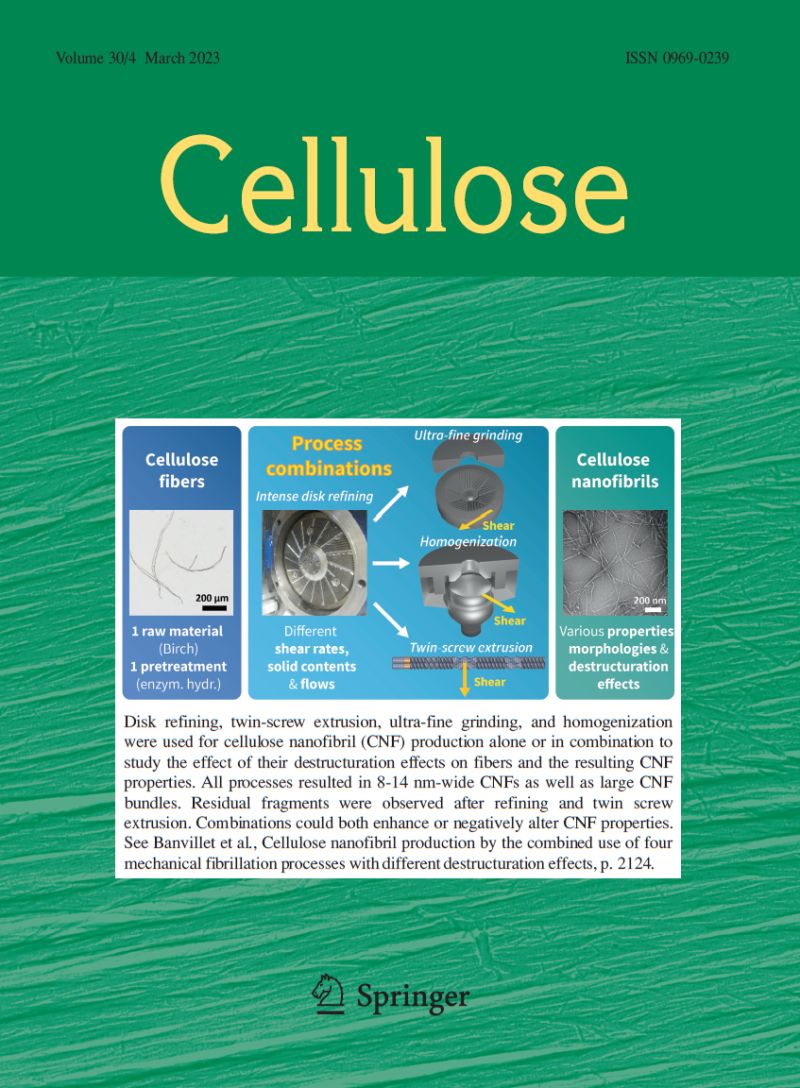
Cellulose is an international journal devoted to the dissemination of research and scientific and technological progress in the field of cellulose and related naturally occurring polymers. The journal is concerned with the pure and applied science of cellulose and related materials, and also with the development of relevant new technologies. This includes the chemistry, biochemistry, physics and materials science of cellulose and its sources, including wood and other biomass resources, and their derivatives. Coverage extends to the conversion of these polymers and resources into manufactured goods, such as pulp, paper, textiles, and manufactured as well natural fibers, and to the chemistry of materials used in their processing. Cellulose publishes review articles, research papers, and technical notes.




 京公网安备 11010802042870号
京ICP备2023020795号-1
京公网安备 11010802042870号
京ICP备2023020795号-1

 分享
分享
 求助内容:
求助内容: 应助结果提醒方式:
 扫码关注我们
