Jianming Yuan, Qinfeng Chen, Mingxiang Zuo, Xiaoxia Li, ChiYi Ou, Qinghua Chen, Dongsheng Yu, Haowen Li, Chenhui Hao, Jing Yang, Shuang Liu and Du Cheng
{"title":"利用双敏纳米凝胶通过肿瘤微环境激活的细胞摄取和ros敏感药物释放增强联合治疗。","authors":"Jianming Yuan, Qinfeng Chen, Mingxiang Zuo, Xiaoxia Li, ChiYi Ou, Qinghua Chen, Dongsheng Yu, Haowen Li, Chenhui Hao, Jing Yang, Shuang Liu and Du Cheng","doi":"10.1039/D4BM01377H","DOIUrl":null,"url":null,"abstract":"<p >Although the co-delivery of chemotherapeutic and photodynamic agents has been studied for years, developing a simple and efficient nanoplatform for high co-delivery efficiency remains a challenge for clinical applications. In this study, we prepared a reactive oxygen species (ROS) and pH dual-sensitive nanogel for the co-encapsulation of doxorubicin (DOX) and indocyanine green (ICG)-conjugated bovine serum albumin (BSA) <em>via</em> a simple inverse miniemulsion polymerization process. This was followed by modification with pegylated cell-penetrating peptides (CPPs) containing citraconic anhydride (CDM) linkers, which are sensitive to weakly acidic microenvironments (pH 6.5). Pegylation endowed the nanogel with extended blood circulation, while the de-shielding of polyethylene glycol (PEG) exposed the CPPs, significantly enhancing cellular uptake. Upon near-infrared (NIR) irradiation, ROS generated by ICG not only killed tumor cells but also triggered the release of DOX through nanogel disintegration. Serial experiments verified the nanogel's high co-delivery efficiency, tumor tissue matrix microenvironment-triggered cellular uptake, controlled drug release, and synergistic antitumor effects. Therefore, this dual-sensitive nanogel, prepared <em>via</em> inverse miniemulsion polymerization, offers a facile approach to improving co-delivery efficiency for combination therapy.</p>","PeriodicalId":65,"journal":{"name":"Biomaterials Science","volume":" 6","pages":" 1554-1567"},"PeriodicalIF":6.1000,"publicationDate":"2025-02-12","publicationTypes":"Journal Article","fieldsOfStudy":null,"isOpenAccess":false,"openAccessPdf":"https://pubs.rsc.org/en/content/articlepdf/2025/bm/d4bm01377h?page=search","citationCount":"0","resultStr":"{\"title\":\"Enhanced combination therapy through tumor microenvironment-activated cellular uptake and ROS-sensitive drug release using a dual-sensitive nanogel†\",\"authors\":\"Jianming Yuan, Qinfeng Chen, Mingxiang Zuo, Xiaoxia Li, ChiYi Ou, Qinghua Chen, Dongsheng Yu, Haowen Li, Chenhui Hao, Jing Yang, Shuang Liu and Du Cheng\",\"doi\":\"10.1039/D4BM01377H\",\"DOIUrl\":null,\"url\":null,\"abstract\":\"<p >Although the co-delivery of chemotherapeutic and photodynamic agents has been studied for years, developing a simple and efficient nanoplatform for high co-delivery efficiency remains a challenge for clinical applications. In this study, we prepared a reactive oxygen species (ROS) and pH dual-sensitive nanogel for the co-encapsulation of doxorubicin (DOX) and indocyanine green (ICG)-conjugated bovine serum albumin (BSA) <em>via</em> a simple inverse miniemulsion polymerization process. This was followed by modification with pegylated cell-penetrating peptides (CPPs) containing citraconic anhydride (CDM) linkers, which are sensitive to weakly acidic microenvironments (pH 6.5). Pegylation endowed the nanogel with extended blood circulation, while the de-shielding of polyethylene glycol (PEG) exposed the CPPs, significantly enhancing cellular uptake. Upon near-infrared (NIR) irradiation, ROS generated by ICG not only killed tumor cells but also triggered the release of DOX through nanogel disintegration. Serial experiments verified the nanogel's high co-delivery efficiency, tumor tissue matrix microenvironment-triggered cellular uptake, controlled drug release, and synergistic antitumor effects. Therefore, this dual-sensitive nanogel, prepared <em>via</em> inverse miniemulsion polymerization, offers a facile approach to improving co-delivery efficiency for combination therapy.</p>\",\"PeriodicalId\":65,\"journal\":{\"name\":\"Biomaterials Science\",\"volume\":\" 6\",\"pages\":\" 1554-1567\"},\"PeriodicalIF\":6.1000,\"publicationDate\":\"2025-02-12\",\"publicationTypes\":\"Journal Article\",\"fieldsOfStudy\":null,\"isOpenAccess\":false,\"openAccessPdf\":\"https://pubs.rsc.org/en/content/articlepdf/2025/bm/d4bm01377h?page=search\",\"citationCount\":\"0\",\"resultStr\":null,\"platform\":\"Semanticscholar\",\"paperid\":null,\"PeriodicalName\":\"Biomaterials Science\",\"FirstCategoryId\":\"5\",\"ListUrlMain\":\"https://pubs.rsc.org/en/content/articlelanding/2025/bm/d4bm01377h\",\"RegionNum\":3,\"RegionCategory\":\"医学\",\"ArticlePicture\":[],\"TitleCN\":null,\"AbstractTextCN\":null,\"PMCID\":null,\"EPubDate\":\"\",\"PubModel\":\"\",\"JCR\":\"Q1\",\"JCRName\":\"MATERIALS SCIENCE, BIOMATERIALS\",\"Score\":null,\"Total\":0}","platform":"Semanticscholar","paperid":null,"PeriodicalName":"Biomaterials Science","FirstCategoryId":"5","ListUrlMain":"https://pubs.rsc.org/en/content/articlelanding/2025/bm/d4bm01377h","RegionNum":3,"RegionCategory":"医学","ArticlePicture":[],"TitleCN":null,"AbstractTextCN":null,"PMCID":null,"EPubDate":"","PubModel":"","JCR":"Q1","JCRName":"MATERIALS SCIENCE, BIOMATERIALS","Score":null,"Total":0}
Enhanced combination therapy through tumor microenvironment-activated cellular uptake and ROS-sensitive drug release using a dual-sensitive nanogel†
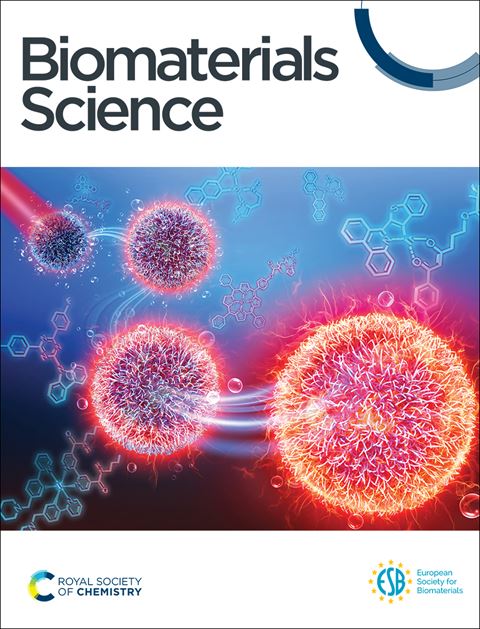
Although the co-delivery of chemotherapeutic and photodynamic agents has been studied for years, developing a simple and efficient nanoplatform for high co-delivery efficiency remains a challenge for clinical applications. In this study, we prepared a reactive oxygen species (ROS) and pH dual-sensitive nanogel for the co-encapsulation of doxorubicin (DOX) and indocyanine green (ICG)-conjugated bovine serum albumin (BSA) via a simple inverse miniemulsion polymerization process. This was followed by modification with pegylated cell-penetrating peptides (CPPs) containing citraconic anhydride (CDM) linkers, which are sensitive to weakly acidic microenvironments (pH 6.5). Pegylation endowed the nanogel with extended blood circulation, while the de-shielding of polyethylene glycol (PEG) exposed the CPPs, significantly enhancing cellular uptake. Upon near-infrared (NIR) irradiation, ROS generated by ICG not only killed tumor cells but also triggered the release of DOX through nanogel disintegration. Serial experiments verified the nanogel's high co-delivery efficiency, tumor tissue matrix microenvironment-triggered cellular uptake, controlled drug release, and synergistic antitumor effects. Therefore, this dual-sensitive nanogel, prepared via inverse miniemulsion polymerization, offers a facile approach to improving co-delivery efficiency for combination therapy.
期刊介绍:
Biomaterials Science is an international high impact journal exploring the science of biomaterials and their translation towards clinical use. Its scope encompasses new concepts in biomaterials design, studies into the interaction of biomaterials with the body, and the use of materials to answer fundamental biological questions.





 京公网安备 11010802042870号
京ICP备2023020795号-1
京公网安备 11010802042870号
京ICP备2023020795号-1

 分享
分享
 求助内容:
求助内容: 应助结果提醒方式:
 扫码关注我们
