Paulo Ferreira Mega, Vitor Ottoboni Brunaldi, Alexandre Moraes Bestetti, Angelo So Taa Kum, Igor Valdeir de Sousa, Marcos Eduardo Lera Dos Santos, Eduardo Guimarães Hourneaux de Moura
{"title":"超镜夹与标准内窥镜干预在一线治疗NVUGI出血:随机试验的荟萃分析","authors":"Paulo Ferreira Mega, Vitor Ottoboni Brunaldi, Alexandre Moraes Bestetti, Angelo So Taa Kum, Igor Valdeir de Sousa, Marcos Eduardo Lera Dos Santos, Eduardo Guimarães Hourneaux de Moura","doi":"10.1055/a-2465-7023","DOIUrl":null,"url":null,"abstract":"<p><p><b>Background and study aims</b> Recently, over-the-scope clips (OTSCs) have been extensively studied for hemostasis of nonvariceal upper gastrointestinal bleeding (NVUGIB). Our goal was to compare the efficacy of OTSCs with standard endoscopic interventions (SEIs) as first-line treatments. <b>Patients and methods</b> A comprehensive search of electronic databases was performed to identify randomized clinical trials (RCTs) comparing OTSCs with SEIs as first-line therapy for NVUGIB. This search was performed in accordance with the Preferred Reporting Items for Systematic Reviews and Meta-analyses (PRISMA) guidelines. <b>Results</b> Of 819 reviewed studies, five RCTs comprising 555 patients (277 OTSCs vs. 278 SEIs) were included. The OTSC group had a lower 30-day rebleeding rate (risk ratio [RR] 0.43; 95% confidence interval [CI] 0.24-0.77; I² = 0%; <i>P</i> = 0.004) and a higher clinical success rate (RR 1.19; 95% CI 1.11-1.28; I² = 0%; <i>P</i> < 0.00001). There was no significant difference in technical success (RR 1.06; 95% CI 0.98-1.14; I² = 73%; <i>P</i> = 0.13), 30-day all-cause mortality (RR 0.50; 95% CI 0.22-1.14; I² = 0%; <i>P</i> = 0.10), need for further intervention (RR 1.22; 95% CI 0.43-3.47; I² = 0%; <i>P</i> = 0.71), or length of hospital stay (mean difference 0.31; 95% CI: -1.08- 1.70; I² = 0%; <i>P</i> = 0.66). Risk of bias, which was assessed using the Cochrane Risk of Bias 2.0 tool, indicated some concerns about bias. <b>Conclusions</b> OTSCs are more efficient than SEIs as first-line treatment in terms of rebleeding within 30 days and clinical success rates.</p>","PeriodicalId":11671,"journal":{"name":"Endoscopy International Open","volume":"13 ","pages":"a24657023"},"PeriodicalIF":2.3000,"publicationDate":"2025-02-05","publicationTypes":"Journal Article","fieldsOfStudy":null,"isOpenAccess":false,"openAccessPdf":"https://www.ncbi.nlm.nih.gov/pmc/articles/PMC11827746/pdf/","citationCount":"0","resultStr":"{\"title\":\"Over-the-scope clips vs standard endoscopic interventions for first-line treatment of NVUGI bleeding: Meta-analysis of randomized trials.\",\"authors\":\"Paulo Ferreira Mega, Vitor Ottoboni Brunaldi, Alexandre Moraes Bestetti, Angelo So Taa Kum, Igor Valdeir de Sousa, Marcos Eduardo Lera Dos Santos, Eduardo Guimarães Hourneaux de Moura\",\"doi\":\"10.1055/a-2465-7023\",\"DOIUrl\":null,\"url\":null,\"abstract\":\"<p><p><b>Background and study aims</b> Recently, over-the-scope clips (OTSCs) have been extensively studied for hemostasis of nonvariceal upper gastrointestinal bleeding (NVUGIB). Our goal was to compare the efficacy of OTSCs with standard endoscopic interventions (SEIs) as first-line treatments. <b>Patients and methods</b> A comprehensive search of electronic databases was performed to identify randomized clinical trials (RCTs) comparing OTSCs with SEIs as first-line therapy for NVUGIB. This search was performed in accordance with the Preferred Reporting Items for Systematic Reviews and Meta-analyses (PRISMA) guidelines. <b>Results</b> Of 819 reviewed studies, five RCTs comprising 555 patients (277 OTSCs vs. 278 SEIs) were included. The OTSC group had a lower 30-day rebleeding rate (risk ratio [RR] 0.43; 95% confidence interval [CI] 0.24-0.77; I² = 0%; <i>P</i> = 0.004) and a higher clinical success rate (RR 1.19; 95% CI 1.11-1.28; I² = 0%; <i>P</i> < 0.00001). There was no significant difference in technical success (RR 1.06; 95% CI 0.98-1.14; I² = 73%; <i>P</i> = 0.13), 30-day all-cause mortality (RR 0.50; 95% CI 0.22-1.14; I² = 0%; <i>P</i> = 0.10), need for further intervention (RR 1.22; 95% CI 0.43-3.47; I² = 0%; <i>P</i> = 0.71), or length of hospital stay (mean difference 0.31; 95% CI: -1.08- 1.70; I² = 0%; <i>P</i> = 0.66). Risk of bias, which was assessed using the Cochrane Risk of Bias 2.0 tool, indicated some concerns about bias. <b>Conclusions</b> OTSCs are more efficient than SEIs as first-line treatment in terms of rebleeding within 30 days and clinical success rates.</p>\",\"PeriodicalId\":11671,\"journal\":{\"name\":\"Endoscopy International Open\",\"volume\":\"13 \",\"pages\":\"a24657023\"},\"PeriodicalIF\":2.3000,\"publicationDate\":\"2025-02-05\",\"publicationTypes\":\"Journal Article\",\"fieldsOfStudy\":null,\"isOpenAccess\":false,\"openAccessPdf\":\"https://www.ncbi.nlm.nih.gov/pmc/articles/PMC11827746/pdf/\",\"citationCount\":\"0\",\"resultStr\":null,\"platform\":\"Semanticscholar\",\"paperid\":null,\"PeriodicalName\":\"Endoscopy International Open\",\"FirstCategoryId\":\"1085\",\"ListUrlMain\":\"https://doi.org/10.1055/a-2465-7023\",\"RegionNum\":0,\"RegionCategory\":null,\"ArticlePicture\":[],\"TitleCN\":null,\"AbstractTextCN\":null,\"PMCID\":null,\"EPubDate\":\"2025/1/1 0:00:00\",\"PubModel\":\"eCollection\",\"JCR\":\"Q3\",\"JCRName\":\"GASTROENTEROLOGY & HEPATOLOGY\",\"Score\":null,\"Total\":0}","platform":"Semanticscholar","paperid":null,"PeriodicalName":"Endoscopy International Open","FirstCategoryId":"1085","ListUrlMain":"https://doi.org/10.1055/a-2465-7023","RegionNum":0,"RegionCategory":null,"ArticlePicture":[],"TitleCN":null,"AbstractTextCN":null,"PMCID":null,"EPubDate":"2025/1/1 0:00:00","PubModel":"eCollection","JCR":"Q3","JCRName":"GASTROENTEROLOGY & HEPATOLOGY","Score":null,"Total":0}
引用次数: 0
摘要
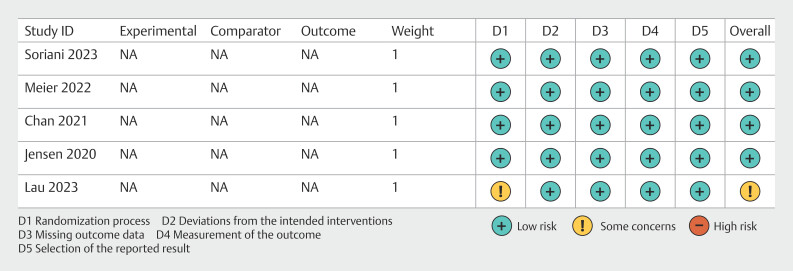
背景和研究目的近年来,超镜夹(OTSCs)在非静脉曲张性上消化道出血(NVUGIB)止血方面得到了广泛的研究。我们的目的是比较OTSCs与标准内镜干预(SEIs)作为一线治疗的疗效。对电子数据库进行全面检索,以确定比较OTSCs与SEIs作为NVUGIB一线治疗的随机临床试验(rct)。本研究按照系统评价和荟萃分析首选报告项目(PRISMA)指南进行。结果在819项综述研究中,纳入了5项随机对照试验,包括555例患者(277例OTSCs vs 278例SEIs)。OTSC组30天再出血率较低(风险比[RR] 0.43;95%置信区间[CI] 0.24-0.77;I²= 0%;P = 0.004)和更高的临床成功率(RR 1.19;95% ci 1.11-1.28;I²= 0%;P < 0.00001)。技术成功率无显著差异(RR 1.06;95% ci 0.98-1.14;I²= 73%;P = 0.13), 30天全因死亡率(RR 0.50;95% ci 0.22-1.14;I²= 0%;P = 0.10),需要进一步干预(RR 1.22;95% ci 0.43-3.47;I²= 0%;P = 0.71)或住院时间(平均差值0.31;95% ci: -1.08- 1.70;I²= 0%;P = 0.66)。使用Cochrane Risk of bias 2.0工具评估的偏倚风险显示了对偏倚的一些担忧。结论在30天再出血和临床成功率方面,OTSCs作为一线治疗方法优于SEIs。
Over-the-scope clips vs standard endoscopic interventions for first-line treatment of NVUGI bleeding: Meta-analysis of randomized trials.
Background and study aims Recently, over-the-scope clips (OTSCs) have been extensively studied for hemostasis of nonvariceal upper gastrointestinal bleeding (NVUGIB). Our goal was to compare the efficacy of OTSCs with standard endoscopic interventions (SEIs) as first-line treatments. Patients and methods A comprehensive search of electronic databases was performed to identify randomized clinical trials (RCTs) comparing OTSCs with SEIs as first-line therapy for NVUGIB. This search was performed in accordance with the Preferred Reporting Items for Systematic Reviews and Meta-analyses (PRISMA) guidelines. Results Of 819 reviewed studies, five RCTs comprising 555 patients (277 OTSCs vs. 278 SEIs) were included. The OTSC group had a lower 30-day rebleeding rate (risk ratio [RR] 0.43; 95% confidence interval [CI] 0.24-0.77; I² = 0%; P = 0.004) and a higher clinical success rate (RR 1.19; 95% CI 1.11-1.28; I² = 0%; P < 0.00001). There was no significant difference in technical success (RR 1.06; 95% CI 0.98-1.14; I² = 73%; P = 0.13), 30-day all-cause mortality (RR 0.50; 95% CI 0.22-1.14; I² = 0%; P = 0.10), need for further intervention (RR 1.22; 95% CI 0.43-3.47; I² = 0%; P = 0.71), or length of hospital stay (mean difference 0.31; 95% CI: -1.08- 1.70; I² = 0%; P = 0.66). Risk of bias, which was assessed using the Cochrane Risk of Bias 2.0 tool, indicated some concerns about bias. Conclusions OTSCs are more efficient than SEIs as first-line treatment in terms of rebleeding within 30 days and clinical success rates.







 京公网安备 11010802042870号
京ICP备2023020795号-1
京公网安备 11010802042870号
京ICP备2023020795号-1

 分享
分享
 求助内容:
求助内容: 应助结果提醒方式:
 扫码关注我们
