S Borodzicz-Jazdzyk, G W de Mooij, C E M Vink, M A van de Wiel, M Benovoy, M J W Götte
{"title":"疑似阻塞性冠状动脉疾病患者的应激T1定位和定量灌注心血管磁共振。","authors":"S Borodzicz-Jazdzyk, G W de Mooij, C E M Vink, M A van de Wiel, M Benovoy, M J W Götte","doi":"10.1093/ehjci/jeaf059","DOIUrl":null,"url":null,"abstract":"<p><strong>Aims: </strong>T1 mapping reactivity (ΔT1) has been proposed as a novel contrast-free technique to detect obstructive coronary artery disease (CAD). The aims of the study are: (i) to compare the cardiovascular magnetic resonance (CMR)-derived ΔT1 with quantitative perfusion (QP CMR) measures; (ii) to assess the influence of sex and comorbidities on ΔT1; and (iii) to assess the diagnostic accuracy of ΔT1 to detect obstructive CAD diagnosed with the invasive coronary angiography (ICA) and/or fractional flow reserve.</p><p><strong>Methods and results: </strong>This study retrospectively analysed 51 patients with suspected obstructive CAD who underwent CMR including rest and adenosine stress first-pass perfusion and native T1 mapping (MOLLI). A moderate correlation was found between pooled rest and stress native T1 mapping and myocardial blood flow (Pearson's r = 0.476; P < 0.001). When stratified by myocardial perfusion reserve (MPR), ischaemic myocardium had significantly lower stress T1 mapping values (P < 0.001) and ΔT1 (P = 0.005) vs. nonischaemic myocardium. Male sex and history of diabetes were independently associated with lower ΔT1. The optimal cut-off value of ΔT1 to detect impaired MPR on a per-vessel basis was ≤5.4%, with an area under the curve of 0.662 (95% CI: 0.563-0.752, P = 0.003), sensitivity of 84% (95% CI: 67-95), and specificity of 46% (95% CI: 34-58). When validated against ICA, stress T1 and ΔT1 did not reach statistical significance in detecting obstructive CAD.</p><p><strong>Conclusion: </strong>ΔT1 is significantly influenced by sex and comorbidities and has poor diagnostic accuracy for detecting myocardial ischaemia. Therefore, the clinical utility of ΔT1 in a real-world cohort of patients to detect obstructive CAD is limited.</p>","PeriodicalId":12026,"journal":{"name":"European Heart Journal - Cardiovascular Imaging","volume":" ","pages":"980-990"},"PeriodicalIF":6.6000,"publicationDate":"2025-05-30","publicationTypes":"Journal Article","fieldsOfStudy":null,"isOpenAccess":false,"openAccessPdf":"https://www.ncbi.nlm.nih.gov/pmc/articles/PMC12123514/pdf/","citationCount":"0","resultStr":"{\"title\":\"Stress T1 mapping and quantitative perfusion cardiovascular magnetic resonance in patients with suspected obstructive coronary artery disease.\",\"authors\":\"S Borodzicz-Jazdzyk, G W de Mooij, C E M Vink, M A van de Wiel, M Benovoy, M J W Götte\",\"doi\":\"10.1093/ehjci/jeaf059\",\"DOIUrl\":null,\"url\":null,\"abstract\":\"<p><strong>Aims: </strong>T1 mapping reactivity (ΔT1) has been proposed as a novel contrast-free technique to detect obstructive coronary artery disease (CAD). The aims of the study are: (i) to compare the cardiovascular magnetic resonance (CMR)-derived ΔT1 with quantitative perfusion (QP CMR) measures; (ii) to assess the influence of sex and comorbidities on ΔT1; and (iii) to assess the diagnostic accuracy of ΔT1 to detect obstructive CAD diagnosed with the invasive coronary angiography (ICA) and/or fractional flow reserve.</p><p><strong>Methods and results: </strong>This study retrospectively analysed 51 patients with suspected obstructive CAD who underwent CMR including rest and adenosine stress first-pass perfusion and native T1 mapping (MOLLI). A moderate correlation was found between pooled rest and stress native T1 mapping and myocardial blood flow (Pearson's r = 0.476; P < 0.001). When stratified by myocardial perfusion reserve (MPR), ischaemic myocardium had significantly lower stress T1 mapping values (P < 0.001) and ΔT1 (P = 0.005) vs. nonischaemic myocardium. Male sex and history of diabetes were independently associated with lower ΔT1. The optimal cut-off value of ΔT1 to detect impaired MPR on a per-vessel basis was ≤5.4%, with an area under the curve of 0.662 (95% CI: 0.563-0.752, P = 0.003), sensitivity of 84% (95% CI: 67-95), and specificity of 46% (95% CI: 34-58). When validated against ICA, stress T1 and ΔT1 did not reach statistical significance in detecting obstructive CAD.</p><p><strong>Conclusion: </strong>ΔT1 is significantly influenced by sex and comorbidities and has poor diagnostic accuracy for detecting myocardial ischaemia. Therefore, the clinical utility of ΔT1 in a real-world cohort of patients to detect obstructive CAD is limited.</p>\",\"PeriodicalId\":12026,\"journal\":{\"name\":\"European Heart Journal - Cardiovascular Imaging\",\"volume\":\" \",\"pages\":\"980-990\"},\"PeriodicalIF\":6.6000,\"publicationDate\":\"2025-05-30\",\"publicationTypes\":\"Journal Article\",\"fieldsOfStudy\":null,\"isOpenAccess\":false,\"openAccessPdf\":\"https://www.ncbi.nlm.nih.gov/pmc/articles/PMC12123514/pdf/\",\"citationCount\":\"0\",\"resultStr\":null,\"platform\":\"Semanticscholar\",\"paperid\":null,\"PeriodicalName\":\"European Heart Journal - Cardiovascular Imaging\",\"FirstCategoryId\":\"3\",\"ListUrlMain\":\"https://doi.org/10.1093/ehjci/jeaf059\",\"RegionNum\":1,\"RegionCategory\":\"医学\",\"ArticlePicture\":[],\"TitleCN\":null,\"AbstractTextCN\":null,\"PMCID\":null,\"EPubDate\":\"\",\"PubModel\":\"\",\"JCR\":\"Q1\",\"JCRName\":\"CARDIAC & CARDIOVASCULAR SYSTEMS\",\"Score\":null,\"Total\":0}","platform":"Semanticscholar","paperid":null,"PeriodicalName":"European Heart Journal - Cardiovascular Imaging","FirstCategoryId":"3","ListUrlMain":"https://doi.org/10.1093/ehjci/jeaf059","RegionNum":1,"RegionCategory":"医学","ArticlePicture":[],"TitleCN":null,"AbstractTextCN":null,"PMCID":null,"EPubDate":"","PubModel":"","JCR":"Q1","JCRName":"CARDIAC & CARDIOVASCULAR SYSTEMS","Score":null,"Total":0}
Stress T1 mapping and quantitative perfusion cardiovascular magnetic resonance in patients with suspected obstructive coronary artery disease.
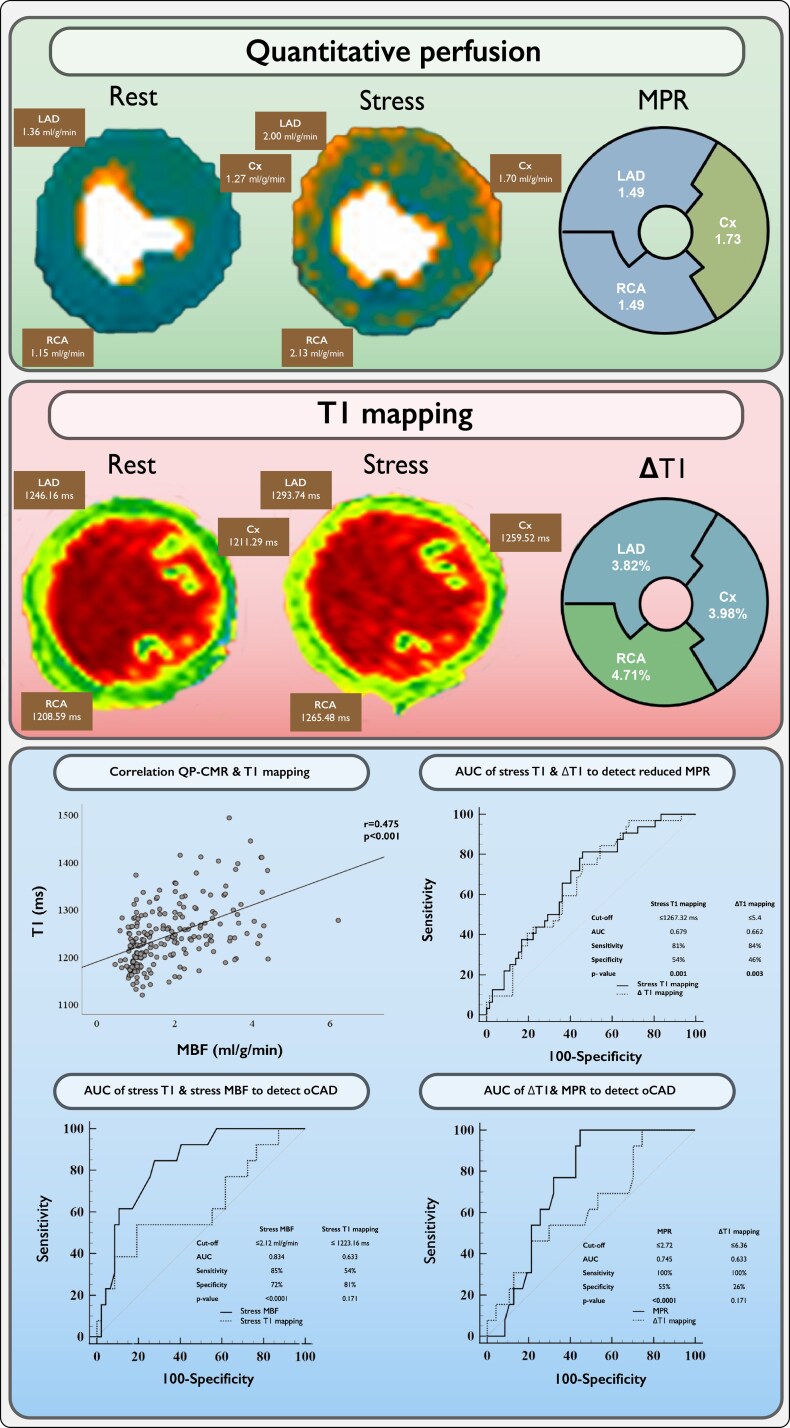
Aims: T1 mapping reactivity (ΔT1) has been proposed as a novel contrast-free technique to detect obstructive coronary artery disease (CAD). The aims of the study are: (i) to compare the cardiovascular magnetic resonance (CMR)-derived ΔT1 with quantitative perfusion (QP CMR) measures; (ii) to assess the influence of sex and comorbidities on ΔT1; and (iii) to assess the diagnostic accuracy of ΔT1 to detect obstructive CAD diagnosed with the invasive coronary angiography (ICA) and/or fractional flow reserve.
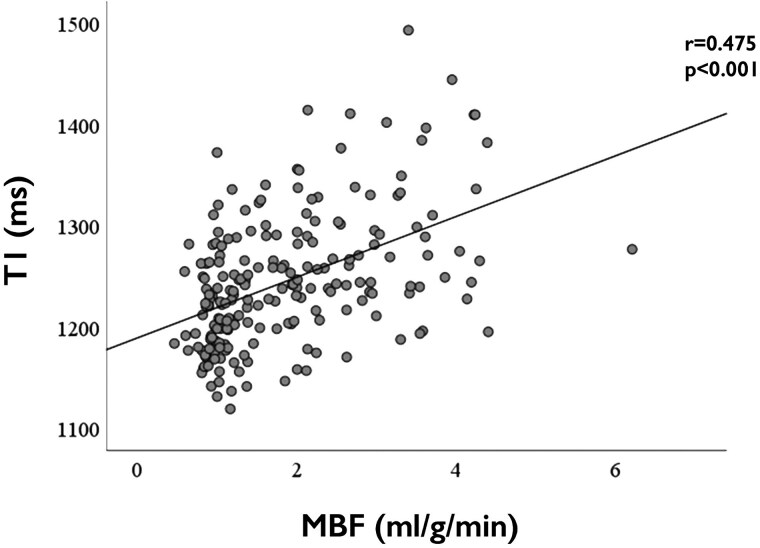
Methods and results: This study retrospectively analysed 51 patients with suspected obstructive CAD who underwent CMR including rest and adenosine stress first-pass perfusion and native T1 mapping (MOLLI). A moderate correlation was found between pooled rest and stress native T1 mapping and myocardial blood flow (Pearson's r = 0.476; P < 0.001). When stratified by myocardial perfusion reserve (MPR), ischaemic myocardium had significantly lower stress T1 mapping values (P < 0.001) and ΔT1 (P = 0.005) vs. nonischaemic myocardium. Male sex and history of diabetes were independently associated with lower ΔT1. The optimal cut-off value of ΔT1 to detect impaired MPR on a per-vessel basis was ≤5.4%, with an area under the curve of 0.662 (95% CI: 0.563-0.752, P = 0.003), sensitivity of 84% (95% CI: 67-95), and specificity of 46% (95% CI: 34-58). When validated against ICA, stress T1 and ΔT1 did not reach statistical significance in detecting obstructive CAD.
Conclusion: ΔT1 is significantly influenced by sex and comorbidities and has poor diagnostic accuracy for detecting myocardial ischaemia. Therefore, the clinical utility of ΔT1 in a real-world cohort of patients to detect obstructive CAD is limited.
期刊介绍:
European Heart Journal – Cardiovascular Imaging is a monthly international peer reviewed journal dealing with Cardiovascular Imaging. It is an official publication of the European Association of Cardiovascular Imaging, a branch of the European Society of Cardiology.
The journal aims to publish the highest quality material, both scientific and clinical from all areas of cardiovascular imaging including echocardiography, magnetic resonance, computed tomography, nuclear and invasive imaging. A range of article types will be considered, including original research, reviews, editorials, image focus, letters and recommendation papers from relevant groups of the European Society of Cardiology. In addition it provides a forum for the exchange of information on all aspects of cardiovascular imaging.





 京公网安备 11010802042870号
京ICP备2023020795号-1
京公网安备 11010802042870号
京ICP备2023020795号-1

 分享
分享
 求助内容:
求助内容: 应助结果提醒方式:
 扫码关注我们
