Reza Saberisani, Amir Hossein Barati, Mostafa Zarei, Paulo Santos, Armin Gorouhi, Luca Paolo Ardigò, Hadi Nobari
{"title":"利用伊朗职业足球运动员基于gps的数据预测足球损伤:一种机器学习方法。","authors":"Reza Saberisani, Amir Hossein Barati, Mostafa Zarei, Paulo Santos, Armin Gorouhi, Luca Paolo Ardigò, Hadi Nobari","doi":"10.3389/fspor.2025.1425180","DOIUrl":null,"url":null,"abstract":"<p><strong>Introduction: </strong>The study aims to assess and compare the predictive effectiveness of football-related injuries using external load data and a decision tree classification algorithm by unidimensional approach.</p><p><strong>Methods: </strong>The sample consisted of 25 players from one of the 16 teams participating in the Persian Gulf Pro League during the 2022--2023 season. Player injury data and raw GPS data from all training and competition sessions throughout the football league season were gathered (214 training sessions and 34 competition sessions). The acute-tochronic workload ratio was calculated separately for each variable using a ratio of 1:3 weeks. Finally, the decision tree algorithm with machine learning was utilised to assess the predictive power of injury occurrence based on the acute-to-chronic workload ratio.</p><p><strong>Results: </strong>The results showed that the variable of the number of decelerations had the highest predictive power compared to other variables [area under the curve (AUC) = 0.91, recall = 87.5%, precision = 58.3%, accuracy = 94.7%].</p><p><strong>Conclusion: </strong>Although none of the selected external load variables in this study had high predictive power (AUC > 0.95), due to the high predictive power of injury of the number of deceleration variables compared with other variables, the necessity of attention and management of this variable as a risk factor for injury occurrence is essential for preventing future injuries.</p>","PeriodicalId":12716,"journal":{"name":"Frontiers in Sports and Active Living","volume":"7 ","pages":"1425180"},"PeriodicalIF":3.0000,"publicationDate":"2025-01-31","publicationTypes":"Journal Article","fieldsOfStudy":null,"isOpenAccess":false,"openAccessPdf":"https://www.ncbi.nlm.nih.gov/pmc/articles/PMC11825737/pdf/","citationCount":"0","resultStr":"{\"title\":\"Prediction of football injuries using GPS-based data in Iranian professional football players: a machine learning approach.\",\"authors\":\"Reza Saberisani, Amir Hossein Barati, Mostafa Zarei, Paulo Santos, Armin Gorouhi, Luca Paolo Ardigò, Hadi Nobari\",\"doi\":\"10.3389/fspor.2025.1425180\",\"DOIUrl\":null,\"url\":null,\"abstract\":\"<p><strong>Introduction: </strong>The study aims to assess and compare the predictive effectiveness of football-related injuries using external load data and a decision tree classification algorithm by unidimensional approach.</p><p><strong>Methods: </strong>The sample consisted of 25 players from one of the 16 teams participating in the Persian Gulf Pro League during the 2022--2023 season. Player injury data and raw GPS data from all training and competition sessions throughout the football league season were gathered (214 training sessions and 34 competition sessions). The acute-tochronic workload ratio was calculated separately for each variable using a ratio of 1:3 weeks. Finally, the decision tree algorithm with machine learning was utilised to assess the predictive power of injury occurrence based on the acute-to-chronic workload ratio.</p><p><strong>Results: </strong>The results showed that the variable of the number of decelerations had the highest predictive power compared to other variables [area under the curve (AUC) = 0.91, recall = 87.5%, precision = 58.3%, accuracy = 94.7%].</p><p><strong>Conclusion: </strong>Although none of the selected external load variables in this study had high predictive power (AUC > 0.95), due to the high predictive power of injury of the number of deceleration variables compared with other variables, the necessity of attention and management of this variable as a risk factor for injury occurrence is essential for preventing future injuries.</p>\",\"PeriodicalId\":12716,\"journal\":{\"name\":\"Frontiers in Sports and Active Living\",\"volume\":\"7 \",\"pages\":\"1425180\"},\"PeriodicalIF\":3.0000,\"publicationDate\":\"2025-01-31\",\"publicationTypes\":\"Journal Article\",\"fieldsOfStudy\":null,\"isOpenAccess\":false,\"openAccessPdf\":\"https://www.ncbi.nlm.nih.gov/pmc/articles/PMC11825737/pdf/\",\"citationCount\":\"0\",\"resultStr\":null,\"platform\":\"Semanticscholar\",\"paperid\":null,\"PeriodicalName\":\"Frontiers in Sports and Active Living\",\"FirstCategoryId\":\"1085\",\"ListUrlMain\":\"https://doi.org/10.3389/fspor.2025.1425180\",\"RegionNum\":0,\"RegionCategory\":null,\"ArticlePicture\":[],\"TitleCN\":null,\"AbstractTextCN\":null,\"PMCID\":null,\"EPubDate\":\"2025/1/1 0:00:00\",\"PubModel\":\"eCollection\",\"JCR\":\"Q2\",\"JCRName\":\"SPORT SCIENCES\",\"Score\":null,\"Total\":0}","platform":"Semanticscholar","paperid":null,"PeriodicalName":"Frontiers in Sports and Active Living","FirstCategoryId":"1085","ListUrlMain":"https://doi.org/10.3389/fspor.2025.1425180","RegionNum":0,"RegionCategory":null,"ArticlePicture":[],"TitleCN":null,"AbstractTextCN":null,"PMCID":null,"EPubDate":"2025/1/1 0:00:00","PubModel":"eCollection","JCR":"Q2","JCRName":"SPORT SCIENCES","Score":null,"Total":0}
引用次数: 0
摘要
摘要:本研究旨在通过单维方法,利用外部载荷数据和决策树分类算法,评估和比较足球相关损伤的预测效果。方法:样本由参加2022- 2023赛季波斯湾职业联赛的16支球队中的一支的25名球员组成。收集了整个足球联赛赛季中所有训练和比赛的球员受伤数据和原始GPS数据(214次训练和34次比赛)。使用1:3周的比率分别计算每个变量的急性与慢性工作量比。最后,利用机器学习的决策树算法评估基于急性-慢性工作量比的损伤发生预测能力。结果:减速次数变量的预测能力最高[曲线下面积(area under The curve, AUC) = 0.91,召回率= 87.5%,精密度= 58.3%,准确度= 94.7%]。结论:虽然本研究选取的外负荷变量均不具有较高的预测能力(AUC > 0.95),但由于减速变量数量相对于其他变量具有较高的损伤预测能力,因此对减速变量作为损伤发生的危险因素予以重视和管理对于预防未来损伤至关重要。
Prediction of football injuries using GPS-based data in Iranian professional football players: a machine learning approach.
Introduction: The study aims to assess and compare the predictive effectiveness of football-related injuries using external load data and a decision tree classification algorithm by unidimensional approach.
Methods: The sample consisted of 25 players from one of the 16 teams participating in the Persian Gulf Pro League during the 2022--2023 season. Player injury data and raw GPS data from all training and competition sessions throughout the football league season were gathered (214 training sessions and 34 competition sessions). The acute-tochronic workload ratio was calculated separately for each variable using a ratio of 1:3 weeks. Finally, the decision tree algorithm with machine learning was utilised to assess the predictive power of injury occurrence based on the acute-to-chronic workload ratio.
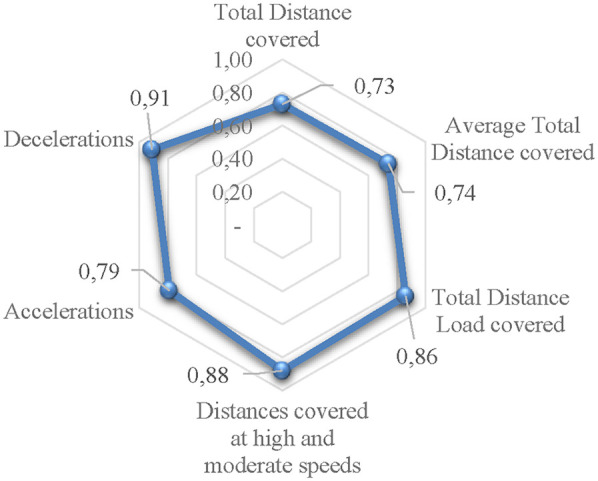
Results: The results showed that the variable of the number of decelerations had the highest predictive power compared to other variables [area under the curve (AUC) = 0.91, recall = 87.5%, precision = 58.3%, accuracy = 94.7%].
Conclusion: Although none of the selected external load variables in this study had high predictive power (AUC > 0.95), due to the high predictive power of injury of the number of deceleration variables compared with other variables, the necessity of attention and management of this variable as a risk factor for injury occurrence is essential for preventing future injuries.





 京公网安备 11010802042870号
京ICP备2023020795号-1
京公网安备 11010802042870号
京ICP备2023020795号-1

 分享
分享
 求助内容:
求助内容: 应助结果提醒方式:
 扫码关注我们
