Lingxiao Qiu, Tingcheng Li, Bin Qing, Cailin Zhao, Xinye Zhang, Satoshi Watanabe, Armida D'Incecco, Ninh M La-Beck, Tracy L Leong, Chuangye Wang, Jincheng Liu, Qi Li, Li Bai, Gang Liu, Xueping Liu, Zhi Xu
{"title":"MS4A15基因表达作为肺腺癌临床预后的预后指标","authors":"Lingxiao Qiu, Tingcheng Li, Bin Qing, Cailin Zhao, Xinye Zhang, Satoshi Watanabe, Armida D'Incecco, Ninh M La-Beck, Tracy L Leong, Chuangye Wang, Jincheng Liu, Qi Li, Li Bai, Gang Liu, Xueping Liu, Zhi Xu","doi":"10.21037/tlcr-24-623","DOIUrl":null,"url":null,"abstract":"<p><strong>Background: </strong>Lung adenocarcinoma (LUAD) is the predominant histological subtype of lung cancer. In the past decade, various targeted drugs have prolonged the survival of LUAD patients. Unfortunately, not all LUAD patients can benefit from the current target agents. Although the membrane spanning 4-domains A15 (<i>MS4A15</i>) gene has been implicated in the progression of various cancers, its role in LUAD remains understudied. This study aimed to evaluate the role and potential mechanism of MS4A15 in the progression of LUAD.</p><p><strong>Methods: </strong>The pan-cancer RNA sequencing and clinical data of LUAD patients, originally comprising data from The Cancer Genome Atlas and Genotypic Tissue Expression, were acquired from University of California Santa Cruz XENA (UCSC XENA). Additionally, the GSE116959 and GSE130779 data sets were retrieved from the Gene Expression Omnibus database. The Differential Expression analysis of Sequencing data version 2 (DESeq2) package was used to identify the differentially expressed genes. The ClusteProfiler package was used to perform the Gene Ontology, Kyoto Encyclopedia of Genes and Genomes, and gene set enrichment analyses. An immune cell infiltration analysis was conducted using the gene set variation analysis (GSVA) package. The expression level of <i>MS4A15</i> was analyzed by the Wilcoxon rank-sum test. A logistic regression analysis was conducted to examine the correlation between the clinical pathological factors of LUAD patients and the high-low dichotomy of <i>MS4A15</i>. A receiver operating characteristic (ROC) curve analysis was employed to evaluate the effectiveness of <i>MS4A15</i> as a biomarker for distinguishing LUAD patients from healthy individuals. A Kaplan-Meier analysis was conducted to examine the overall survival of LUAD patients based on <i>MS4A15</i>. All the bioinformatic results were obtained using R (version 3.6.2) package. Real-time quantitative polymerase chain reaction (RT-qPCR) was performed to validate the messenger RNA transcription level <i>in vitro</i>.</p><p><strong>Results: </strong><i>MS4A15</i> expression was significantly more decreased in the tumor tissues from the LUAD patients than the normal adjacent samples. <i>MS4A15</i> expression was positively correlated with various immune cell types, notably including mast cells (MCs), dendritic cells, and macrophages. Specifically, <i>MS4A15</i> was most positively associated with MCs. Lower expression levels of <i>MS4A15</i> in LUAD patients were correlated with a poorer pathologic stage and poorer primary therapy outcomes. The area under the curve of the ROC curve for <i>MS4A15</i> effectiveness was 0.863. <i>MS4A15</i> was validated to be more lowly expressed in the tumor tissues samples than the normal tissues samples in both the GSE116959 and GSE130779 data sets. The expression of <i>MS4A15</i> was also significantly lower in the in A549 cells than the normal human bronchial epithelia cells.</p><p><strong>Conclusions: </strong>Overall, <i>MS4A15</i> emerged as a promising prognostic biomarker for LUAD and could serve as a potential target for the development of novel therapeutic interventions.</p>","PeriodicalId":23271,"journal":{"name":"Translational lung cancer research","volume":"14 1","pages":"224-238"},"PeriodicalIF":3.4000,"publicationDate":"2025-01-24","publicationTypes":"Journal Article","fieldsOfStudy":null,"isOpenAccess":false,"openAccessPdf":"https://www.ncbi.nlm.nih.gov/pmc/articles/PMC11826265/pdf/","citationCount":"0","resultStr":"{\"title\":\"<i>MS4A15</i> gene expression as a prognostic marker for clinical outcomes in lung adenocarcinoma.\",\"authors\":\"Lingxiao Qiu, Tingcheng Li, Bin Qing, Cailin Zhao, Xinye Zhang, Satoshi Watanabe, Armida D'Incecco, Ninh M La-Beck, Tracy L Leong, Chuangye Wang, Jincheng Liu, Qi Li, Li Bai, Gang Liu, Xueping Liu, Zhi Xu\",\"doi\":\"10.21037/tlcr-24-623\",\"DOIUrl\":null,\"url\":null,\"abstract\":\"<p><strong>Background: </strong>Lung adenocarcinoma (LUAD) is the predominant histological subtype of lung cancer. In the past decade, various targeted drugs have prolonged the survival of LUAD patients. Unfortunately, not all LUAD patients can benefit from the current target agents. Although the membrane spanning 4-domains A15 (<i>MS4A15</i>) gene has been implicated in the progression of various cancers, its role in LUAD remains understudied. This study aimed to evaluate the role and potential mechanism of MS4A15 in the progression of LUAD.</p><p><strong>Methods: </strong>The pan-cancer RNA sequencing and clinical data of LUAD patients, originally comprising data from The Cancer Genome Atlas and Genotypic Tissue Expression, were acquired from University of California Santa Cruz XENA (UCSC XENA). Additionally, the GSE116959 and GSE130779 data sets were retrieved from the Gene Expression Omnibus database. The Differential Expression analysis of Sequencing data version 2 (DESeq2) package was used to identify the differentially expressed genes. The ClusteProfiler package was used to perform the Gene Ontology, Kyoto Encyclopedia of Genes and Genomes, and gene set enrichment analyses. An immune cell infiltration analysis was conducted using the gene set variation analysis (GSVA) package. The expression level of <i>MS4A15</i> was analyzed by the Wilcoxon rank-sum test. A logistic regression analysis was conducted to examine the correlation between the clinical pathological factors of LUAD patients and the high-low dichotomy of <i>MS4A15</i>. A receiver operating characteristic (ROC) curve analysis was employed to evaluate the effectiveness of <i>MS4A15</i> as a biomarker for distinguishing LUAD patients from healthy individuals. A Kaplan-Meier analysis was conducted to examine the overall survival of LUAD patients based on <i>MS4A15</i>. All the bioinformatic results were obtained using R (version 3.6.2) package. Real-time quantitative polymerase chain reaction (RT-qPCR) was performed to validate the messenger RNA transcription level <i>in vitro</i>.</p><p><strong>Results: </strong><i>MS4A15</i> expression was significantly more decreased in the tumor tissues from the LUAD patients than the normal adjacent samples. <i>MS4A15</i> expression was positively correlated with various immune cell types, notably including mast cells (MCs), dendritic cells, and macrophages. Specifically, <i>MS4A15</i> was most positively associated with MCs. Lower expression levels of <i>MS4A15</i> in LUAD patients were correlated with a poorer pathologic stage and poorer primary therapy outcomes. The area under the curve of the ROC curve for <i>MS4A15</i> effectiveness was 0.863. <i>MS4A15</i> was validated to be more lowly expressed in the tumor tissues samples than the normal tissues samples in both the GSE116959 and GSE130779 data sets. The expression of <i>MS4A15</i> was also significantly lower in the in A549 cells than the normal human bronchial epithelia cells.</p><p><strong>Conclusions: </strong>Overall, <i>MS4A15</i> emerged as a promising prognostic biomarker for LUAD and could serve as a potential target for the development of novel therapeutic interventions.</p>\",\"PeriodicalId\":23271,\"journal\":{\"name\":\"Translational lung cancer research\",\"volume\":\"14 1\",\"pages\":\"224-238\"},\"PeriodicalIF\":3.4000,\"publicationDate\":\"2025-01-24\",\"publicationTypes\":\"Journal Article\",\"fieldsOfStudy\":null,\"isOpenAccess\":false,\"openAccessPdf\":\"https://www.ncbi.nlm.nih.gov/pmc/articles/PMC11826265/pdf/\",\"citationCount\":\"0\",\"resultStr\":null,\"platform\":\"Semanticscholar\",\"paperid\":null,\"PeriodicalName\":\"Translational lung cancer research\",\"FirstCategoryId\":\"3\",\"ListUrlMain\":\"https://doi.org/10.21037/tlcr-24-623\",\"RegionNum\":2,\"RegionCategory\":\"医学\",\"ArticlePicture\":[],\"TitleCN\":null,\"AbstractTextCN\":null,\"PMCID\":null,\"EPubDate\":\"2024/12/16 0:00:00\",\"PubModel\":\"Epub\",\"JCR\":\"Q2\",\"JCRName\":\"ONCOLOGY\",\"Score\":null,\"Total\":0}","platform":"Semanticscholar","paperid":null,"PeriodicalName":"Translational lung cancer research","FirstCategoryId":"3","ListUrlMain":"https://doi.org/10.21037/tlcr-24-623","RegionNum":2,"RegionCategory":"医学","ArticlePicture":[],"TitleCN":null,"AbstractTextCN":null,"PMCID":null,"EPubDate":"2024/12/16 0:00:00","PubModel":"Epub","JCR":"Q2","JCRName":"ONCOLOGY","Score":null,"Total":0}
MS4A15 gene expression as a prognostic marker for clinical outcomes in lung adenocarcinoma.
Background: Lung adenocarcinoma (LUAD) is the predominant histological subtype of lung cancer. In the past decade, various targeted drugs have prolonged the survival of LUAD patients. Unfortunately, not all LUAD patients can benefit from the current target agents. Although the membrane spanning 4-domains A15 (MS4A15) gene has been implicated in the progression of various cancers, its role in LUAD remains understudied. This study aimed to evaluate the role and potential mechanism of MS4A15 in the progression of LUAD.
Methods: The pan-cancer RNA sequencing and clinical data of LUAD patients, originally comprising data from The Cancer Genome Atlas and Genotypic Tissue Expression, were acquired from University of California Santa Cruz XENA (UCSC XENA). Additionally, the GSE116959 and GSE130779 data sets were retrieved from the Gene Expression Omnibus database. The Differential Expression analysis of Sequencing data version 2 (DESeq2) package was used to identify the differentially expressed genes. The ClusteProfiler package was used to perform the Gene Ontology, Kyoto Encyclopedia of Genes and Genomes, and gene set enrichment analyses. An immune cell infiltration analysis was conducted using the gene set variation analysis (GSVA) package. The expression level of MS4A15 was analyzed by the Wilcoxon rank-sum test. A logistic regression analysis was conducted to examine the correlation between the clinical pathological factors of LUAD patients and the high-low dichotomy of MS4A15. A receiver operating characteristic (ROC) curve analysis was employed to evaluate the effectiveness of MS4A15 as a biomarker for distinguishing LUAD patients from healthy individuals. A Kaplan-Meier analysis was conducted to examine the overall survival of LUAD patients based on MS4A15. All the bioinformatic results were obtained using R (version 3.6.2) package. Real-time quantitative polymerase chain reaction (RT-qPCR) was performed to validate the messenger RNA transcription level in vitro.
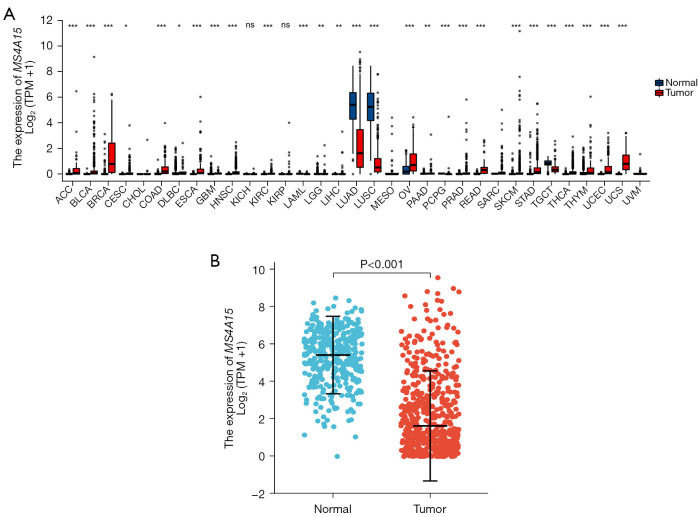
Results: MS4A15 expression was significantly more decreased in the tumor tissues from the LUAD patients than the normal adjacent samples. MS4A15 expression was positively correlated with various immune cell types, notably including mast cells (MCs), dendritic cells, and macrophages. Specifically, MS4A15 was most positively associated with MCs. Lower expression levels of MS4A15 in LUAD patients were correlated with a poorer pathologic stage and poorer primary therapy outcomes. The area under the curve of the ROC curve for MS4A15 effectiveness was 0.863. MS4A15 was validated to be more lowly expressed in the tumor tissues samples than the normal tissues samples in both the GSE116959 and GSE130779 data sets. The expression of MS4A15 was also significantly lower in the in A549 cells than the normal human bronchial epithelia cells.
Conclusions: Overall, MS4A15 emerged as a promising prognostic biomarker for LUAD and could serve as a potential target for the development of novel therapeutic interventions.
期刊介绍:
Translational Lung Cancer Research(TLCR, Transl Lung Cancer Res, Print ISSN 2218-6751; Online ISSN 2226-4477) is an international, peer-reviewed, open-access journal, which was founded in March 2012. TLCR is indexed by PubMed/PubMed Central and the Chemical Abstracts Service (CAS) Databases. It is published quarterly the first year, and published bimonthly since February 2013. It provides practical up-to-date information on prevention, early detection, diagnosis, and treatment of lung cancer. Specific areas of its interest include, but not limited to, multimodality therapy, markers, imaging, tumor biology, pathology, chemoprevention, and technical advances related to lung cancer.




 京公网安备 11010802042870号
京ICP备2023020795号-1
京公网安备 11010802042870号
京ICP备2023020795号-1

 分享
分享
 求助内容:
求助内容: 应助结果提醒方式:
 扫码关注我们
