{"title":"利用植物次生代谢物调控印楝素纳米组装物的可持续害虫管理","authors":"Xiaohong Zhang, Jianhua Xiao, Yuqi Huang, Yulu Liu, Gaohua Hu, Weiyao Yan, Guangyao Yan, Qing Guo, Jiawei Shi, Ruyue Han, Jianqiang Li, Gang Tang, Yongsong Cao","doi":"10.1038/s41467-025-57028-w","DOIUrl":null,"url":null,"abstract":"<p>Biopesticides have emerged as a global trend to minimize the risks associated with synthetic agrochemicals. However, their stability and efficacies remain challenges for widespread application. Herein, co-assembled nanoparticles (AT NPs or AP NPs) based on azadirachtin (AZA) and tannic acid (TA) or phenylalanine (PA) are constructed in aqueous solution through self-assembly technology. The small particle size, low PDI, high ζ-potential, and related other physicochemical characteristics of nanoparticles can improve wettability, adhesiveness, rain erosion resistance, and photostability compared to the commercial AZA formulation. Importantly, co-assemblies with bidirectional pH-responsive disassembly in acidic or alkaline solutions, allow them to respond to microenvironmental stimuli of targets and enable controlled release of AZA. The nanosystems demonstrated remarkable in vitro and in vivo insecticidal activities against <i>Ostrinia furnacalis</i> and <i>Aphis gossypii</i>. This study illustrates a distinctive perspective for developing eco-friendly nanosystems, highlighting a water-based treatment method for biopesticides with improved physicochemical properties and utilization efficiency.</p>","PeriodicalId":19066,"journal":{"name":"Nature Communications","volume":"64 1","pages":""},"PeriodicalIF":15.7000,"publicationDate":"2025-02-18","publicationTypes":"Journal Article","fieldsOfStudy":null,"isOpenAccess":false,"openAccessPdf":"","citationCount":"0","resultStr":"{\"title\":\"Sustainable pest management using plant secondary metabolites regulated azadirachtin nano-assemblies\",\"authors\":\"Xiaohong Zhang, Jianhua Xiao, Yuqi Huang, Yulu Liu, Gaohua Hu, Weiyao Yan, Guangyao Yan, Qing Guo, Jiawei Shi, Ruyue Han, Jianqiang Li, Gang Tang, Yongsong Cao\",\"doi\":\"10.1038/s41467-025-57028-w\",\"DOIUrl\":null,\"url\":null,\"abstract\":\"<p>Biopesticides have emerged as a global trend to minimize the risks associated with synthetic agrochemicals. However, their stability and efficacies remain challenges for widespread application. Herein, co-assembled nanoparticles (AT NPs or AP NPs) based on azadirachtin (AZA) and tannic acid (TA) or phenylalanine (PA) are constructed in aqueous solution through self-assembly technology. The small particle size, low PDI, high ζ-potential, and related other physicochemical characteristics of nanoparticles can improve wettability, adhesiveness, rain erosion resistance, and photostability compared to the commercial AZA formulation. Importantly, co-assemblies with bidirectional pH-responsive disassembly in acidic or alkaline solutions, allow them to respond to microenvironmental stimuli of targets and enable controlled release of AZA. The nanosystems demonstrated remarkable in vitro and in vivo insecticidal activities against <i>Ostrinia furnacalis</i> and <i>Aphis gossypii</i>. This study illustrates a distinctive perspective for developing eco-friendly nanosystems, highlighting a water-based treatment method for biopesticides with improved physicochemical properties and utilization efficiency.</p>\",\"PeriodicalId\":19066,\"journal\":{\"name\":\"Nature Communications\",\"volume\":\"64 1\",\"pages\":\"\"},\"PeriodicalIF\":15.7000,\"publicationDate\":\"2025-02-18\",\"publicationTypes\":\"Journal Article\",\"fieldsOfStudy\":null,\"isOpenAccess\":false,\"openAccessPdf\":\"\",\"citationCount\":\"0\",\"resultStr\":null,\"platform\":\"Semanticscholar\",\"paperid\":null,\"PeriodicalName\":\"Nature Communications\",\"FirstCategoryId\":\"103\",\"ListUrlMain\":\"https://doi.org/10.1038/s41467-025-57028-w\",\"RegionNum\":1,\"RegionCategory\":\"综合性期刊\",\"ArticlePicture\":[],\"TitleCN\":null,\"AbstractTextCN\":null,\"PMCID\":null,\"EPubDate\":\"\",\"PubModel\":\"\",\"JCR\":\"Q1\",\"JCRName\":\"MULTIDISCIPLINARY SCIENCES\",\"Score\":null,\"Total\":0}","platform":"Semanticscholar","paperid":null,"PeriodicalName":"Nature Communications","FirstCategoryId":"103","ListUrlMain":"https://doi.org/10.1038/s41467-025-57028-w","RegionNum":1,"RegionCategory":"综合性期刊","ArticlePicture":[],"TitleCN":null,"AbstractTextCN":null,"PMCID":null,"EPubDate":"","PubModel":"","JCR":"Q1","JCRName":"MULTIDISCIPLINARY SCIENCES","Score":null,"Total":0}
Sustainable pest management using plant secondary metabolites regulated azadirachtin nano-assemblies
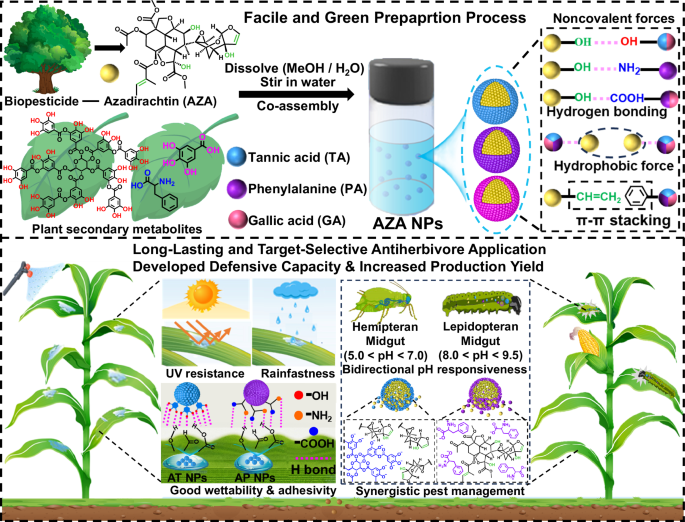
Biopesticides have emerged as a global trend to minimize the risks associated with synthetic agrochemicals. However, their stability and efficacies remain challenges for widespread application. Herein, co-assembled nanoparticles (AT NPs or AP NPs) based on azadirachtin (AZA) and tannic acid (TA) or phenylalanine (PA) are constructed in aqueous solution through self-assembly technology. The small particle size, low PDI, high ζ-potential, and related other physicochemical characteristics of nanoparticles can improve wettability, adhesiveness, rain erosion resistance, and photostability compared to the commercial AZA formulation. Importantly, co-assemblies with bidirectional pH-responsive disassembly in acidic or alkaline solutions, allow them to respond to microenvironmental stimuli of targets and enable controlled release of AZA. The nanosystems demonstrated remarkable in vitro and in vivo insecticidal activities against Ostrinia furnacalis and Aphis gossypii. This study illustrates a distinctive perspective for developing eco-friendly nanosystems, highlighting a water-based treatment method for biopesticides with improved physicochemical properties and utilization efficiency.
期刊介绍:
Nature Communications, an open-access journal, publishes high-quality research spanning all areas of the natural sciences. Papers featured in the journal showcase significant advances relevant to specialists in each respective field. With a 2-year impact factor of 16.6 (2022) and a median time of 8 days from submission to the first editorial decision, Nature Communications is committed to rapid dissemination of research findings. As a multidisciplinary journal, it welcomes contributions from biological, health, physical, chemical, Earth, social, mathematical, applied, and engineering sciences, aiming to highlight important breakthroughs within each domain.




 京公网安备 11010802042870号
京ICP备2023020795号-1
京公网安备 11010802042870号
京ICP备2023020795号-1

 分享
分享
 求助内容:
求助内容: 应助结果提醒方式:
 扫码关注我们
