{"title":"双向有利平台:用于多种生物标志物检测的双靶向探针编码枫叶型荧光侧流免疫分析","authors":"Siqi Zeng, Wanchao Zuo, Huilin Zhang, Jiaren Song, Qing Yang, Qiannan Hu, Xiangming Meng, Wenxuan Chen, Yazhou Wang, Jianjun Dai, Yanmin Ju","doi":"10.1021/acs.analchem.4c06414","DOIUrl":null,"url":null,"abstract":"In the traditional multiplexed lateral flow immunoassay (LFIA), different detection probes against different targets are necessary. However, the relative complexity and high cost of probe preparation, as well as the insufficient user-friendliness, limit the application of the multiplexed LFIA in disease diagnosis. Here, we reported a bidirectionally favorable LFIA (BDF-LFIA) platform to maximize convenience for both manufacturers and users. Red-emitting time-resolved fluorescent nanoparticles were coated with different antibodies to recognize multiple targets simultaneously, which greatly simplified probe preparation by the manufacturers. Ultrabright green-emitting gold nanoclusters were pre-embedded on the test line as a reference signal to achieve a target concentration-dependent maple leaf-type hue readout from green to yellow to red, which was quite user-friendly. Taking cancer biomarkers alpha-fetoprotein and carcinoembryonic antigen as examples, this assay achieved a visual detection limit of 2 ng/mL. Compared with the conventional fluorescent LFIA, the BDF-LFIA could generate a more discernible signal around the threshold concentration of the targets. Moreover, the assay successfully diagnosed 54 clinical samples. Overall, the BDF-LFIA showed bidirectional benefits for both manufacturers and users and provided a new concept for the LFIA in multiplexed detection.","PeriodicalId":27,"journal":{"name":"Analytical Chemistry","volume":"49 1","pages":""},"PeriodicalIF":6.7000,"publicationDate":"2025-02-17","publicationTypes":"Journal Article","fieldsOfStudy":null,"isOpenAccess":false,"openAccessPdf":"","citationCount":"0","resultStr":"{\"title\":\"Bidirectionally Favorable Platform: A Dual-Targeting Probe-Encoded Maple Leaf-Type Fluorescent Lateral Flow Immunoassay for Multiple Biomarker Detection\",\"authors\":\"Siqi Zeng, Wanchao Zuo, Huilin Zhang, Jiaren Song, Qing Yang, Qiannan Hu, Xiangming Meng, Wenxuan Chen, Yazhou Wang, Jianjun Dai, Yanmin Ju\",\"doi\":\"10.1021/acs.analchem.4c06414\",\"DOIUrl\":null,\"url\":null,\"abstract\":\"In the traditional multiplexed lateral flow immunoassay (LFIA), different detection probes against different targets are necessary. However, the relative complexity and high cost of probe preparation, as well as the insufficient user-friendliness, limit the application of the multiplexed LFIA in disease diagnosis. Here, we reported a bidirectionally favorable LFIA (BDF-LFIA) platform to maximize convenience for both manufacturers and users. Red-emitting time-resolved fluorescent nanoparticles were coated with different antibodies to recognize multiple targets simultaneously, which greatly simplified probe preparation by the manufacturers. Ultrabright green-emitting gold nanoclusters were pre-embedded on the test line as a reference signal to achieve a target concentration-dependent maple leaf-type hue readout from green to yellow to red, which was quite user-friendly. Taking cancer biomarkers alpha-fetoprotein and carcinoembryonic antigen as examples, this assay achieved a visual detection limit of 2 ng/mL. Compared with the conventional fluorescent LFIA, the BDF-LFIA could generate a more discernible signal around the threshold concentration of the targets. Moreover, the assay successfully diagnosed 54 clinical samples. Overall, the BDF-LFIA showed bidirectional benefits for both manufacturers and users and provided a new concept for the LFIA in multiplexed detection.\",\"PeriodicalId\":27,\"journal\":{\"name\":\"Analytical Chemistry\",\"volume\":\"49 1\",\"pages\":\"\"},\"PeriodicalIF\":6.7000,\"publicationDate\":\"2025-02-17\",\"publicationTypes\":\"Journal Article\",\"fieldsOfStudy\":null,\"isOpenAccess\":false,\"openAccessPdf\":\"\",\"citationCount\":\"0\",\"resultStr\":null,\"platform\":\"Semanticscholar\",\"paperid\":null,\"PeriodicalName\":\"Analytical Chemistry\",\"FirstCategoryId\":\"92\",\"ListUrlMain\":\"https://doi.org/10.1021/acs.analchem.4c06414\",\"RegionNum\":1,\"RegionCategory\":\"化学\",\"ArticlePicture\":[],\"TitleCN\":null,\"AbstractTextCN\":null,\"PMCID\":null,\"EPubDate\":\"\",\"PubModel\":\"\",\"JCR\":\"Q1\",\"JCRName\":\"CHEMISTRY, ANALYTICAL\",\"Score\":null,\"Total\":0}","platform":"Semanticscholar","paperid":null,"PeriodicalName":"Analytical Chemistry","FirstCategoryId":"92","ListUrlMain":"https://doi.org/10.1021/acs.analchem.4c06414","RegionNum":1,"RegionCategory":"化学","ArticlePicture":[],"TitleCN":null,"AbstractTextCN":null,"PMCID":null,"EPubDate":"","PubModel":"","JCR":"Q1","JCRName":"CHEMISTRY, ANALYTICAL","Score":null,"Total":0}
Bidirectionally Favorable Platform: A Dual-Targeting Probe-Encoded Maple Leaf-Type Fluorescent Lateral Flow Immunoassay for Multiple Biomarker Detection
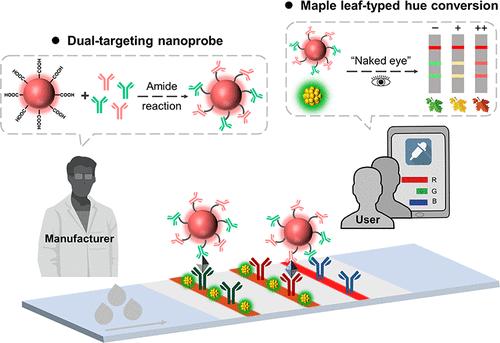
In the traditional multiplexed lateral flow immunoassay (LFIA), different detection probes against different targets are necessary. However, the relative complexity and high cost of probe preparation, as well as the insufficient user-friendliness, limit the application of the multiplexed LFIA in disease diagnosis. Here, we reported a bidirectionally favorable LFIA (BDF-LFIA) platform to maximize convenience for both manufacturers and users. Red-emitting time-resolved fluorescent nanoparticles were coated with different antibodies to recognize multiple targets simultaneously, which greatly simplified probe preparation by the manufacturers. Ultrabright green-emitting gold nanoclusters were pre-embedded on the test line as a reference signal to achieve a target concentration-dependent maple leaf-type hue readout from green to yellow to red, which was quite user-friendly. Taking cancer biomarkers alpha-fetoprotein and carcinoembryonic antigen as examples, this assay achieved a visual detection limit of 2 ng/mL. Compared with the conventional fluorescent LFIA, the BDF-LFIA could generate a more discernible signal around the threshold concentration of the targets. Moreover, the assay successfully diagnosed 54 clinical samples. Overall, the BDF-LFIA showed bidirectional benefits for both manufacturers and users and provided a new concept for the LFIA in multiplexed detection.
期刊介绍:
Analytical Chemistry, a peer-reviewed research journal, focuses on disseminating new and original knowledge across all branches of analytical chemistry. Fundamental articles may explore general principles of chemical measurement science and need not directly address existing or potential analytical methodology. They can be entirely theoretical or report experimental results. Contributions may cover various phases of analytical operations, including sampling, bioanalysis, electrochemistry, mass spectrometry, microscale and nanoscale systems, environmental analysis, separations, spectroscopy, chemical reactions and selectivity, instrumentation, imaging, surface analysis, and data processing. Papers discussing known analytical methods should present a significant, original application of the method, a notable improvement, or results on an important analyte.



 京公网安备 11010802042870号
京ICP备2023020795号-1
京公网安备 11010802042870号
京ICP备2023020795号-1

 分享
分享
 求助内容:
求助内容: 应助结果提醒方式:
 扫码关注我们
