Shangchen Cai , Qiao Yang , Jing Li , Changan Zhou , Lei Song , Chao Wang , Lirong Zheng , Kui Ma , Hairong Yue
{"title":"Cu-C相互作用实现CO2加氢制甲醇的高性能芯鞘C@CuSiO3纳米催化剂","authors":"Shangchen Cai , Qiao Yang , Jing Li , Changan Zhou , Lei Song , Chao Wang , Lirong Zheng , Kui Ma , Hairong Yue","doi":"10.1016/j.ces.2025.121393","DOIUrl":null,"url":null,"abstract":"<div><div>Catalytic hydrogenation of CO<sub>2</sub> to chemicals and alternative fuels such as methanol is an attractive approach for CO<sub>2</sub> utilization and hydrogen storage. Copper silicate is considered as efficient for hydrogenation of C-O/C=O bonds due to the synergistic effect from its unique dual-sites of Cu<sup>0</sup>-Cu<sup>+</sup>. However, it still confronts great obstacles of poor CO<sub>2</sub> conversion and methanol selectivity. Herein, we introduce carbon nanotubes (CNTs) to electronically interact with Cu<sup>0</sup>-Cu<sup>+</sup> sites, achieving CO<sub>2</sub> conversion of ∼ 25 % with methanol selectivity up to 80 %, which breaks the equilibrium selectivity (∼51 %) on this condition. Intrinsically, CNTs could not alter the *HOCO and *CO intermediates pathway of hydrogenation over Cu<sup>0</sup>-Cu<sup>+</sup> sites, but accelerate H<sub>2</sub> dissociation on Cu<sup>δ+</sup> (0 < δ < 1) originated from Cu<sup>0</sup>-C interaction at their interface. This leads to a local concentration enrichment of active H to boost deep hydrogenation to methanol. These findings open a new avenue for designing highly efficient and selective catalytic hydrogenation systems.</div></div>","PeriodicalId":271,"journal":{"name":"Chemical Engineering Science","volume":"308 ","pages":"Article 121393"},"PeriodicalIF":4.3000,"publicationDate":"2025-04-01","publicationTypes":"Journal Article","fieldsOfStudy":null,"isOpenAccess":false,"openAccessPdf":"","citationCount":"0","resultStr":"{\"title\":\"A high-performance core-sheath C@CuSiO3 nanocatalyst for CO2 hydrogenation to methanol achieved by Cu-C interaction\",\"authors\":\"Shangchen Cai , Qiao Yang , Jing Li , Changan Zhou , Lei Song , Chao Wang , Lirong Zheng , Kui Ma , Hairong Yue\",\"doi\":\"10.1016/j.ces.2025.121393\",\"DOIUrl\":null,\"url\":null,\"abstract\":\"<div><div>Catalytic hydrogenation of CO<sub>2</sub> to chemicals and alternative fuels such as methanol is an attractive approach for CO<sub>2</sub> utilization and hydrogen storage. Copper silicate is considered as efficient for hydrogenation of C-O/C=O bonds due to the synergistic effect from its unique dual-sites of Cu<sup>0</sup>-Cu<sup>+</sup>. However, it still confronts great obstacles of poor CO<sub>2</sub> conversion and methanol selectivity. Herein, we introduce carbon nanotubes (CNTs) to electronically interact with Cu<sup>0</sup>-Cu<sup>+</sup> sites, achieving CO<sub>2</sub> conversion of ∼ 25 % with methanol selectivity up to 80 %, which breaks the equilibrium selectivity (∼51 %) on this condition. Intrinsically, CNTs could not alter the *HOCO and *CO intermediates pathway of hydrogenation over Cu<sup>0</sup>-Cu<sup>+</sup> sites, but accelerate H<sub>2</sub> dissociation on Cu<sup>δ+</sup> (0 < δ < 1) originated from Cu<sup>0</sup>-C interaction at their interface. This leads to a local concentration enrichment of active H to boost deep hydrogenation to methanol. These findings open a new avenue for designing highly efficient and selective catalytic hydrogenation systems.</div></div>\",\"PeriodicalId\":271,\"journal\":{\"name\":\"Chemical Engineering Science\",\"volume\":\"308 \",\"pages\":\"Article 121393\"},\"PeriodicalIF\":4.3000,\"publicationDate\":\"2025-04-01\",\"publicationTypes\":\"Journal Article\",\"fieldsOfStudy\":null,\"isOpenAccess\":false,\"openAccessPdf\":\"\",\"citationCount\":\"0\",\"resultStr\":null,\"platform\":\"Semanticscholar\",\"paperid\":null,\"PeriodicalName\":\"Chemical Engineering Science\",\"FirstCategoryId\":\"5\",\"ListUrlMain\":\"https://www.sciencedirect.com/science/article/pii/S0009250925002167\",\"RegionNum\":2,\"RegionCategory\":\"工程技术\",\"ArticlePicture\":[],\"TitleCN\":null,\"AbstractTextCN\":null,\"PMCID\":null,\"EPubDate\":\"2025/2/18 0:00:00\",\"PubModel\":\"Epub\",\"JCR\":\"Q2\",\"JCRName\":\"ENGINEERING, CHEMICAL\",\"Score\":null,\"Total\":0}","platform":"Semanticscholar","paperid":null,"PeriodicalName":"Chemical Engineering Science","FirstCategoryId":"5","ListUrlMain":"https://www.sciencedirect.com/science/article/pii/S0009250925002167","RegionNum":2,"RegionCategory":"工程技术","ArticlePicture":[],"TitleCN":null,"AbstractTextCN":null,"PMCID":null,"EPubDate":"2025/2/18 0:00:00","PubModel":"Epub","JCR":"Q2","JCRName":"ENGINEERING, CHEMICAL","Score":null,"Total":0}
A high-performance core-sheath C@CuSiO3 nanocatalyst for CO2 hydrogenation to methanol achieved by Cu-C interaction
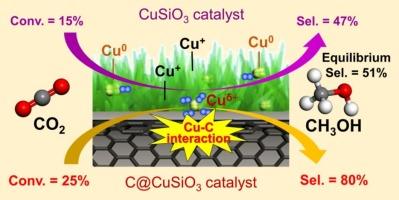
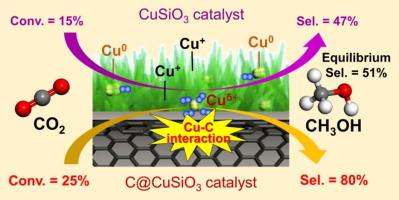
Catalytic hydrogenation of CO2 to chemicals and alternative fuels such as methanol is an attractive approach for CO2 utilization and hydrogen storage. Copper silicate is considered as efficient for hydrogenation of C-O/C=O bonds due to the synergistic effect from its unique dual-sites of Cu0-Cu+. However, it still confronts great obstacles of poor CO2 conversion and methanol selectivity. Herein, we introduce carbon nanotubes (CNTs) to electronically interact with Cu0-Cu+ sites, achieving CO2 conversion of ∼ 25 % with methanol selectivity up to 80 %, which breaks the equilibrium selectivity (∼51 %) on this condition. Intrinsically, CNTs could not alter the *HOCO and *CO intermediates pathway of hydrogenation over Cu0-Cu+ sites, but accelerate H2 dissociation on Cuδ+ (0 < δ < 1) originated from Cu0-C interaction at their interface. This leads to a local concentration enrichment of active H to boost deep hydrogenation to methanol. These findings open a new avenue for designing highly efficient and selective catalytic hydrogenation systems.
期刊介绍:
Chemical engineering enables the transformation of natural resources and energy into useful products for society. It draws on and applies natural sciences, mathematics and economics, and has developed fundamental engineering science that underpins the discipline.
Chemical Engineering Science (CES) has been publishing papers on the fundamentals of chemical engineering since 1951. CES is the platform where the most significant advances in the discipline have ever since been published. Chemical Engineering Science has accompanied and sustained chemical engineering through its development into the vibrant and broad scientific discipline it is today.




 京公网安备 11010802042870号
京ICP备2023020795号-1
京公网安备 11010802042870号
京ICP备2023020795号-1

 分享
分享
 求助内容:
求助内容: 应助结果提醒方式:
 扫码关注我们
