Jongyun Choi , Seonhui Choi , Sei-Min Park , Jung-Chul An , Hai Woong Park , Ji Chul Jung , Inchan Yang
{"title":"焦炭废弃物的环保回收:将炼钢废弃物转化为锂离子电池用高纯度石墨","authors":"Jongyun Choi , Seonhui Choi , Sei-Min Park , Jung-Chul An , Hai Woong Park , Ji Chul Jung , Inchan Yang","doi":"10.1016/j.carbon.2025.120119","DOIUrl":null,"url":null,"abstract":"<div><div>This study aims to develop an environmentally friendly process for recycling ECS dust (dust collected through the Emission Control System), a waste product generated in steel manufacturing, into high-purity graphite for lithium-ion batteries. Although ECS dust is primarily composed of carbon derived from coke, its low purity limits its use as a raw material. To address this limitation, we developed a process that converts ECS dust into high-quality graphite using a sustainable and economically viable approach that avoids harmful chemicals, thereby enhancing industrial applicability. Through the process we developed, we successfully produced high-quality graphite with a high degree of graphitization of 93 %. Additionally, we conducted half-cell and full-cell tests using electrodes with high mass loading that incorporate SiO<sub>x</sub>, aligning with the current trends in secondary battery technology. Our results demonstrated the recycling potential of ECS dust, anticipating prospective practical applications through experimental designs tailored to industrial processes.</div></div>","PeriodicalId":262,"journal":{"name":"Carbon","volume":"236 ","pages":"Article 120119"},"PeriodicalIF":11.6000,"publicationDate":"2025-03-20","publicationTypes":"Journal Article","fieldsOfStudy":null,"isOpenAccess":false,"openAccessPdf":"","citationCount":"0","resultStr":"{\"title\":\"Eco-friendly recycling of coke waste: Transforming steel manufacturing waste into high-purity graphite for lithium-ion batteries\",\"authors\":\"Jongyun Choi , Seonhui Choi , Sei-Min Park , Jung-Chul An , Hai Woong Park , Ji Chul Jung , Inchan Yang\",\"doi\":\"10.1016/j.carbon.2025.120119\",\"DOIUrl\":null,\"url\":null,\"abstract\":\"<div><div>This study aims to develop an environmentally friendly process for recycling ECS dust (dust collected through the Emission Control System), a waste product generated in steel manufacturing, into high-purity graphite for lithium-ion batteries. Although ECS dust is primarily composed of carbon derived from coke, its low purity limits its use as a raw material. To address this limitation, we developed a process that converts ECS dust into high-quality graphite using a sustainable and economically viable approach that avoids harmful chemicals, thereby enhancing industrial applicability. Through the process we developed, we successfully produced high-quality graphite with a high degree of graphitization of 93 %. Additionally, we conducted half-cell and full-cell tests using electrodes with high mass loading that incorporate SiO<sub>x</sub>, aligning with the current trends in secondary battery technology. Our results demonstrated the recycling potential of ECS dust, anticipating prospective practical applications through experimental designs tailored to industrial processes.</div></div>\",\"PeriodicalId\":262,\"journal\":{\"name\":\"Carbon\",\"volume\":\"236 \",\"pages\":\"Article 120119\"},\"PeriodicalIF\":11.6000,\"publicationDate\":\"2025-03-20\",\"publicationTypes\":\"Journal Article\",\"fieldsOfStudy\":null,\"isOpenAccess\":false,\"openAccessPdf\":\"\",\"citationCount\":\"0\",\"resultStr\":null,\"platform\":\"Semanticscholar\",\"paperid\":null,\"PeriodicalName\":\"Carbon\",\"FirstCategoryId\":\"88\",\"ListUrlMain\":\"https://www.sciencedirect.com/science/article/pii/S0008622325001356\",\"RegionNum\":2,\"RegionCategory\":\"材料科学\",\"ArticlePicture\":[],\"TitleCN\":null,\"AbstractTextCN\":null,\"PMCID\":null,\"EPubDate\":\"2025/2/14 0:00:00\",\"PubModel\":\"Epub\",\"JCR\":\"Q1\",\"JCRName\":\"CHEMISTRY, PHYSICAL\",\"Score\":null,\"Total\":0}","platform":"Semanticscholar","paperid":null,"PeriodicalName":"Carbon","FirstCategoryId":"88","ListUrlMain":"https://www.sciencedirect.com/science/article/pii/S0008622325001356","RegionNum":2,"RegionCategory":"材料科学","ArticlePicture":[],"TitleCN":null,"AbstractTextCN":null,"PMCID":null,"EPubDate":"2025/2/14 0:00:00","PubModel":"Epub","JCR":"Q1","JCRName":"CHEMISTRY, PHYSICAL","Score":null,"Total":0}
Eco-friendly recycling of coke waste: Transforming steel manufacturing waste into high-purity graphite for lithium-ion batteries
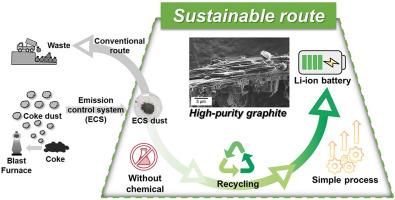
This study aims to develop an environmentally friendly process for recycling ECS dust (dust collected through the Emission Control System), a waste product generated in steel manufacturing, into high-purity graphite for lithium-ion batteries. Although ECS dust is primarily composed of carbon derived from coke, its low purity limits its use as a raw material. To address this limitation, we developed a process that converts ECS dust into high-quality graphite using a sustainable and economically viable approach that avoids harmful chemicals, thereby enhancing industrial applicability. Through the process we developed, we successfully produced high-quality graphite with a high degree of graphitization of 93 %. Additionally, we conducted half-cell and full-cell tests using electrodes with high mass loading that incorporate SiOx, aligning with the current trends in secondary battery technology. Our results demonstrated the recycling potential of ECS dust, anticipating prospective practical applications through experimental designs tailored to industrial processes.
期刊介绍:
The journal Carbon is an international multidisciplinary forum for communicating scientific advances in the field of carbon materials. It reports new findings related to the formation, structure, properties, behaviors, and technological applications of carbons. Carbons are a broad class of ordered or disordered solid phases composed primarily of elemental carbon, including but not limited to carbon black, carbon fibers and filaments, carbon nanotubes, diamond and diamond-like carbon, fullerenes, glassy carbon, graphite, graphene, graphene-oxide, porous carbons, pyrolytic carbon, and other sp2 and non-sp2 hybridized carbon systems. Carbon is the companion title to the open access journal Carbon Trends. Relevant application areas for carbon materials include biology and medicine, catalysis, electronic, optoelectronic, spintronic, high-frequency, and photonic devices, energy storage and conversion systems, environmental applications and water treatment, smart materials and systems, and structural and thermal applications.




 京公网安备 11010802042870号
京ICP备2023020795号-1
京公网安备 11010802042870号
京ICP备2023020795号-1

 分享
分享
 求助内容:
求助内容: 应助结果提醒方式:
 扫码关注我们
