Sangmin Lee , Jeongbok Lee , Hyunseok Kwon , Heungsoo Shin
{"title":"用于工程三维血管化脂肪组织的功能控制模块化组织构建块的仿生集成","authors":"Sangmin Lee , Jeongbok Lee , Hyunseok Kwon , Heungsoo Shin","doi":"10.1016/j.bioactmat.2025.02.024","DOIUrl":null,"url":null,"abstract":"<div><div>Adipose tissue is highly vascularized, which is crucial for homeostasis and energy storage. Current efforts to engineer 3D vascularized adipose tissue <em>in vitro</em> typically involve co-culturing adipocytes and endothelial cells, but adipogenic differentiation often suppresses endothelial function. In this study, we propose a novel approach to reconstruct vascularized adipose tissues <em>in vitro</em> by effectively coupling adipogenesis and vasculogenesis. First, we developed adipo-inductive nanofibers (ID/F@INS) that contain indomethacin and insulin. The <em>in vitro</em> adipogenesis of human adipose-derived stem cells (hADSCs) in general medium was significantly enhanced in adipogenic spheroids (AS) prepared with hADSCs and ID/F@INS, which were encapsulated in a gelatin methacryloyl (GelMA) hydrogel. To further replicate clustering during <em>de novo</em> adipogenesis, we generated AS of varying sizes and found that larger spheroids exhibited markedly greater adipogenesis than smaller ones. At the same time, we used hADSCs and human umbilical vein endothelial cells to generate vascular spheroids (VS). The biomimetic integration of AS and VS within GelMA hydrogels enabled us to investigate the interactions between <em>de novo</em> adipogenesis and vascularization. The integration of the two types of spheroids (VS:AS ratio of 2:1) significantly improved vascular network formation, indicating the concurrent stimulation of adipogenesis and vasculogenesis. This system was then applied to develop an <em>in vitro</em> obesity-like white adipose dysfunction model characterized by reduced vascularization and the elevated expression of pro-inflammatory cytokines. In addition, we found both vascularization and adipogenesis <em>in vivo</em> when we implanted the engineered tissue into mice, demonstrating the potential of our tissue for therapeutic applications in tissue reconstruction.</div></div>","PeriodicalId":8762,"journal":{"name":"Bioactive Materials","volume":"48 ","pages":"Pages 171-188"},"PeriodicalIF":23.6000,"publicationDate":"2025-06-01","publicationTypes":"Journal Article","fieldsOfStudy":null,"isOpenAccess":false,"openAccessPdf":"","citationCount":"0","resultStr":"{\"title\":\"Biomimetic integration of functionally controlled modular tissue building blocks for engineering 3D vascularized adipose tissue\",\"authors\":\"Sangmin Lee , Jeongbok Lee , Hyunseok Kwon , Heungsoo Shin\",\"doi\":\"10.1016/j.bioactmat.2025.02.024\",\"DOIUrl\":null,\"url\":null,\"abstract\":\"<div><div>Adipose tissue is highly vascularized, which is crucial for homeostasis and energy storage. Current efforts to engineer 3D vascularized adipose tissue <em>in vitro</em> typically involve co-culturing adipocytes and endothelial cells, but adipogenic differentiation often suppresses endothelial function. In this study, we propose a novel approach to reconstruct vascularized adipose tissues <em>in vitro</em> by effectively coupling adipogenesis and vasculogenesis. First, we developed adipo-inductive nanofibers (ID/F@INS) that contain indomethacin and insulin. The <em>in vitro</em> adipogenesis of human adipose-derived stem cells (hADSCs) in general medium was significantly enhanced in adipogenic spheroids (AS) prepared with hADSCs and ID/F@INS, which were encapsulated in a gelatin methacryloyl (GelMA) hydrogel. To further replicate clustering during <em>de novo</em> adipogenesis, we generated AS of varying sizes and found that larger spheroids exhibited markedly greater adipogenesis than smaller ones. At the same time, we used hADSCs and human umbilical vein endothelial cells to generate vascular spheroids (VS). The biomimetic integration of AS and VS within GelMA hydrogels enabled us to investigate the interactions between <em>de novo</em> adipogenesis and vascularization. The integration of the two types of spheroids (VS:AS ratio of 2:1) significantly improved vascular network formation, indicating the concurrent stimulation of adipogenesis and vasculogenesis. This system was then applied to develop an <em>in vitro</em> obesity-like white adipose dysfunction model characterized by reduced vascularization and the elevated expression of pro-inflammatory cytokines. In addition, we found both vascularization and adipogenesis <em>in vivo</em> when we implanted the engineered tissue into mice, demonstrating the potential of our tissue for therapeutic applications in tissue reconstruction.</div></div>\",\"PeriodicalId\":8762,\"journal\":{\"name\":\"Bioactive Materials\",\"volume\":\"48 \",\"pages\":\"Pages 171-188\"},\"PeriodicalIF\":23.6000,\"publicationDate\":\"2025-06-01\",\"publicationTypes\":\"Journal Article\",\"fieldsOfStudy\":null,\"isOpenAccess\":false,\"openAccessPdf\":\"\",\"citationCount\":\"0\",\"resultStr\":null,\"platform\":\"Semanticscholar\",\"paperid\":null,\"PeriodicalName\":\"Bioactive Materials\",\"FirstCategoryId\":\"5\",\"ListUrlMain\":\"https://www.sciencedirect.com/science/article/pii/S2452199X25000799\",\"RegionNum\":1,\"RegionCategory\":\"医学\",\"ArticlePicture\":[],\"TitleCN\":null,\"AbstractTextCN\":null,\"PMCID\":null,\"EPubDate\":\"2025/2/18 0:00:00\",\"PubModel\":\"Epub\",\"JCR\":\"Q1\",\"JCRName\":\"ENGINEERING, BIOMEDICAL\",\"Score\":null,\"Total\":0}","platform":"Semanticscholar","paperid":null,"PeriodicalName":"Bioactive Materials","FirstCategoryId":"5","ListUrlMain":"https://www.sciencedirect.com/science/article/pii/S2452199X25000799","RegionNum":1,"RegionCategory":"医学","ArticlePicture":[],"TitleCN":null,"AbstractTextCN":null,"PMCID":null,"EPubDate":"2025/2/18 0:00:00","PubModel":"Epub","JCR":"Q1","JCRName":"ENGINEERING, BIOMEDICAL","Score":null,"Total":0}
Biomimetic integration of functionally controlled modular tissue building blocks for engineering 3D vascularized adipose tissue
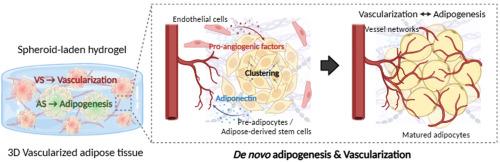
Adipose tissue is highly vascularized, which is crucial for homeostasis and energy storage. Current efforts to engineer 3D vascularized adipose tissue in vitro typically involve co-culturing adipocytes and endothelial cells, but adipogenic differentiation often suppresses endothelial function. In this study, we propose a novel approach to reconstruct vascularized adipose tissues in vitro by effectively coupling adipogenesis and vasculogenesis. First, we developed adipo-inductive nanofibers (ID/F@INS) that contain indomethacin and insulin. The in vitro adipogenesis of human adipose-derived stem cells (hADSCs) in general medium was significantly enhanced in adipogenic spheroids (AS) prepared with hADSCs and ID/F@INS, which were encapsulated in a gelatin methacryloyl (GelMA) hydrogel. To further replicate clustering during de novo adipogenesis, we generated AS of varying sizes and found that larger spheroids exhibited markedly greater adipogenesis than smaller ones. At the same time, we used hADSCs and human umbilical vein endothelial cells to generate vascular spheroids (VS). The biomimetic integration of AS and VS within GelMA hydrogels enabled us to investigate the interactions between de novo adipogenesis and vascularization. The integration of the two types of spheroids (VS:AS ratio of 2:1) significantly improved vascular network formation, indicating the concurrent stimulation of adipogenesis and vasculogenesis. This system was then applied to develop an in vitro obesity-like white adipose dysfunction model characterized by reduced vascularization and the elevated expression of pro-inflammatory cytokines. In addition, we found both vascularization and adipogenesis in vivo when we implanted the engineered tissue into mice, demonstrating the potential of our tissue for therapeutic applications in tissue reconstruction.
Bioactive MaterialsBiochemistry, Genetics and Molecular Biology-Biotechnology
CiteScore
28.00
自引率
6.30%
发文量
436
审稿时长
20 days
期刊介绍:
Bioactive Materials is a peer-reviewed research publication that focuses on advancements in bioactive materials. The journal accepts research papers, reviews, and rapid communications in the field of next-generation biomaterials that interact with cells, tissues, and organs in various living organisms.
The primary goal of Bioactive Materials is to promote the science and engineering of biomaterials that exhibit adaptiveness to the biological environment. These materials are specifically designed to stimulate or direct appropriate cell and tissue responses or regulate interactions with microorganisms.
The journal covers a wide range of bioactive materials, including those that are engineered or designed in terms of their physical form (e.g. particulate, fiber), topology (e.g. porosity, surface roughness), or dimensions (ranging from macro to nano-scales). Contributions are sought from the following categories of bioactive materials:
Bioactive metals and alloys
Bioactive inorganics: ceramics, glasses, and carbon-based materials
Bioactive polymers and gels
Bioactive materials derived from natural sources
Bioactive composites
These materials find applications in human and veterinary medicine, such as implants, tissue engineering scaffolds, cell/drug/gene carriers, as well as imaging and sensing devices.





 京公网安备 11010802042870号
京ICP备2023020795号-1
京公网安备 11010802042870号
京ICP备2023020795号-1

 分享
分享
 求助内容:
求助内容: 应助结果提醒方式:
 扫码关注我们
