Grace Gillis, Gaurav Bhalerao, Jasmine Blane, Robert Mitchell, Pieter M. Pretorius, Celeste McCracken, Thomas E. Nichols, Stephen M. Smith, Karla L. Miller, Fidel Alfaro-Almagro, Vanessa Raymont, Lola Martos, Clare E. Mackay, Ludovica Griffanti
{"title":"从大数据到诊所:在记忆诊所实施英国生物库成像框架的方法和统计增强","authors":"Grace Gillis, Gaurav Bhalerao, Jasmine Blane, Robert Mitchell, Pieter M. Pretorius, Celeste McCracken, Thomas E. Nichols, Stephen M. Smith, Karla L. Miller, Fidel Alfaro-Almagro, Vanessa Raymont, Lola Martos, Clare E. Mackay, Ludovica Griffanti","doi":"10.1002/hbm.70151","DOIUrl":null,"url":null,"abstract":"<p>The analysis tools and statistical methods used in large neuroimaging research studies differ from those applied in clinical contexts, making it unclear whether these techniques can be translated to a memory clinic setting. The Oxford Brain Health Clinic (OBHC) was established in 2020 to bridge this gap between research studies and memory clinics. We optimised the UK Biobank imaging framework for the memory clinic setting by integrating enhanced quality control (QC) processes (MRIQC, QUAD, and DSE decomposition) and supplementary dementia-informed analyses (lobar volumes, NBM volumes, WMH classification, PSMD, cortical diffusion MRI metrics, and tract volumes) into the analysis pipeline. We explored associations between resultant imaging-derived phenotypes (IDPs) and clinical phenotypes in the OBHC patient population (<i>N</i> = 213), applying hierarchical FDR correction to account for multiple testing. 14%–24% of scans were flagged by automated QC tools, but upon visual inspection, only 0%–2.4% of outputs were excluded. The pipeline successfully generated 5683 IDPs aligned with UK Biobank and 110 IDPs targeted towards dementia-related changes. We replicated established associations and found novel associations between brain metrics and age, cognition, and dementia-related diagnoses. The imaging protocol is feasible, acceptable, and yields high-quality data that is usable for both clinical and research purposes. We validated the use of this methodology in a real-world memory clinic population, which demonstrates the potential of this enhanced pipeline to bridge the gap between big data studies and clinical settings.</p>","PeriodicalId":13019,"journal":{"name":"Human Brain Mapping","volume":"46 3","pages":""},"PeriodicalIF":3.3000,"publicationDate":"2025-02-19","publicationTypes":"Journal Article","fieldsOfStudy":null,"isOpenAccess":false,"openAccessPdf":"https://onlinelibrary.wiley.com/doi/epdf/10.1002/hbm.70151","citationCount":"0","resultStr":"{\"title\":\"From Big Data to the Clinic: Methodological and Statistical Enhancements to Implement the UK Biobank Imaging Framework in a Memory Clinic\",\"authors\":\"Grace Gillis, Gaurav Bhalerao, Jasmine Blane, Robert Mitchell, Pieter M. Pretorius, Celeste McCracken, Thomas E. Nichols, Stephen M. Smith, Karla L. Miller, Fidel Alfaro-Almagro, Vanessa Raymont, Lola Martos, Clare E. Mackay, Ludovica Griffanti\",\"doi\":\"10.1002/hbm.70151\",\"DOIUrl\":null,\"url\":null,\"abstract\":\"<p>The analysis tools and statistical methods used in large neuroimaging research studies differ from those applied in clinical contexts, making it unclear whether these techniques can be translated to a memory clinic setting. The Oxford Brain Health Clinic (OBHC) was established in 2020 to bridge this gap between research studies and memory clinics. We optimised the UK Biobank imaging framework for the memory clinic setting by integrating enhanced quality control (QC) processes (MRIQC, QUAD, and DSE decomposition) and supplementary dementia-informed analyses (lobar volumes, NBM volumes, WMH classification, PSMD, cortical diffusion MRI metrics, and tract volumes) into the analysis pipeline. We explored associations between resultant imaging-derived phenotypes (IDPs) and clinical phenotypes in the OBHC patient population (<i>N</i> = 213), applying hierarchical FDR correction to account for multiple testing. 14%–24% of scans were flagged by automated QC tools, but upon visual inspection, only 0%–2.4% of outputs were excluded. The pipeline successfully generated 5683 IDPs aligned with UK Biobank and 110 IDPs targeted towards dementia-related changes. We replicated established associations and found novel associations between brain metrics and age, cognition, and dementia-related diagnoses. The imaging protocol is feasible, acceptable, and yields high-quality data that is usable for both clinical and research purposes. We validated the use of this methodology in a real-world memory clinic population, which demonstrates the potential of this enhanced pipeline to bridge the gap between big data studies and clinical settings.</p>\",\"PeriodicalId\":13019,\"journal\":{\"name\":\"Human Brain Mapping\",\"volume\":\"46 3\",\"pages\":\"\"},\"PeriodicalIF\":3.3000,\"publicationDate\":\"2025-02-19\",\"publicationTypes\":\"Journal Article\",\"fieldsOfStudy\":null,\"isOpenAccess\":false,\"openAccessPdf\":\"https://onlinelibrary.wiley.com/doi/epdf/10.1002/hbm.70151\",\"citationCount\":\"0\",\"resultStr\":null,\"platform\":\"Semanticscholar\",\"paperid\":null,\"PeriodicalName\":\"Human Brain Mapping\",\"FirstCategoryId\":\"3\",\"ListUrlMain\":\"https://onlinelibrary.wiley.com/doi/10.1002/hbm.70151\",\"RegionNum\":2,\"RegionCategory\":\"医学\",\"ArticlePicture\":[],\"TitleCN\":null,\"AbstractTextCN\":null,\"PMCID\":null,\"EPubDate\":\"\",\"PubModel\":\"\",\"JCR\":\"Q1\",\"JCRName\":\"NEUROIMAGING\",\"Score\":null,\"Total\":0}","platform":"Semanticscholar","paperid":null,"PeriodicalName":"Human Brain Mapping","FirstCategoryId":"3","ListUrlMain":"https://onlinelibrary.wiley.com/doi/10.1002/hbm.70151","RegionNum":2,"RegionCategory":"医学","ArticlePicture":[],"TitleCN":null,"AbstractTextCN":null,"PMCID":null,"EPubDate":"","PubModel":"","JCR":"Q1","JCRName":"NEUROIMAGING","Score":null,"Total":0}
From Big Data to the Clinic: Methodological and Statistical Enhancements to Implement the UK Biobank Imaging Framework in a Memory Clinic
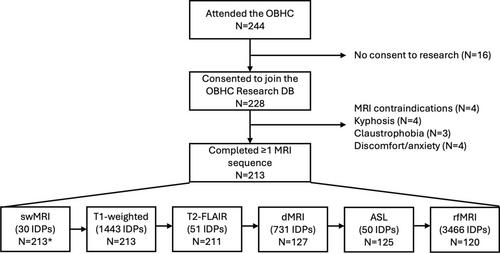
The analysis tools and statistical methods used in large neuroimaging research studies differ from those applied in clinical contexts, making it unclear whether these techniques can be translated to a memory clinic setting. The Oxford Brain Health Clinic (OBHC) was established in 2020 to bridge this gap between research studies and memory clinics. We optimised the UK Biobank imaging framework for the memory clinic setting by integrating enhanced quality control (QC) processes (MRIQC, QUAD, and DSE decomposition) and supplementary dementia-informed analyses (lobar volumes, NBM volumes, WMH classification, PSMD, cortical diffusion MRI metrics, and tract volumes) into the analysis pipeline. We explored associations between resultant imaging-derived phenotypes (IDPs) and clinical phenotypes in the OBHC patient population (N = 213), applying hierarchical FDR correction to account for multiple testing. 14%–24% of scans were flagged by automated QC tools, but upon visual inspection, only 0%–2.4% of outputs were excluded. The pipeline successfully generated 5683 IDPs aligned with UK Biobank and 110 IDPs targeted towards dementia-related changes. We replicated established associations and found novel associations between brain metrics and age, cognition, and dementia-related diagnoses. The imaging protocol is feasible, acceptable, and yields high-quality data that is usable for both clinical and research purposes. We validated the use of this methodology in a real-world memory clinic population, which demonstrates the potential of this enhanced pipeline to bridge the gap between big data studies and clinical settings.
期刊介绍:
Human Brain Mapping publishes peer-reviewed basic, clinical, technical, and theoretical research in the interdisciplinary and rapidly expanding field of human brain mapping. The journal features research derived from non-invasive brain imaging modalities used to explore the spatial and temporal organization of the neural systems supporting human behavior. Imaging modalities of interest include positron emission tomography, event-related potentials, electro-and magnetoencephalography, magnetic resonance imaging, and single-photon emission tomography. Brain mapping research in both normal and clinical populations is encouraged.
Article formats include Research Articles, Review Articles, Clinical Case Studies, and Technique, as well as Technological Developments, Theoretical Articles, and Synthetic Reviews. Technical advances, such as novel brain imaging methods, analyses for detecting or localizing neural activity, synergistic uses of multiple imaging modalities, and strategies for the design of behavioral paradigms and neural-systems modeling are of particular interest. The journal endorses the propagation of methodological standards and encourages database development in the field of human brain mapping.




 京公网安备 11010802042870号
京ICP备2023020795号-1
京公网安备 11010802042870号
京ICP备2023020795号-1

 分享
分享
 求助内容:
求助内容: 应助结果提醒方式:
 扫码关注我们
