Rui Zhao, Ai Zhang, Yao Wang, Yi Chai, Fei Du, Qian Xu, Qiuzhen Wang
{"title":"妊娠期体重增加对双胎妊娠不良结局的影响:一项针对中国妇女的前瞻性队列研究。","authors":"Rui Zhao, Ai Zhang, Yao Wang, Yi Chai, Fei Du, Qian Xu, Qiuzhen Wang","doi":"10.1186/s12884-025-07234-7","DOIUrl":null,"url":null,"abstract":"<p><strong>Background: </strong>Gestational weight gain (GWG) plays a critical role in determining birth outcomes, especially in twin pregnancies. However, the association between GWG and adverse birth outcomes in twin pregnancies remains inconclusive. This study aims to define GWG according to different classification criteria and explore their associations with adverse birth outcomes in twin pregnancies.</p><p><strong>Methods: </strong>This was a prospective cohort study that included 1,029 twin pregnant women recruited from Qingdao Women and Children's Hospital between September 2018 and December 2020. Participants were categorized into insufficient, adequate, and excessive GWG groups using both the interquartile range (P25-P75) method and the Institute of Medicine (IOM) criteria. Logistic regression models were employed to assess the associations between GWG and adverse birth outcomes, including preterm birth (PTB), low birth weight (LBW), and small for gestational age (SGA).</p><p><strong>Results: </strong>According to the interquartile range method, women in the insufficient GWG group had a significantly increased risk of PTB (OR: 2.13, 95% CI: 1.55-2.94), LBW (OR: 2.01, 95% CI: 1.33-3.05), and SGA (OR: 1.62, 95% CI: 1.03-2.54) compared to adequate GWG group. In contrast, the excessive GWG group was associated with a reduced risk of LBW (OR: 0.64, 95% CI: 0.45-0.92) and SGA (OR: 0.51, 95% CI: 0.28-0.91) after adjusting for potential confounders. Similar trends were observed using the IOM criteria, with a significantly increased risk of PTB and LBW in twin pregnant women with insufficient GWG and a reduced risk of SGA with excessive GWG.</p><p><strong>Conclusions: </strong>Achieving an appropriate level of weight gain during pregnancy is essential to reduce the risk of adverse birth outcomes in women with twin pregnancies.</p>","PeriodicalId":9033,"journal":{"name":"BMC Pregnancy and Childbirth","volume":"25 1","pages":"169"},"PeriodicalIF":2.7000,"publicationDate":"2025-02-17","publicationTypes":"Journal Article","fieldsOfStudy":null,"isOpenAccess":false,"openAccessPdf":"https://www.ncbi.nlm.nih.gov/pmc/articles/PMC11834644/pdf/","citationCount":"0","resultStr":"{\"title\":\"Effect of gestational weight gain on adverse birth outcomes in twin pregnancies: a prospective cohort study in Chinese women.\",\"authors\":\"Rui Zhao, Ai Zhang, Yao Wang, Yi Chai, Fei Du, Qian Xu, Qiuzhen Wang\",\"doi\":\"10.1186/s12884-025-07234-7\",\"DOIUrl\":null,\"url\":null,\"abstract\":\"<p><strong>Background: </strong>Gestational weight gain (GWG) plays a critical role in determining birth outcomes, especially in twin pregnancies. However, the association between GWG and adverse birth outcomes in twin pregnancies remains inconclusive. This study aims to define GWG according to different classification criteria and explore their associations with adverse birth outcomes in twin pregnancies.</p><p><strong>Methods: </strong>This was a prospective cohort study that included 1,029 twin pregnant women recruited from Qingdao Women and Children's Hospital between September 2018 and December 2020. Participants were categorized into insufficient, adequate, and excessive GWG groups using both the interquartile range (P25-P75) method and the Institute of Medicine (IOM) criteria. Logistic regression models were employed to assess the associations between GWG and adverse birth outcomes, including preterm birth (PTB), low birth weight (LBW), and small for gestational age (SGA).</p><p><strong>Results: </strong>According to the interquartile range method, women in the insufficient GWG group had a significantly increased risk of PTB (OR: 2.13, 95% CI: 1.55-2.94), LBW (OR: 2.01, 95% CI: 1.33-3.05), and SGA (OR: 1.62, 95% CI: 1.03-2.54) compared to adequate GWG group. In contrast, the excessive GWG group was associated with a reduced risk of LBW (OR: 0.64, 95% CI: 0.45-0.92) and SGA (OR: 0.51, 95% CI: 0.28-0.91) after adjusting for potential confounders. Similar trends were observed using the IOM criteria, with a significantly increased risk of PTB and LBW in twin pregnant women with insufficient GWG and a reduced risk of SGA with excessive GWG.</p><p><strong>Conclusions: </strong>Achieving an appropriate level of weight gain during pregnancy is essential to reduce the risk of adverse birth outcomes in women with twin pregnancies.</p>\",\"PeriodicalId\":9033,\"journal\":{\"name\":\"BMC Pregnancy and Childbirth\",\"volume\":\"25 1\",\"pages\":\"169\"},\"PeriodicalIF\":2.7000,\"publicationDate\":\"2025-02-17\",\"publicationTypes\":\"Journal Article\",\"fieldsOfStudy\":null,\"isOpenAccess\":false,\"openAccessPdf\":\"https://www.ncbi.nlm.nih.gov/pmc/articles/PMC11834644/pdf/\",\"citationCount\":\"0\",\"resultStr\":null,\"platform\":\"Semanticscholar\",\"paperid\":null,\"PeriodicalName\":\"BMC Pregnancy and Childbirth\",\"FirstCategoryId\":\"3\",\"ListUrlMain\":\"https://doi.org/10.1186/s12884-025-07234-7\",\"RegionNum\":2,\"RegionCategory\":\"医学\",\"ArticlePicture\":[],\"TitleCN\":null,\"AbstractTextCN\":null,\"PMCID\":null,\"EPubDate\":\"\",\"PubModel\":\"\",\"JCR\":\"Q1\",\"JCRName\":\"OBSTETRICS & GYNECOLOGY\",\"Score\":null,\"Total\":0}","platform":"Semanticscholar","paperid":null,"PeriodicalName":"BMC Pregnancy and Childbirth","FirstCategoryId":"3","ListUrlMain":"https://doi.org/10.1186/s12884-025-07234-7","RegionNum":2,"RegionCategory":"医学","ArticlePicture":[],"TitleCN":null,"AbstractTextCN":null,"PMCID":null,"EPubDate":"","PubModel":"","JCR":"Q1","JCRName":"OBSTETRICS & GYNECOLOGY","Score":null,"Total":0}
Effect of gestational weight gain on adverse birth outcomes in twin pregnancies: a prospective cohort study in Chinese women.
Background: Gestational weight gain (GWG) plays a critical role in determining birth outcomes, especially in twin pregnancies. However, the association between GWG and adverse birth outcomes in twin pregnancies remains inconclusive. This study aims to define GWG according to different classification criteria and explore their associations with adverse birth outcomes in twin pregnancies.
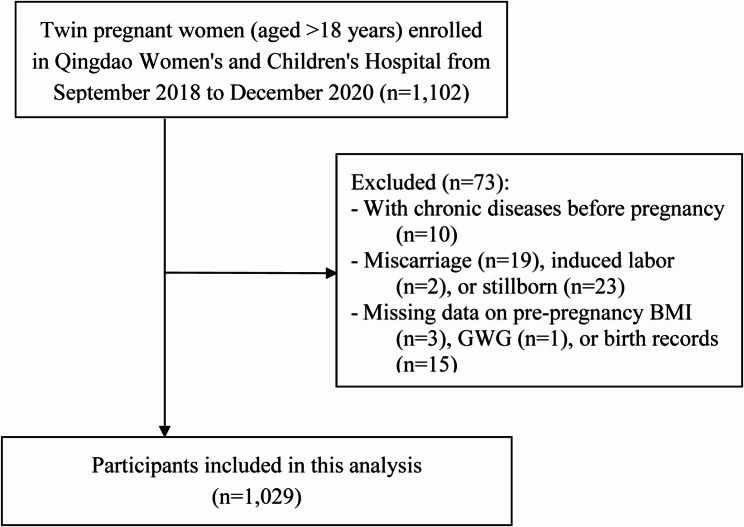
Methods: This was a prospective cohort study that included 1,029 twin pregnant women recruited from Qingdao Women and Children's Hospital between September 2018 and December 2020. Participants were categorized into insufficient, adequate, and excessive GWG groups using both the interquartile range (P25-P75) method and the Institute of Medicine (IOM) criteria. Logistic regression models were employed to assess the associations between GWG and adverse birth outcomes, including preterm birth (PTB), low birth weight (LBW), and small for gestational age (SGA).
Results: According to the interquartile range method, women in the insufficient GWG group had a significantly increased risk of PTB (OR: 2.13, 95% CI: 1.55-2.94), LBW (OR: 2.01, 95% CI: 1.33-3.05), and SGA (OR: 1.62, 95% CI: 1.03-2.54) compared to adequate GWG group. In contrast, the excessive GWG group was associated with a reduced risk of LBW (OR: 0.64, 95% CI: 0.45-0.92) and SGA (OR: 0.51, 95% CI: 0.28-0.91) after adjusting for potential confounders. Similar trends were observed using the IOM criteria, with a significantly increased risk of PTB and LBW in twin pregnant women with insufficient GWG and a reduced risk of SGA with excessive GWG.
Conclusions: Achieving an appropriate level of weight gain during pregnancy is essential to reduce the risk of adverse birth outcomes in women with twin pregnancies.
期刊介绍:
BMC Pregnancy & Childbirth is an open access, peer-reviewed journal that considers articles on all aspects of pregnancy and childbirth. The journal welcomes submissions on the biomedical aspects of pregnancy, breastfeeding, labor, maternal health, maternity care, trends and sociological aspects of pregnancy and childbirth.




 京公网安备 11010802042870号
京ICP备2023020795号-1
京公网安备 11010802042870号
京ICP备2023020795号-1

 分享
分享
 求助内容:
求助内容: 应助结果提醒方式:
 扫码关注我们
