{"title":"伴有原发性颅内肿瘤的成人中风。","authors":"Stuart C Innes, Lucia Yin, Gerald T Finnerty","doi":"10.1007/s00415-025-12929-0","DOIUrl":null,"url":null,"abstract":"<p><strong>Background: </strong>We investigated stroke in patients with either benign or malignant primary intracranial tumours to give insights into how malignant and non-malignant intracranial tumours affect stroke and to provide evidence for stroke guidelines for these patients.</p><p><strong>Methods: </strong>We conducted a retrospective cohort study of patients with benign or malignant primary intracranial tumours admitted with stroke (2011-2022) to a single centre with regional stroke and neuro-oncology units. Data collected included: stroke aetiology, stroke timing relative to tumour diagnosis, pre-stroke disability, post-stroke disability, stroke recurrence and treatment.</p><p><strong>Results: </strong>We identified 258 patients who had an index stroke (120 haemorrhagic, 135 ischaemic, three coincident haemorrhagic/ischaemic) at or after the diagnosis of their primary intracranial tumour (71% benign, 29% malignant). Stroke incidence spiked at tumour diagnosis and subsequent months. Symptomatic intracranial haemorrhage was more commonly associated with malignant primary intracranial tumours. In-hospital mortality and level of disability at hospital discharge (median modified Rankin scale score, 4) were similar for patients with benign or malignant primary intracranial tumours. Stroke recurrence was 22% at one year. Statins were associated with reduced stroke recurrence (HR = 0.35 [95% CI 0.13-0.96]). The probability of patients with malignant tumours receiving chemotherapy was inversely related to disability at hospital discharge (ratio OR per unit increase modified Rankin scale = 0.65 [95% CI 0.42-0.96]).</p><p><strong>Conclusion: </strong>Stroke has wider consequences for patients with primary intracranial tumours than commonly recognised. Our data indicated that statins may help to prevent stroke recurrence. Despite concerns about intracranial haemorrhage, antiplatelet agents should be considered after ischaemic stroke.</p>","PeriodicalId":16558,"journal":{"name":"Journal of Neurology","volume":"272 3","pages":"212"},"PeriodicalIF":4.6000,"publicationDate":"2025-02-17","publicationTypes":"Journal Article","fieldsOfStudy":null,"isOpenAccess":false,"openAccessPdf":"https://www.ncbi.nlm.nih.gov/pmc/articles/PMC11832572/pdf/","citationCount":"0","resultStr":"{\"title\":\"Stroke in adults with primary intracranial tumours.\",\"authors\":\"Stuart C Innes, Lucia Yin, Gerald T Finnerty\",\"doi\":\"10.1007/s00415-025-12929-0\",\"DOIUrl\":null,\"url\":null,\"abstract\":\"<p><strong>Background: </strong>We investigated stroke in patients with either benign or malignant primary intracranial tumours to give insights into how malignant and non-malignant intracranial tumours affect stroke and to provide evidence for stroke guidelines for these patients.</p><p><strong>Methods: </strong>We conducted a retrospective cohort study of patients with benign or malignant primary intracranial tumours admitted with stroke (2011-2022) to a single centre with regional stroke and neuro-oncology units. Data collected included: stroke aetiology, stroke timing relative to tumour diagnosis, pre-stroke disability, post-stroke disability, stroke recurrence and treatment.</p><p><strong>Results: </strong>We identified 258 patients who had an index stroke (120 haemorrhagic, 135 ischaemic, three coincident haemorrhagic/ischaemic) at or after the diagnosis of their primary intracranial tumour (71% benign, 29% malignant). Stroke incidence spiked at tumour diagnosis and subsequent months. Symptomatic intracranial haemorrhage was more commonly associated with malignant primary intracranial tumours. In-hospital mortality and level of disability at hospital discharge (median modified Rankin scale score, 4) were similar for patients with benign or malignant primary intracranial tumours. Stroke recurrence was 22% at one year. Statins were associated with reduced stroke recurrence (HR = 0.35 [95% CI 0.13-0.96]). The probability of patients with malignant tumours receiving chemotherapy was inversely related to disability at hospital discharge (ratio OR per unit increase modified Rankin scale = 0.65 [95% CI 0.42-0.96]).</p><p><strong>Conclusion: </strong>Stroke has wider consequences for patients with primary intracranial tumours than commonly recognised. Our data indicated that statins may help to prevent stroke recurrence. Despite concerns about intracranial haemorrhage, antiplatelet agents should be considered after ischaemic stroke.</p>\",\"PeriodicalId\":16558,\"journal\":{\"name\":\"Journal of Neurology\",\"volume\":\"272 3\",\"pages\":\"212\"},\"PeriodicalIF\":4.6000,\"publicationDate\":\"2025-02-17\",\"publicationTypes\":\"Journal Article\",\"fieldsOfStudy\":null,\"isOpenAccess\":false,\"openAccessPdf\":\"https://www.ncbi.nlm.nih.gov/pmc/articles/PMC11832572/pdf/\",\"citationCount\":\"0\",\"resultStr\":null,\"platform\":\"Semanticscholar\",\"paperid\":null,\"PeriodicalName\":\"Journal of Neurology\",\"FirstCategoryId\":\"3\",\"ListUrlMain\":\"https://doi.org/10.1007/s00415-025-12929-0\",\"RegionNum\":2,\"RegionCategory\":\"医学\",\"ArticlePicture\":[],\"TitleCN\":null,\"AbstractTextCN\":null,\"PMCID\":null,\"EPubDate\":\"\",\"PubModel\":\"\",\"JCR\":\"Q1\",\"JCRName\":\"CLINICAL NEUROLOGY\",\"Score\":null,\"Total\":0}","platform":"Semanticscholar","paperid":null,"PeriodicalName":"Journal of Neurology","FirstCategoryId":"3","ListUrlMain":"https://doi.org/10.1007/s00415-025-12929-0","RegionNum":2,"RegionCategory":"医学","ArticlePicture":[],"TitleCN":null,"AbstractTextCN":null,"PMCID":null,"EPubDate":"","PubModel":"","JCR":"Q1","JCRName":"CLINICAL NEUROLOGY","Score":null,"Total":0}
引用次数: 0
摘要
背景:我们研究了患有良性或恶性原发性颅内肿瘤的患者的卒中,以深入了解恶性和非恶性颅内肿瘤如何影响卒中,并为这些患者的卒中指南提供证据。方法:我们进行了一项回顾性队列研究,纳入了2011-2022年卒中住院的单一中心的良性或恶性原发性颅内肿瘤患者,该中心设有区域性卒中和神经肿瘤科。收集的数据包括:中风的病因、与肿瘤诊断相关的中风时间、中风前残疾、中风后残疾、中风复发和治疗。结果:我们确定了258例在诊断原发颅内肿瘤(71%为良性,29%为恶性)时或之后发生指数脑卒中的患者(120例出血性,135例缺血性,3例合并出血/缺血性)。中风发病率在肿瘤诊断和随后的几个月里急剧上升。症状性颅内出血常与原发性颅内恶性肿瘤相关。良性或恶性原发性颅内肿瘤患者的住院死亡率和出院时残疾水平(修正Rankin评分中位数为4)相似。一年后卒中复发率为22%。他汀类药物与卒中复发率降低相关(HR = 0.35 [95% CI 0.13-0.96])。恶性肿瘤患者接受化疗的概率与出院时残疾呈负相关(单位增加修正Rankin量表比值OR = 0.65 [95% CI 0.42-0.96])。结论:脑卒中对原发性颅内肿瘤患者的影响比通常认为的要广泛。我们的数据表明,他汀类药物可能有助于预防中风复发。尽管担心颅内出血,但缺血性脑卒中后仍应考虑使用抗血小板药物。
Stroke in adults with primary intracranial tumours.
Background: We investigated stroke in patients with either benign or malignant primary intracranial tumours to give insights into how malignant and non-malignant intracranial tumours affect stroke and to provide evidence for stroke guidelines for these patients.
Methods: We conducted a retrospective cohort study of patients with benign or malignant primary intracranial tumours admitted with stroke (2011-2022) to a single centre with regional stroke and neuro-oncology units. Data collected included: stroke aetiology, stroke timing relative to tumour diagnosis, pre-stroke disability, post-stroke disability, stroke recurrence and treatment.
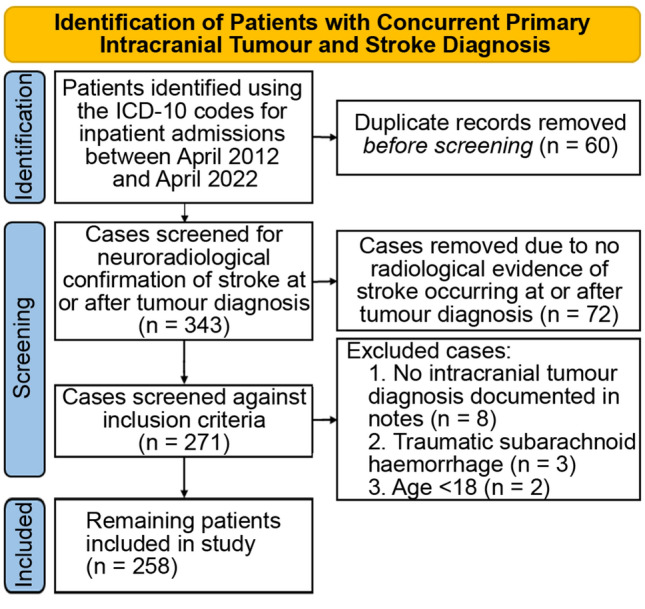
Results: We identified 258 patients who had an index stroke (120 haemorrhagic, 135 ischaemic, three coincident haemorrhagic/ischaemic) at or after the diagnosis of their primary intracranial tumour (71% benign, 29% malignant). Stroke incidence spiked at tumour diagnosis and subsequent months. Symptomatic intracranial haemorrhage was more commonly associated with malignant primary intracranial tumours. In-hospital mortality and level of disability at hospital discharge (median modified Rankin scale score, 4) were similar for patients with benign or malignant primary intracranial tumours. Stroke recurrence was 22% at one year. Statins were associated with reduced stroke recurrence (HR = 0.35 [95% CI 0.13-0.96]). The probability of patients with malignant tumours receiving chemotherapy was inversely related to disability at hospital discharge (ratio OR per unit increase modified Rankin scale = 0.65 [95% CI 0.42-0.96]).
Conclusion: Stroke has wider consequences for patients with primary intracranial tumours than commonly recognised. Our data indicated that statins may help to prevent stroke recurrence. Despite concerns about intracranial haemorrhage, antiplatelet agents should be considered after ischaemic stroke.
期刊介绍:
The Journal of Neurology is an international peer-reviewed journal which provides a source for publishing original communications and reviews on clinical neurology covering the whole field.
In addition, Letters to the Editors serve as a forum for clinical cases and the exchange of ideas which highlight important new findings. A section on Neurological progress serves to summarise the major findings in certain fields of neurology. Commentaries on new developments in clinical neuroscience, which may be commissioned or submitted, are published as editorials.
Every neurologist interested in the current diagnosis and treatment of neurological disorders needs access to the information contained in this valuable journal.






 京公网安备 11010802042870号
京ICP备2023020795号-1
京公网安备 11010802042870号
京ICP备2023020795号-1

 分享
分享
 求助内容:
求助内容: 应助结果提醒方式:
 扫码关注我们
