{"title":"脑白质损伤介导脑年龄对脑血管病患者认知功能的影响。","authors":"Yuanhao Li, Tian Tian, Yuanyuan Qin, Shun Zhang, Chengxia Liu, Wenzhen Zhu","doi":"10.1007/s00234-025-03568-3","DOIUrl":null,"url":null,"abstract":"<p><strong>Purpose: </strong>This study aims to investigate the potential effect of compromised structural integrity on cerebral aging and cognitive function in cerebral small vessel disease (CSVD).</p><p><strong>Methods: </strong>Fifty-five CSVD patients and 42 controls underwent three-dimensional T1-weighted imaging and diffusion tensor imaging. Relative brain age (RBA) was computed to assess cerebral aging. Variables of structural integrity included cortical thickness, cortical volume, white matter hyperintensity (WMH) volume, peak width of skeletonized mean diffusivity (PSMD), ventricular volume, and choroid plexus volume. Mini-Mental State Examination (MMSE) was conducted to assess general cognition. Trail Making Test (TMT) and Auditory Verbal Learning Test were administered to evaluate executive function and episodic memory, respectively. Mediation analysis and multivariate linear regression with interaction terms were performed to explore the differential impacts of RBA on cognitive function and structural integrity between CSVD patients and controls.</p><p><strong>Results: </strong>RBA was significantly increased in CSVD patients compared to controls (p < 0.001). White matter injuries as assessed with PSMD (mediation magnitude: 41.1%) and WMH volume (mediation magnitude: 56.9%) significantly mediated the relationship between CSVD pathologies and RBA (p < 0.001). Higher RBA was significantly correlated with poorer scores of MMSE, TMT-A, and TMT-B in CSVD patients (p < 0.01). Additionally, PSMD (mediation magnitude: 57.8% in MMSE, 48.3% in TMT-A, and 28.8% in TMT-B) and WMH volume (mediation magnitude: 55.1% in MMSE) significantly mediated the relationship between RBA and cognitive function (p < 0.05).</p><p><strong>Conclusion: </strong>White matter injuries play a critical role in the cerebral aging and cognitive decline in CSVD patients.</p>","PeriodicalId":19422,"journal":{"name":"Neuroradiology","volume":" ","pages":"613-622"},"PeriodicalIF":2.6000,"publicationDate":"2025-03-01","publicationTypes":"Journal Article","fieldsOfStudy":null,"isOpenAccess":false,"openAccessPdf":"https://www.ncbi.nlm.nih.gov/pmc/articles/PMC12003548/pdf/","citationCount":"0","resultStr":"{\"title\":\"White matter injuries mediate brain age effects on cognitive function in cerebral small vessel disease.\",\"authors\":\"Yuanhao Li, Tian Tian, Yuanyuan Qin, Shun Zhang, Chengxia Liu, Wenzhen Zhu\",\"doi\":\"10.1007/s00234-025-03568-3\",\"DOIUrl\":null,\"url\":null,\"abstract\":\"<p><strong>Purpose: </strong>This study aims to investigate the potential effect of compromised structural integrity on cerebral aging and cognitive function in cerebral small vessel disease (CSVD).</p><p><strong>Methods: </strong>Fifty-five CSVD patients and 42 controls underwent three-dimensional T1-weighted imaging and diffusion tensor imaging. Relative brain age (RBA) was computed to assess cerebral aging. Variables of structural integrity included cortical thickness, cortical volume, white matter hyperintensity (WMH) volume, peak width of skeletonized mean diffusivity (PSMD), ventricular volume, and choroid plexus volume. Mini-Mental State Examination (MMSE) was conducted to assess general cognition. Trail Making Test (TMT) and Auditory Verbal Learning Test were administered to evaluate executive function and episodic memory, respectively. Mediation analysis and multivariate linear regression with interaction terms were performed to explore the differential impacts of RBA on cognitive function and structural integrity between CSVD patients and controls.</p><p><strong>Results: </strong>RBA was significantly increased in CSVD patients compared to controls (p < 0.001). White matter injuries as assessed with PSMD (mediation magnitude: 41.1%) and WMH volume (mediation magnitude: 56.9%) significantly mediated the relationship between CSVD pathologies and RBA (p < 0.001). Higher RBA was significantly correlated with poorer scores of MMSE, TMT-A, and TMT-B in CSVD patients (p < 0.01). Additionally, PSMD (mediation magnitude: 57.8% in MMSE, 48.3% in TMT-A, and 28.8% in TMT-B) and WMH volume (mediation magnitude: 55.1% in MMSE) significantly mediated the relationship between RBA and cognitive function (p < 0.05).</p><p><strong>Conclusion: </strong>White matter injuries play a critical role in the cerebral aging and cognitive decline in CSVD patients.</p>\",\"PeriodicalId\":19422,\"journal\":{\"name\":\"Neuroradiology\",\"volume\":\" \",\"pages\":\"613-622\"},\"PeriodicalIF\":2.6000,\"publicationDate\":\"2025-03-01\",\"publicationTypes\":\"Journal Article\",\"fieldsOfStudy\":null,\"isOpenAccess\":false,\"openAccessPdf\":\"https://www.ncbi.nlm.nih.gov/pmc/articles/PMC12003548/pdf/\",\"citationCount\":\"0\",\"resultStr\":null,\"platform\":\"Semanticscholar\",\"paperid\":null,\"PeriodicalName\":\"Neuroradiology\",\"FirstCategoryId\":\"3\",\"ListUrlMain\":\"https://doi.org/10.1007/s00234-025-03568-3\",\"RegionNum\":3,\"RegionCategory\":\"医学\",\"ArticlePicture\":[],\"TitleCN\":null,\"AbstractTextCN\":null,\"PMCID\":null,\"EPubDate\":\"2025/2/17 0:00:00\",\"PubModel\":\"Epub\",\"JCR\":\"Q2\",\"JCRName\":\"CLINICAL NEUROLOGY\",\"Score\":null,\"Total\":0}","platform":"Semanticscholar","paperid":null,"PeriodicalName":"Neuroradiology","FirstCategoryId":"3","ListUrlMain":"https://doi.org/10.1007/s00234-025-03568-3","RegionNum":3,"RegionCategory":"医学","ArticlePicture":[],"TitleCN":null,"AbstractTextCN":null,"PMCID":null,"EPubDate":"2025/2/17 0:00:00","PubModel":"Epub","JCR":"Q2","JCRName":"CLINICAL NEUROLOGY","Score":null,"Total":0}
引用次数: 0
摘要
目的:本研究旨在探讨结构完整性受损对脑小血管疾病(CSVD)患者脑衰老和认知功能的潜在影响。方法:55例CSVD患者和42例对照组分别行三维t1加权成像和弥散张量成像。计算相对脑年龄(Relative brain age, RBA)来评估脑老化。结构完整性的变量包括皮质厚度、皮质体积、白质高强度(WMH)体积、骨架化平均扩散系数(PSMD)峰宽、心室体积和脉络膜丛体积。采用简易精神状态检查(MMSE)评估一般认知能力。用Trail Making Test (TMT)和听觉言语学习Test (Auditory Verbal Learning Test)分别评估执行功能和情景记忆。通过中介分析和多变量线性回归分析,探讨RBA对CSVD患者和对照组认知功能和结构完整性的差异影响。结果:与对照组相比,CSVD患者RBA明显增加(p)。结论:脑白质损伤在CSVD患者脑老化和认知能力下降中起关键作用。
White matter injuries mediate brain age effects on cognitive function in cerebral small vessel disease.
Purpose: This study aims to investigate the potential effect of compromised structural integrity on cerebral aging and cognitive function in cerebral small vessel disease (CSVD).
Methods: Fifty-five CSVD patients and 42 controls underwent three-dimensional T1-weighted imaging and diffusion tensor imaging. Relative brain age (RBA) was computed to assess cerebral aging. Variables of structural integrity included cortical thickness, cortical volume, white matter hyperintensity (WMH) volume, peak width of skeletonized mean diffusivity (PSMD), ventricular volume, and choroid plexus volume. Mini-Mental State Examination (MMSE) was conducted to assess general cognition. Trail Making Test (TMT) and Auditory Verbal Learning Test were administered to evaluate executive function and episodic memory, respectively. Mediation analysis and multivariate linear regression with interaction terms were performed to explore the differential impacts of RBA on cognitive function and structural integrity between CSVD patients and controls.
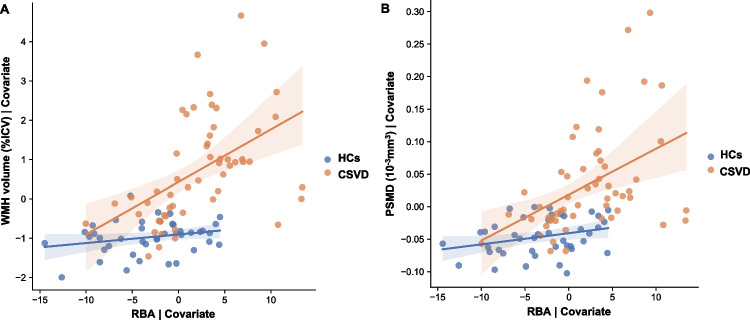
Results: RBA was significantly increased in CSVD patients compared to controls (p < 0.001). White matter injuries as assessed with PSMD (mediation magnitude: 41.1%) and WMH volume (mediation magnitude: 56.9%) significantly mediated the relationship between CSVD pathologies and RBA (p < 0.001). Higher RBA was significantly correlated with poorer scores of MMSE, TMT-A, and TMT-B in CSVD patients (p < 0.01). Additionally, PSMD (mediation magnitude: 57.8% in MMSE, 48.3% in TMT-A, and 28.8% in TMT-B) and WMH volume (mediation magnitude: 55.1% in MMSE) significantly mediated the relationship between RBA and cognitive function (p < 0.05).
Conclusion: White matter injuries play a critical role in the cerebral aging and cognitive decline in CSVD patients.
期刊介绍:
Neuroradiology aims to provide state-of-the-art medical and scientific information in the fields of Neuroradiology, Neurosciences, Neurology, Psychiatry, Neurosurgery, and related medical specialities. Neuroradiology as the official Journal of the European Society of Neuroradiology receives submissions from all parts of the world and publishes peer-reviewed original research, comprehensive reviews, educational papers, opinion papers, and short reports on exceptional clinical observations and new technical developments in the field of Neuroimaging and Neurointervention. The journal has subsections for Diagnostic and Interventional Neuroradiology, Advanced Neuroimaging, Paediatric Neuroradiology, Head-Neck-ENT Radiology, Spine Neuroradiology, and for submissions from Japan. Neuroradiology aims to provide new knowledge about and insights into the function and pathology of the human nervous system that may help to better diagnose and treat nervous system diseases. Neuroradiology is a member of the Committee on Publication Ethics (COPE) and follows the COPE core practices. Neuroradiology prefers articles that are free of bias, self-critical regarding limitations, transparent and clear in describing study participants, methods, and statistics, and short in presenting results. Before peer-review all submissions are automatically checked by iThenticate to assess for potential overlap in prior publication.






 京公网安备 11010802042870号
京ICP备2023020795号-1
京公网安备 11010802042870号
京ICP备2023020795号-1

 分享
分享
 求助内容:
求助内容: 应助结果提醒方式:
 扫码关注我们
