{"title":"大型语言模型BERT中的论点结构结构分析。","authors":"Pegah Ramezani, Achim Schilling, Patrick Krauss","doi":"10.3389/frai.2025.1477246","DOIUrl":null,"url":null,"abstract":"<p><p>Understanding how language and linguistic constructions are processed in the brain is a fundamental question in cognitive computational neuroscience. In this study, we investigate the processing and representation of Argument Structure Constructions (ASCs) in the BERT language model, extending previous analyses conducted with Long Short-Term Memory (LSTM) networks. We utilized a custom GPT-4 generated dataset comprising 2000 sentences, evenly distributed among four ASC types: transitive, ditransitive, caused-motion, and resultative constructions. BERT was assessed using the various token embeddings across its 12 layers. Our analyses involved visualizing the embeddings with Multidimensional Scaling (MDS) and t-Distributed Stochastic Neighbor Embedding (t-SNE), and calculating the Generalized Discrimination Value (GDV) to quantify the degree of clustering. We also trained feedforward classifiers (probes) to predict construction categories from these embeddings. Results reveal that CLS token embeddings cluster best according to ASC types in layers 2, 3, and 4, with diminished clustering in intermediate layers and a slight increase in the final layers. Token embeddings for DET and SUBJ showed consistent intermediate-level clustering across layers, while VERB embeddings demonstrated a systematic increase in clustering from layer 1 to 12. OBJ embeddings exhibited minimal clustering initially, which increased substantially, peaking in layer 10. Probe accuracies indicated that initial embeddings contained no specific construction information, as seen in low clustering and chance-level accuracies in layer 1. From layer 2 onward, probe accuracies surpassed 90 percent, highlighting latent construction category information not evident from GDV clustering alone. Additionally, Fisher Discriminant Ratio (FDR) analysis of attention weights revealed that OBJ tokens had the highest FDR scores, indicating they play a crucial role in differentiating ASCs, followed by VERB and DET tokens. SUBJ, CLS, and SEP tokens did not show significant FDR scores. Our study underscores the complex, layered processing of linguistic constructions in BERT, revealing both similarities and differences compared to recurrent models like LSTMs. Future research will compare these computational findings with neuroimaging data during continuous speech perception to better understand the neural correlates of ASC processing. This research demonstrates the potential of both recurrent and transformer-based neural language models to mirror linguistic processing in the human brain, offering valuable insights into the computational and neural mechanisms underlying language understanding.</p>","PeriodicalId":33315,"journal":{"name":"Frontiers in Artificial Intelligence","volume":"8 ","pages":"1477246"},"PeriodicalIF":6.7000,"publicationDate":"2025-01-31","publicationTypes":"Journal Article","fieldsOfStudy":null,"isOpenAccess":false,"openAccessPdf":"https://www.ncbi.nlm.nih.gov/pmc/articles/PMC11825518/pdf/","citationCount":"0","resultStr":"{\"title\":\"Analysis of argument structure constructions in the large language model BERT.\",\"authors\":\"Pegah Ramezani, Achim Schilling, Patrick Krauss\",\"doi\":\"10.3389/frai.2025.1477246\",\"DOIUrl\":null,\"url\":null,\"abstract\":\"<p><p>Understanding how language and linguistic constructions are processed in the brain is a fundamental question in cognitive computational neuroscience. In this study, we investigate the processing and representation of Argument Structure Constructions (ASCs) in the BERT language model, extending previous analyses conducted with Long Short-Term Memory (LSTM) networks. We utilized a custom GPT-4 generated dataset comprising 2000 sentences, evenly distributed among four ASC types: transitive, ditransitive, caused-motion, and resultative constructions. BERT was assessed using the various token embeddings across its 12 layers. Our analyses involved visualizing the embeddings with Multidimensional Scaling (MDS) and t-Distributed Stochastic Neighbor Embedding (t-SNE), and calculating the Generalized Discrimination Value (GDV) to quantify the degree of clustering. We also trained feedforward classifiers (probes) to predict construction categories from these embeddings. Results reveal that CLS token embeddings cluster best according to ASC types in layers 2, 3, and 4, with diminished clustering in intermediate layers and a slight increase in the final layers. Token embeddings for DET and SUBJ showed consistent intermediate-level clustering across layers, while VERB embeddings demonstrated a systematic increase in clustering from layer 1 to 12. OBJ embeddings exhibited minimal clustering initially, which increased substantially, peaking in layer 10. Probe accuracies indicated that initial embeddings contained no specific construction information, as seen in low clustering and chance-level accuracies in layer 1. From layer 2 onward, probe accuracies surpassed 90 percent, highlighting latent construction category information not evident from GDV clustering alone. Additionally, Fisher Discriminant Ratio (FDR) analysis of attention weights revealed that OBJ tokens had the highest FDR scores, indicating they play a crucial role in differentiating ASCs, followed by VERB and DET tokens. SUBJ, CLS, and SEP tokens did not show significant FDR scores. Our study underscores the complex, layered processing of linguistic constructions in BERT, revealing both similarities and differences compared to recurrent models like LSTMs. Future research will compare these computational findings with neuroimaging data during continuous speech perception to better understand the neural correlates of ASC processing. This research demonstrates the potential of both recurrent and transformer-based neural language models to mirror linguistic processing in the human brain, offering valuable insights into the computational and neural mechanisms underlying language understanding.</p>\",\"PeriodicalId\":33315,\"journal\":{\"name\":\"Frontiers in Artificial Intelligence\",\"volume\":\"8 \",\"pages\":\"1477246\"},\"PeriodicalIF\":6.7000,\"publicationDate\":\"2025-01-31\",\"publicationTypes\":\"Journal Article\",\"fieldsOfStudy\":null,\"isOpenAccess\":false,\"openAccessPdf\":\"https://www.ncbi.nlm.nih.gov/pmc/articles/PMC11825518/pdf/\",\"citationCount\":\"0\",\"resultStr\":null,\"platform\":\"Semanticscholar\",\"paperid\":null,\"PeriodicalName\":\"Frontiers in Artificial Intelligence\",\"FirstCategoryId\":\"1085\",\"ListUrlMain\":\"https://doi.org/10.3389/frai.2025.1477246\",\"RegionNum\":0,\"RegionCategory\":null,\"ArticlePicture\":[],\"TitleCN\":null,\"AbstractTextCN\":null,\"PMCID\":null,\"EPubDate\":\"2025/1/1 0:00:00\",\"PubModel\":\"eCollection\",\"JCR\":\"Q2\",\"JCRName\":\"COMPUTER SCIENCE, ARTIFICIAL INTELLIGENCE\",\"Score\":null,\"Total\":0}","platform":"Semanticscholar","paperid":null,"PeriodicalName":"Frontiers in Artificial Intelligence","FirstCategoryId":"1085","ListUrlMain":"https://doi.org/10.3389/frai.2025.1477246","RegionNum":0,"RegionCategory":null,"ArticlePicture":[],"TitleCN":null,"AbstractTextCN":null,"PMCID":null,"EPubDate":"2025/1/1 0:00:00","PubModel":"eCollection","JCR":"Q2","JCRName":"COMPUTER SCIENCE, ARTIFICIAL INTELLIGENCE","Score":null,"Total":0}
Analysis of argument structure constructions in the large language model BERT.
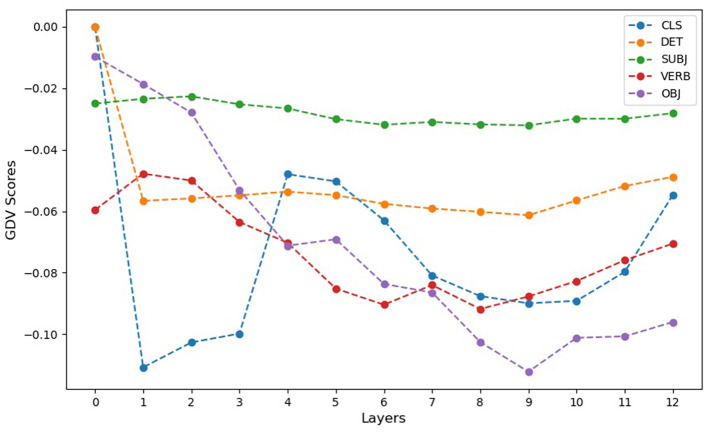
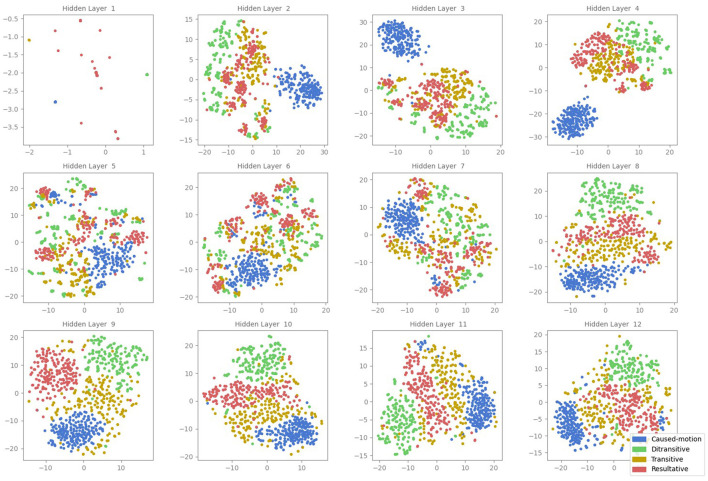
Understanding how language and linguistic constructions are processed in the brain is a fundamental question in cognitive computational neuroscience. In this study, we investigate the processing and representation of Argument Structure Constructions (ASCs) in the BERT language model, extending previous analyses conducted with Long Short-Term Memory (LSTM) networks. We utilized a custom GPT-4 generated dataset comprising 2000 sentences, evenly distributed among four ASC types: transitive, ditransitive, caused-motion, and resultative constructions. BERT was assessed using the various token embeddings across its 12 layers. Our analyses involved visualizing the embeddings with Multidimensional Scaling (MDS) and t-Distributed Stochastic Neighbor Embedding (t-SNE), and calculating the Generalized Discrimination Value (GDV) to quantify the degree of clustering. We also trained feedforward classifiers (probes) to predict construction categories from these embeddings. Results reveal that CLS token embeddings cluster best according to ASC types in layers 2, 3, and 4, with diminished clustering in intermediate layers and a slight increase in the final layers. Token embeddings for DET and SUBJ showed consistent intermediate-level clustering across layers, while VERB embeddings demonstrated a systematic increase in clustering from layer 1 to 12. OBJ embeddings exhibited minimal clustering initially, which increased substantially, peaking in layer 10. Probe accuracies indicated that initial embeddings contained no specific construction information, as seen in low clustering and chance-level accuracies in layer 1. From layer 2 onward, probe accuracies surpassed 90 percent, highlighting latent construction category information not evident from GDV clustering alone. Additionally, Fisher Discriminant Ratio (FDR) analysis of attention weights revealed that OBJ tokens had the highest FDR scores, indicating they play a crucial role in differentiating ASCs, followed by VERB and DET tokens. SUBJ, CLS, and SEP tokens did not show significant FDR scores. Our study underscores the complex, layered processing of linguistic constructions in BERT, revealing both similarities and differences compared to recurrent models like LSTMs. Future research will compare these computational findings with neuroimaging data during continuous speech perception to better understand the neural correlates of ASC processing. This research demonstrates the potential of both recurrent and transformer-based neural language models to mirror linguistic processing in the human brain, offering valuable insights into the computational and neural mechanisms underlying language understanding.






 京公网安备 11010802042870号
京ICP备2023020795号-1
京公网安备 11010802042870号
京ICP备2023020795号-1

 分享
分享
 求助内容:
求助内容: 应助结果提醒方式:
 扫码关注我们
