Sayantanee Paul, Thijs J. Hagenbeek, Julien Tremblay, Vasumathi Kameswaran, Christy Ong, Chad Liu, Alissa D. Guarnaccia, James A. Mondo, Peter L. Hsu, Noelyn M. Kljavin, Bartosz Czech, Janina Smola, Dieu An H. Nguyen, Jennifer A. Lacap, Trang H. Pham, Yuxin Liang, Robert A. Blake, Luca Gerosa, Matthew Grimmer, Shiqi Xie, Bence Daniel, Xiaosai Yao, Anwesha Dey
{"title":"Hippo和MAPK通路激活之间的合作驱动对TEAD抑制的获得性抗性","authors":"Sayantanee Paul, Thijs J. Hagenbeek, Julien Tremblay, Vasumathi Kameswaran, Christy Ong, Chad Liu, Alissa D. Guarnaccia, James A. Mondo, Peter L. Hsu, Noelyn M. Kljavin, Bartosz Czech, Janina Smola, Dieu An H. Nguyen, Jennifer A. Lacap, Trang H. Pham, Yuxin Liang, Robert A. Blake, Luca Gerosa, Matthew Grimmer, Shiqi Xie, Bence Daniel, Xiaosai Yao, Anwesha Dey","doi":"10.1038/s41467-025-56634-y","DOIUrl":null,"url":null,"abstract":"<p>TEAD (transcriptional enhanced associate domain) transcription factors (TEAD1-4) serve as the primary effectors of the Hippo signaling pathway in various cancers. Targeted therapy leads to the emergence of resistance and the underlying mechanism of resistance to TEAD inhibition in cancers is less characterized. We uncover that upregulation of the AP-1 (activator protein-1) transcription factors, along with restored YAP (yes-associated protein) and TEAD activity, drives resistance to GNE-7883, a pan-TEAD inhibitor. Acute GNE-7883 treatment abrogates YAP-TEAD binding and attenuates FOSL1 (FOS like 1) activity. TEAD inhibitor resistant cells restore YAP and TEAD chromatin occupancy, acquire additional FOSL1 binding and exhibit increased MAPK (mitogen-activated protein kinase) pathway activity. FOSL1 is required for the chromatin binding of YAP and TEAD. This study describes a clinically relevant interplay between the Hippo and MAPK pathway and highlights the key role of MAPK pathway inhibitors in mitigating resistance to TEAD inhibition in Hippo pathway dependent cancers.</p>","PeriodicalId":19066,"journal":{"name":"Nature Communications","volume":"1 1","pages":""},"PeriodicalIF":15.7000,"publicationDate":"2025-02-18","publicationTypes":"Journal Article","fieldsOfStudy":null,"isOpenAccess":false,"openAccessPdf":"","citationCount":"0","resultStr":"{\"title\":\"Cooperation between the Hippo and MAPK pathway activation drives acquired resistance to TEAD inhibition\",\"authors\":\"Sayantanee Paul, Thijs J. Hagenbeek, Julien Tremblay, Vasumathi Kameswaran, Christy Ong, Chad Liu, Alissa D. Guarnaccia, James A. Mondo, Peter L. Hsu, Noelyn M. Kljavin, Bartosz Czech, Janina Smola, Dieu An H. Nguyen, Jennifer A. Lacap, Trang H. Pham, Yuxin Liang, Robert A. Blake, Luca Gerosa, Matthew Grimmer, Shiqi Xie, Bence Daniel, Xiaosai Yao, Anwesha Dey\",\"doi\":\"10.1038/s41467-025-56634-y\",\"DOIUrl\":null,\"url\":null,\"abstract\":\"<p>TEAD (transcriptional enhanced associate domain) transcription factors (TEAD1-4) serve as the primary effectors of the Hippo signaling pathway in various cancers. Targeted therapy leads to the emergence of resistance and the underlying mechanism of resistance to TEAD inhibition in cancers is less characterized. We uncover that upregulation of the AP-1 (activator protein-1) transcription factors, along with restored YAP (yes-associated protein) and TEAD activity, drives resistance to GNE-7883, a pan-TEAD inhibitor. Acute GNE-7883 treatment abrogates YAP-TEAD binding and attenuates FOSL1 (FOS like 1) activity. TEAD inhibitor resistant cells restore YAP and TEAD chromatin occupancy, acquire additional FOSL1 binding and exhibit increased MAPK (mitogen-activated protein kinase) pathway activity. FOSL1 is required for the chromatin binding of YAP and TEAD. This study describes a clinically relevant interplay between the Hippo and MAPK pathway and highlights the key role of MAPK pathway inhibitors in mitigating resistance to TEAD inhibition in Hippo pathway dependent cancers.</p>\",\"PeriodicalId\":19066,\"journal\":{\"name\":\"Nature Communications\",\"volume\":\"1 1\",\"pages\":\"\"},\"PeriodicalIF\":15.7000,\"publicationDate\":\"2025-02-18\",\"publicationTypes\":\"Journal Article\",\"fieldsOfStudy\":null,\"isOpenAccess\":false,\"openAccessPdf\":\"\",\"citationCount\":\"0\",\"resultStr\":null,\"platform\":\"Semanticscholar\",\"paperid\":null,\"PeriodicalName\":\"Nature Communications\",\"FirstCategoryId\":\"103\",\"ListUrlMain\":\"https://doi.org/10.1038/s41467-025-56634-y\",\"RegionNum\":1,\"RegionCategory\":\"综合性期刊\",\"ArticlePicture\":[],\"TitleCN\":null,\"AbstractTextCN\":null,\"PMCID\":null,\"EPubDate\":\"\",\"PubModel\":\"\",\"JCR\":\"Q1\",\"JCRName\":\"MULTIDISCIPLINARY SCIENCES\",\"Score\":null,\"Total\":0}","platform":"Semanticscholar","paperid":null,"PeriodicalName":"Nature Communications","FirstCategoryId":"103","ListUrlMain":"https://doi.org/10.1038/s41467-025-56634-y","RegionNum":1,"RegionCategory":"综合性期刊","ArticlePicture":[],"TitleCN":null,"AbstractTextCN":null,"PMCID":null,"EPubDate":"","PubModel":"","JCR":"Q1","JCRName":"MULTIDISCIPLINARY SCIENCES","Score":null,"Total":0}
引用次数: 0
摘要
TEAD(转录增强相关域)转录因子(TEAD1-4)是多种癌症中Hippo信号通路的主要效应因子。靶向治疗导致耐药的出现,而癌症对TEAD抑制耐药的潜在机制尚不清楚。我们发现AP-1(激活蛋白-1)转录因子的上调,以及YAP (yes-associated protein)和TEAD活性的恢复,驱动了对泛TEAD抑制剂GNE-7883的抗性。急性GNE-7883治疗可消除YAP-TEAD结合并降低FOSL1 (FOS like 1)活性。TEAD抑制剂耐药细胞恢复YAP和TEAD染色质占用,获得额外的FOSL1结合,并表现出增加的MAPK(丝裂原活化蛋白激酶)途径活性。FOSL1是YAP和TEAD染色质结合所必需的。本研究描述了Hippo和MAPK通路之间的临床相关相互作用,并强调了MAPK通路抑制剂在减轻Hippo通路依赖性癌症对TEAD抑制的抗性中的关键作用。
Cooperation between the Hippo and MAPK pathway activation drives acquired resistance to TEAD inhibition
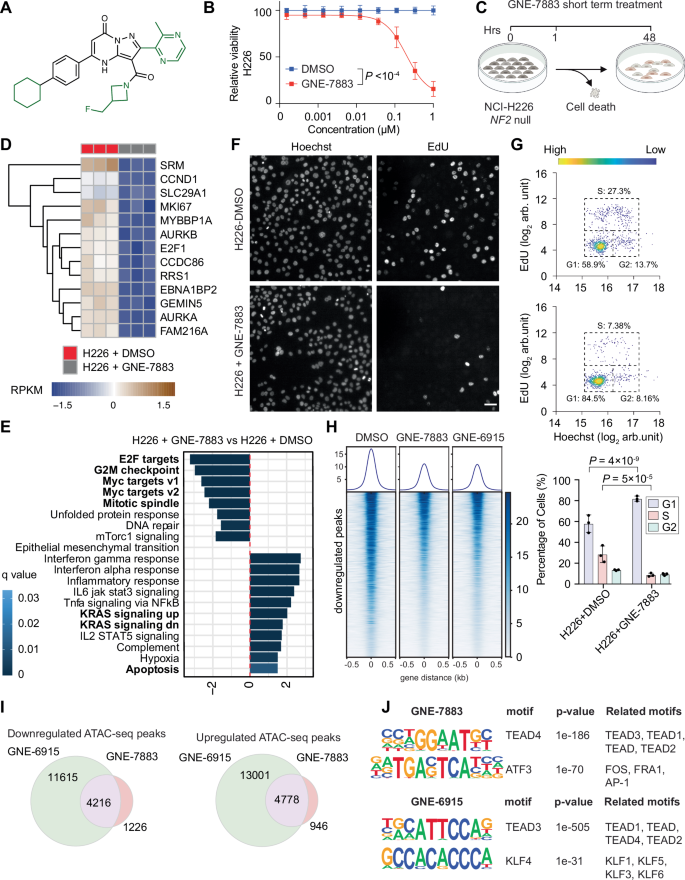
TEAD (transcriptional enhanced associate domain) transcription factors (TEAD1-4) serve as the primary effectors of the Hippo signaling pathway in various cancers. Targeted therapy leads to the emergence of resistance and the underlying mechanism of resistance to TEAD inhibition in cancers is less characterized. We uncover that upregulation of the AP-1 (activator protein-1) transcription factors, along with restored YAP (yes-associated protein) and TEAD activity, drives resistance to GNE-7883, a pan-TEAD inhibitor. Acute GNE-7883 treatment abrogates YAP-TEAD binding and attenuates FOSL1 (FOS like 1) activity. TEAD inhibitor resistant cells restore YAP and TEAD chromatin occupancy, acquire additional FOSL1 binding and exhibit increased MAPK (mitogen-activated protein kinase) pathway activity. FOSL1 is required for the chromatin binding of YAP and TEAD. This study describes a clinically relevant interplay between the Hippo and MAPK pathway and highlights the key role of MAPK pathway inhibitors in mitigating resistance to TEAD inhibition in Hippo pathway dependent cancers.
期刊介绍:
Nature Communications, an open-access journal, publishes high-quality research spanning all areas of the natural sciences. Papers featured in the journal showcase significant advances relevant to specialists in each respective field. With a 2-year impact factor of 16.6 (2022) and a median time of 8 days from submission to the first editorial decision, Nature Communications is committed to rapid dissemination of research findings. As a multidisciplinary journal, it welcomes contributions from biological, health, physical, chemical, Earth, social, mathematical, applied, and engineering sciences, aiming to highlight important breakthroughs within each domain.




 京公网安备 11010802042870号
京ICP备2023020795号-1
京公网安备 11010802042870号
京ICP备2023020795号-1

 分享
分享
 求助内容:
求助内容: 应助结果提醒方式:
 扫码关注我们
