Shailaja Akella, Peter Ledochowitsch, Joshua H. Siegle, Hannah Belski, Daniel D. Denman, Michael A. Buice, Severine Durand, Christof Koch, Shawn R. Olsen, Xiaoxuan Jia
{"title":"破译不同状态的神经元变异揭示了动态的感觉编码","authors":"Shailaja Akella, Peter Ledochowitsch, Joshua H. Siegle, Hannah Belski, Daniel D. Denman, Michael A. Buice, Severine Durand, Christof Koch, Shawn R. Olsen, Xiaoxuan Jia","doi":"10.1038/s41467-025-56733-w","DOIUrl":null,"url":null,"abstract":"<p>Influenced by non-stationary factors such as brain states and behavior, neurons exhibit substantial response variability even to identical stimuli. However, it remains unclear how their relative impact on neuronal variability evolves over time. To address this question, we designed an encoding model conditioned on latent states to partition variability in the mouse visual cortex across internal brain dynamics, behavior, and external visual stimulus. Applying a hidden Markov model to local field potentials, we consistently identified three distinct oscillation states, each with a unique variability profile. Regression models within each state revealed a dynamic composition of factors influencing spiking variability, with the dominant factor switching within seconds. The state-conditioned regression model uncovered extensive diversity in source contributions across units, varying in accordance with anatomical hierarchy and internal state. This heterogeneity in encoding underscores the importance of partitioning variability over time, particularly when considering the influence of non-stationary factors on sensory processing.</p>","PeriodicalId":19066,"journal":{"name":"Nature Communications","volume":"24 1","pages":""},"PeriodicalIF":18.1000,"publicationDate":"2025-02-19","publicationTypes":"Journal Article","fieldsOfStudy":null,"isOpenAccess":false,"openAccessPdf":"","citationCount":"0","resultStr":"{\"title\":\"Deciphering neuronal variability across states reveals dynamic sensory encoding\",\"authors\":\"Shailaja Akella, Peter Ledochowitsch, Joshua H. Siegle, Hannah Belski, Daniel D. Denman, Michael A. Buice, Severine Durand, Christof Koch, Shawn R. Olsen, Xiaoxuan Jia\",\"doi\":\"10.1038/s41467-025-56733-w\",\"DOIUrl\":null,\"url\":null,\"abstract\":\"<p>Influenced by non-stationary factors such as brain states and behavior, neurons exhibit substantial response variability even to identical stimuli. However, it remains unclear how their relative impact on neuronal variability evolves over time. To address this question, we designed an encoding model conditioned on latent states to partition variability in the mouse visual cortex across internal brain dynamics, behavior, and external visual stimulus. Applying a hidden Markov model to local field potentials, we consistently identified three distinct oscillation states, each with a unique variability profile. Regression models within each state revealed a dynamic composition of factors influencing spiking variability, with the dominant factor switching within seconds. The state-conditioned regression model uncovered extensive diversity in source contributions across units, varying in accordance with anatomical hierarchy and internal state. This heterogeneity in encoding underscores the importance of partitioning variability over time, particularly when considering the influence of non-stationary factors on sensory processing.</p>\",\"PeriodicalId\":19066,\"journal\":{\"name\":\"Nature Communications\",\"volume\":\"24 1\",\"pages\":\"\"},\"PeriodicalIF\":18.1000,\"publicationDate\":\"2025-02-19\",\"publicationTypes\":\"Journal Article\",\"fieldsOfStudy\":null,\"isOpenAccess\":false,\"openAccessPdf\":\"\",\"citationCount\":\"0\",\"resultStr\":null,\"platform\":\"Semanticscholar\",\"paperid\":null,\"PeriodicalName\":\"Nature Communications\",\"FirstCategoryId\":\"103\",\"ListUrlMain\":\"https://doi.org/10.1038/s41467-025-56733-w\",\"RegionNum\":1,\"RegionCategory\":\"综合性期刊\",\"ArticlePicture\":[],\"TitleCN\":null,\"AbstractTextCN\":null,\"PMCID\":null,\"EPubDate\":\"\",\"PubModel\":\"\",\"JCR\":\"Q1\",\"JCRName\":\"MULTIDISCIPLINARY SCIENCES\",\"Score\":null,\"Total\":0}","platform":"Semanticscholar","paperid":null,"PeriodicalName":"Nature Communications","FirstCategoryId":"103","ListUrlMain":"https://doi.org/10.1038/s41467-025-56733-w","RegionNum":1,"RegionCategory":"综合性期刊","ArticlePicture":[],"TitleCN":null,"AbstractTextCN":null,"PMCID":null,"EPubDate":"","PubModel":"","JCR":"Q1","JCRName":"MULTIDISCIPLINARY SCIENCES","Score":null,"Total":0}
Deciphering neuronal variability across states reveals dynamic sensory encoding
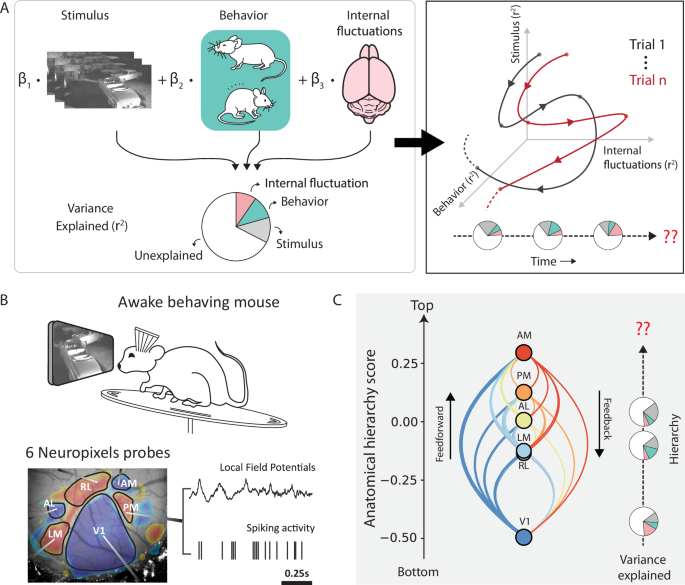
Influenced by non-stationary factors such as brain states and behavior, neurons exhibit substantial response variability even to identical stimuli. However, it remains unclear how their relative impact on neuronal variability evolves over time. To address this question, we designed an encoding model conditioned on latent states to partition variability in the mouse visual cortex across internal brain dynamics, behavior, and external visual stimulus. Applying a hidden Markov model to local field potentials, we consistently identified three distinct oscillation states, each with a unique variability profile. Regression models within each state revealed a dynamic composition of factors influencing spiking variability, with the dominant factor switching within seconds. The state-conditioned regression model uncovered extensive diversity in source contributions across units, varying in accordance with anatomical hierarchy and internal state. This heterogeneity in encoding underscores the importance of partitioning variability over time, particularly when considering the influence of non-stationary factors on sensory processing.
期刊介绍:
Nature Communications, an open-access journal, publishes high-quality research spanning all areas of the natural sciences. Papers featured in the journal showcase significant advances relevant to specialists in each respective field. With a 2-year impact factor of 16.6 (2022) and a median time of 8 days from submission to the first editorial decision, Nature Communications is committed to rapid dissemination of research findings. As a multidisciplinary journal, it welcomes contributions from biological, health, physical, chemical, Earth, social, mathematical, applied, and engineering sciences, aiming to highlight important breakthroughs within each domain.




 京公网安备 11010802042870号
京ICP备2023020795号-1
京公网安备 11010802042870号
京ICP备2023020795号-1

 分享
分享
 求助内容:
求助内容: 应助结果提醒方式:
 扫码关注我们
