Anil-Kumar Singh, Kévin Martin, Maurizio Mastropasqua Talamo, Axel Houssin, Nicolas Vanthuyne, Narcis Avarvari, Oren Tal
{"title":"单分子结映射了电子和手性之间的相互作用","authors":"Anil-Kumar Singh, Kévin Martin, Maurizio Mastropasqua Talamo, Axel Houssin, Nicolas Vanthuyne, Narcis Avarvari, Oren Tal","doi":"10.1038/s41467-025-56718-9","DOIUrl":null,"url":null,"abstract":"<p>The interplay of electrons with a chiral medium has a diverse impact across science and technology, influencing drug separation, chemical reactions, and electronic transport<sup>1-30</sup>. In particular, electron-chirality interactions can significantly affect charge and spin transport in chiral conductors, making them highly appealing for spintronics. However, an atomistic mapping of different electron-chirality interactions remains elusive. Here, we find that helicene-based single-molecule junctions behave as a combined magnetic-diode and spin-valve device. This dual-functionality enables the identification of an atomic-scale coexistence of different electron-chirality interactions: the magnetic-diode behavior is attributed to an interaction between electron’s angular momentum in a chiral medium and magnetic fields, whereas the spin-valve functionality is ascribed to an interaction between the electron’s spin and a chiral medium. This work uncovers the coexistence of electron-chirality interactions at the atomic-scale, identifies their distinct properties, and demonstrates how integrating their functionalities can broaden of the available methods for spintronics.</p>","PeriodicalId":19066,"journal":{"name":"Nature Communications","volume":"69 1","pages":""},"PeriodicalIF":15.7000,"publicationDate":"2025-02-19","publicationTypes":"Journal Article","fieldsOfStudy":null,"isOpenAccess":false,"openAccessPdf":"","citationCount":"0","resultStr":"{\"title\":\"Single-molecule junctions map the interplay between electrons and chirality\",\"authors\":\"Anil-Kumar Singh, Kévin Martin, Maurizio Mastropasqua Talamo, Axel Houssin, Nicolas Vanthuyne, Narcis Avarvari, Oren Tal\",\"doi\":\"10.1038/s41467-025-56718-9\",\"DOIUrl\":null,\"url\":null,\"abstract\":\"<p>The interplay of electrons with a chiral medium has a diverse impact across science and technology, influencing drug separation, chemical reactions, and electronic transport<sup>1-30</sup>. In particular, electron-chirality interactions can significantly affect charge and spin transport in chiral conductors, making them highly appealing for spintronics. However, an atomistic mapping of different electron-chirality interactions remains elusive. Here, we find that helicene-based single-molecule junctions behave as a combined magnetic-diode and spin-valve device. This dual-functionality enables the identification of an atomic-scale coexistence of different electron-chirality interactions: the magnetic-diode behavior is attributed to an interaction between electron’s angular momentum in a chiral medium and magnetic fields, whereas the spin-valve functionality is ascribed to an interaction between the electron’s spin and a chiral medium. This work uncovers the coexistence of electron-chirality interactions at the atomic-scale, identifies their distinct properties, and demonstrates how integrating their functionalities can broaden of the available methods for spintronics.</p>\",\"PeriodicalId\":19066,\"journal\":{\"name\":\"Nature Communications\",\"volume\":\"69 1\",\"pages\":\"\"},\"PeriodicalIF\":15.7000,\"publicationDate\":\"2025-02-19\",\"publicationTypes\":\"Journal Article\",\"fieldsOfStudy\":null,\"isOpenAccess\":false,\"openAccessPdf\":\"\",\"citationCount\":\"0\",\"resultStr\":null,\"platform\":\"Semanticscholar\",\"paperid\":null,\"PeriodicalName\":\"Nature Communications\",\"FirstCategoryId\":\"103\",\"ListUrlMain\":\"https://doi.org/10.1038/s41467-025-56718-9\",\"RegionNum\":1,\"RegionCategory\":\"综合性期刊\",\"ArticlePicture\":[],\"TitleCN\":null,\"AbstractTextCN\":null,\"PMCID\":null,\"EPubDate\":\"\",\"PubModel\":\"\",\"JCR\":\"Q1\",\"JCRName\":\"MULTIDISCIPLINARY SCIENCES\",\"Score\":null,\"Total\":0}","platform":"Semanticscholar","paperid":null,"PeriodicalName":"Nature Communications","FirstCategoryId":"103","ListUrlMain":"https://doi.org/10.1038/s41467-025-56718-9","RegionNum":1,"RegionCategory":"综合性期刊","ArticlePicture":[],"TitleCN":null,"AbstractTextCN":null,"PMCID":null,"EPubDate":"","PubModel":"","JCR":"Q1","JCRName":"MULTIDISCIPLINARY SCIENCES","Score":null,"Total":0}
Single-molecule junctions map the interplay between electrons and chirality
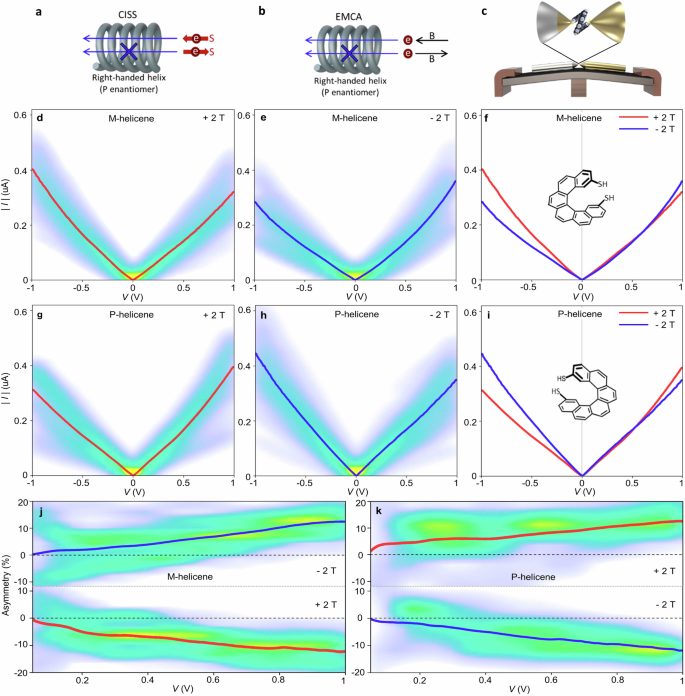
The interplay of electrons with a chiral medium has a diverse impact across science and technology, influencing drug separation, chemical reactions, and electronic transport1-30. In particular, electron-chirality interactions can significantly affect charge and spin transport in chiral conductors, making them highly appealing for spintronics. However, an atomistic mapping of different electron-chirality interactions remains elusive. Here, we find that helicene-based single-molecule junctions behave as a combined magnetic-diode and spin-valve device. This dual-functionality enables the identification of an atomic-scale coexistence of different electron-chirality interactions: the magnetic-diode behavior is attributed to an interaction between electron’s angular momentum in a chiral medium and magnetic fields, whereas the spin-valve functionality is ascribed to an interaction between the electron’s spin and a chiral medium. This work uncovers the coexistence of electron-chirality interactions at the atomic-scale, identifies their distinct properties, and demonstrates how integrating their functionalities can broaden of the available methods for spintronics.
期刊介绍:
Nature Communications, an open-access journal, publishes high-quality research spanning all areas of the natural sciences. Papers featured in the journal showcase significant advances relevant to specialists in each respective field. With a 2-year impact factor of 16.6 (2022) and a median time of 8 days from submission to the first editorial decision, Nature Communications is committed to rapid dissemination of research findings. As a multidisciplinary journal, it welcomes contributions from biological, health, physical, chemical, Earth, social, mathematical, applied, and engineering sciences, aiming to highlight important breakthroughs within each domain.




 京公网安备 11010802042870号
京ICP备2023020795号-1
京公网安备 11010802042870号
京ICP备2023020795号-1

 分享
分享
 求助内容:
求助内容: 应助结果提醒方式:
 扫码关注我们
