Xinyue Hao , Bin Wang , Zhuangfei Tian , Zhouchang Yao , Tianzhang Qiao , Ling Huang , Haigen Fu
{"title":"异芳基和异芳基n -氧化物的生物催化合成","authors":"Xinyue Hao , Bin Wang , Zhuangfei Tian , Zhouchang Yao , Tianzhang Qiao , Ling Huang , Haigen Fu","doi":"10.1039/d5qo00011d","DOIUrl":null,"url":null,"abstract":"<div><div>Heterobiaryl and heterobiaryl <em>N</em>-oxide atropisomers are important scaffolds in various chiral ligands, organocatalysts, and bioactive molecules. Here, we report a highly efficient biocatalytic route for the asymmetric synthesis of axially chiral heterobiaryl amines and heterobiaryl <em>N</em>-oxide amines <em>via</em> dynamic kinetic resolution (DKR). This novel DKR process features a racemization strategy promoted by forming a labile transition state <em>via</em> non-covalent interaction, coupled with a stereoselective reduction catalyzed by engineered imine-reductases (IREDs). Directed evolution of an IRED from <em>Streptomyces</em> sp. GF3546 provided two variants: <em>S</em>-IRED-<em>Ss</em>-M14 is superior for synthesizing diverse heterobiaryl amines, especially the ones containing multiple heteroatoms, and <em>S</em>-IRED-<em>Ss</em>-M16 is efficient for constructing heterobiaryl <em>N</em>-oxide amines. Both engineered IRED variants showed a broad substrate scope with a high level of yield and enantioselectivity (up to 98% yield and >99 : 1 enantiomeric ratio). This evolvable IRED-catalyzed DKR represents a promising solution for the atroposelective preparation of challenging axially chiral heterocyclic atropisomers.</div></div>","PeriodicalId":94379,"journal":{"name":"Organic chemistry frontiers : an international journal of organic chemistry","volume":"12 8","pages":"Pages 2658-2669"},"PeriodicalIF":0.0000,"publicationDate":"2025-02-12","publicationTypes":"Journal Article","fieldsOfStudy":null,"isOpenAccess":false,"openAccessPdf":"","citationCount":"0","resultStr":"{\"title\":\"Biocatalytic atroposelective synthesis of heterobiaryls and heterobiaryl N-oxides via dynamic kinetic resolution†\",\"authors\":\"Xinyue Hao , Bin Wang , Zhuangfei Tian , Zhouchang Yao , Tianzhang Qiao , Ling Huang , Haigen Fu\",\"doi\":\"10.1039/d5qo00011d\",\"DOIUrl\":null,\"url\":null,\"abstract\":\"<div><div>Heterobiaryl and heterobiaryl <em>N</em>-oxide atropisomers are important scaffolds in various chiral ligands, organocatalysts, and bioactive molecules. Here, we report a highly efficient biocatalytic route for the asymmetric synthesis of axially chiral heterobiaryl amines and heterobiaryl <em>N</em>-oxide amines <em>via</em> dynamic kinetic resolution (DKR). This novel DKR process features a racemization strategy promoted by forming a labile transition state <em>via</em> non-covalent interaction, coupled with a stereoselective reduction catalyzed by engineered imine-reductases (IREDs). Directed evolution of an IRED from <em>Streptomyces</em> sp. GF3546 provided two variants: <em>S</em>-IRED-<em>Ss</em>-M14 is superior for synthesizing diverse heterobiaryl amines, especially the ones containing multiple heteroatoms, and <em>S</em>-IRED-<em>Ss</em>-M16 is efficient for constructing heterobiaryl <em>N</em>-oxide amines. Both engineered IRED variants showed a broad substrate scope with a high level of yield and enantioselectivity (up to 98% yield and >99 : 1 enantiomeric ratio). This evolvable IRED-catalyzed DKR represents a promising solution for the atroposelective preparation of challenging axially chiral heterocyclic atropisomers.</div></div>\",\"PeriodicalId\":94379,\"journal\":{\"name\":\"Organic chemistry frontiers : an international journal of organic chemistry\",\"volume\":\"12 8\",\"pages\":\"Pages 2658-2669\"},\"PeriodicalIF\":0.0000,\"publicationDate\":\"2025-02-12\",\"publicationTypes\":\"Journal Article\",\"fieldsOfStudy\":null,\"isOpenAccess\":false,\"openAccessPdf\":\"\",\"citationCount\":\"0\",\"resultStr\":null,\"platform\":\"Semanticscholar\",\"paperid\":null,\"PeriodicalName\":\"Organic chemistry frontiers : an international journal of organic chemistry\",\"FirstCategoryId\":\"1085\",\"ListUrlMain\":\"https://www.sciencedirect.com/org/science/article/pii/S2052412925001226\",\"RegionNum\":0,\"RegionCategory\":null,\"ArticlePicture\":[],\"TitleCN\":null,\"AbstractTextCN\":null,\"PMCID\":null,\"EPubDate\":\"2025/2/19 0:00:00\",\"PubModel\":\"Epub\",\"JCR\":\"\",\"JCRName\":\"\",\"Score\":null,\"Total\":0}","platform":"Semanticscholar","paperid":null,"PeriodicalName":"Organic chemistry frontiers : an international journal of organic chemistry","FirstCategoryId":"1085","ListUrlMain":"https://www.sciencedirect.com/org/science/article/pii/S2052412925001226","RegionNum":0,"RegionCategory":null,"ArticlePicture":[],"TitleCN":null,"AbstractTextCN":null,"PMCID":null,"EPubDate":"2025/2/19 0:00:00","PubModel":"Epub","JCR":"","JCRName":"","Score":null,"Total":0}
Biocatalytic atroposelective synthesis of heterobiaryls and heterobiaryl N-oxides via dynamic kinetic resolution†
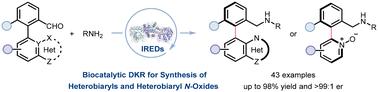
Heterobiaryl and heterobiaryl N-oxide atropisomers are important scaffolds in various chiral ligands, organocatalysts, and bioactive molecules. Here, we report a highly efficient biocatalytic route for the asymmetric synthesis of axially chiral heterobiaryl amines and heterobiaryl N-oxide amines via dynamic kinetic resolution (DKR). This novel DKR process features a racemization strategy promoted by forming a labile transition state via non-covalent interaction, coupled with a stereoselective reduction catalyzed by engineered imine-reductases (IREDs). Directed evolution of an IRED from Streptomyces sp. GF3546 provided two variants: S-IRED-Ss-M14 is superior for synthesizing diverse heterobiaryl amines, especially the ones containing multiple heteroatoms, and S-IRED-Ss-M16 is efficient for constructing heterobiaryl N-oxide amines. Both engineered IRED variants showed a broad substrate scope with a high level of yield and enantioselectivity (up to 98% yield and >99 : 1 enantiomeric ratio). This evolvable IRED-catalyzed DKR represents a promising solution for the atroposelective preparation of challenging axially chiral heterocyclic atropisomers.




 京公网安备 11010802042870号
京ICP备2023020795号-1
京公网安备 11010802042870号
京ICP备2023020795号-1

 分享
分享

 求助内容:
求助内容: 应助结果提醒方式:
 扫码关注我们
